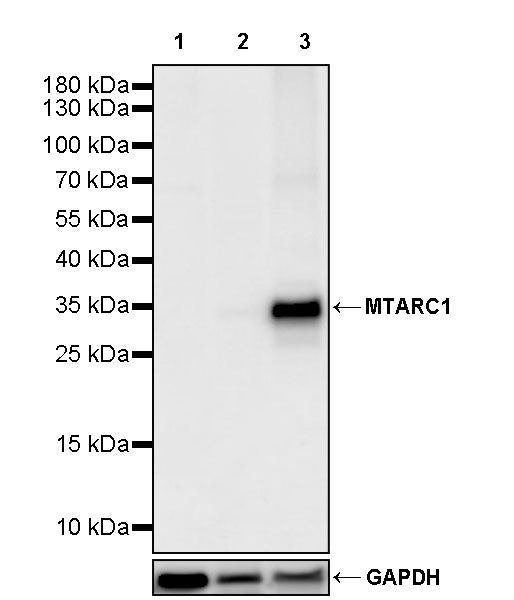
WB result of MTARC1 Rabbit pAb
Primary antibody: MTARC1 Rabbit pAb at 1/1000 dilution
Lane 1: mouse heart lysate 20 µg
Lane 2: mouse lung lysate 20 µg
Lane 3: mouse liver lysate 20 µg
Negative control: mouse heart lysate
Low expression control: mouse lung lysate
Secondary antibody: Goat Anti- rabbit IgG, (H+L), HRP conjugated at 1/10000 dilution
Predicted MW: 38 kDa
Observed MW: 35 kDa
MTARC1 Rabbit Polyclonal Antibody
MTARC1 Rabbit Polyclonal Antibody
Price:
Regular price
$100 USD
Regular price
Sale price
$100 USD
Unit price
per
For shipping services or bulk orders, you may request a quotation.
Secure checkout with

View full details
Product Details
Product Details
Product Specification
| Host | Rabbit |
| Antigen | MTARC1 |
| Synonyms | Mitochondrial amidoxime-reducing component 1; Marc1; Mosc1; Mtarc1 |
| Immunogen | Synthetic Peptide |
| Location | Mitochondrion |
| Accession | Q9CW42 |
| Antibody Type | Polyclonal antibody |
| Isotype | IgG |
| Application | WB |
| Reactivity | Ms, Rt |
| Positive Sample | mouse liver, rat liver |
| Purification | Immunogen Affinity |
| Concentration | 0.5 mg/ml |
| Conjugation | Unconjugated |
| Physical Appearance | Liquid |
| Storage Buffer | PBS, 40% Glycerol, 0.05% BSA, 0.02% sodium azide |
| Stability & Storage | 12 months from date of receipt / reconstitution, -20 °C as supplied |
Dilution
| application | dilution | species |
| WB | 1:1000 | Ms, Rt |
Background
MTARC1, full name mitochondrial amidoxime reducing component 1, is a molybdenum cofactor (Moco)-containing oxidoreductase anchored to the outer mitochondrial membrane, with its catalytic domain exposed to the cytoplasm. It functions in concert with its electron transfer partners—cytochrome b5 and NADH-cytochrome b5 reductase—utilizing reducing equivalents from NADH to catalyze the reduction of a variety of N-hydroxylated substrates. The core physiological functions of this protein include participation in the synthesis and regulation of nitric oxide (NO), detoxification metabolism of nitrogen-containing compounds, and serving as an important component of the drug metabolism system by reducing the amidoxime groups of prodrug molecules to enhance their bioavailability. In recent years, MTARC1 has become a research hotspot due to its critical role in liver diseases. Genome-wide association studies (GWAS) have identified a common missense variant (rs2642438, p.Ala165Thr) in its coding gene that is associated with a significantly reduced risk of non-alcoholic fatty liver disease (NAFLD), cirrhosis, and even hepatocellular carcinoma. Animal experiments have demonstrated that knockout of the Mtarc1 gene alleviates hepatic steatosis, inflammation, and fibrosis, with the underlying mechanism potentially involving the regulation of fatty acid uptake and lipid accumulation in hepatocytes. These findings have identified MTARC1 as a novel and highly promising drug target, suggesting that its functional inhibition may offer new therapeutic strategies for metabolic dysfunction-associated steatotic liver disease (MASLD) and related conditions.
Picture
Picture
Western Blot
WB result of MTARC1 Rabbit pAb
Primary antibody: MTARC1 Rabbit pAb at 1/1000 dilution
Lane 1: rat heart lysate 20 µg
Lane 2: rat lung lysate 20 µg
Lane 3: rat liver lysate 20 µg
Negative control: rat heart lysate
Low expression control: rat lung lysate
Secondary antibody: Goat Anti- rabbit IgG, (H+L), HRP conjugated at 1/10000 dilution
Predicted MW: 38 kDa
Observed MW: 35 kDa