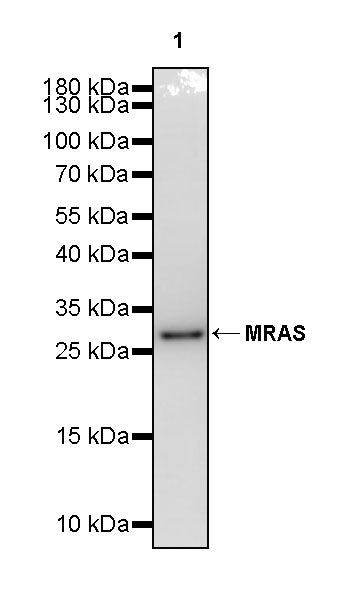
WB result of MRAS Recombinant Rabbit mAb
Primary antibody: MRAS Recombinant Rabbit mAb at 1/1000 dilution
Lane 1: HeLa whole cell lysate 20 µg
Lane 2: SH-SY5Y whole cell lysate 20 µg
Secondary antibody: Goat Anti- rabbit IgG, (H+L), HRP conjugated at 1/10000 dilution
Predicted MW: 24 kDa
Observed MW: 26 kDa
MRAS Recombinant Rabbit mAb (S-4293-71)
MRAS Recombinant Rabbit mAb (S-4293-71)
Price:
Regular price
$100 USD
Regular price
Sale price
$100 USD
Unit price
per
For shipping services or bulk orders, you may request a quotation.
Secure checkout with

View full details
Product Details
Product Details
Product Specification
| Host | Rabbit |
| Antigen | MRAS |
| Synonyms | Ras-related protein M-Ras; RRAS3 |
| Immunogen | Synthetic Peptide |
| Location | Cell membrane |
| Accession | O14807 |
| Clone Number | S-4293-71 |
| Antibody Type | Recombinant mAb |
| Isotype | IgG |
| Application | WB |
| Reactivity | Hu, Ms, Rt, Mk |
| Positive Sample | HeLa, SH-SY5Y, mouse brain, mouse lung, mouse kidney, C6, rat brain, rat lung, rat kidney, COS-7 |
| Purification | Protein A |
| Concentration | 0.5 mg/ml |
| Conjugation | Unconjugated |
| Physical Appearance | Liquid |
| Storage Buffer | PBS, 40% Glycerol, 0.05% BSA, 0.02% sodium azide |
| Stability & Storage | 12 months from date of receipt / reconstitution, -20 °C as supplied |
Dilution
| application | dilution | species |
| WB | 1:1000 | Hu, Ms, Rt, Mk |
Background
MRAS (Muscle RAS Oncogene Homolog), also known as R-Ras3, is one of the members of the Ras small GTPase superfamily with the highest homology to the classical RAS oncoproteins (H-Ras, K-Ras, N-Ras). Its gene is located on chromosome 3q22.3 and is primarily highly expressed in tissues such as the brain and heart under normal physiological conditions. As a membrane-bound signal transduction protein, MRAS shares most of its regulatory factors (such as guanine nucleotide exchange factors like SOS1 and RasGRF) and effectors (such as RAF kinase and PI3K) with classical RAS. However, a breakthrough study published in 2025 revealed that MRAS is not a conventional "molecular switch"—it inherently lacks the capacity for nucleotide exchange between GDP and GTP, and even under GEF catalysis, it exists almost entirely in the inactive GDP-bound form, challenging the fundamental paradigm of Ras family protein function. The most unique feature of MRAS lies in its ability to form a ternary holoenzyme complex with SHOC2 and protein phosphatase 1 (PP1), which specifically dephosphorylates a critical 14-3-3 binding site on RAF kinase (such as S259 of CRAF), thereby relieving RAF autoinhibition and promoting synergistic activation of the downstream ERK signaling pathway. In addition, MRAS is involved in regulating cell polarity, migration, cytoskeletal remodeling, and integrin-mediated cell adhesion through the Rap1 pathway. Gain-of-function mutations in MRAS can cause Noonan syndrome (a developmental RASopathy), while genetic variants in this gene are also associated with traits such as coronary artery disease and platelet counts.
Picture
Picture
Western Blot
WB result of MRAS Recombinant Rabbit mAb
Primary antibody: MRAS Recombinant Rabbit mAb at 1/1000 dilution
Lane 1: mouse brain lysate 20 µg
Lane 2: mouse lung lysate 20 µg
Lane 3: mouse kidney lysate 20 µg
Secondary antibody: Goat Anti- rabbit IgG, (H+L), HRP conjugated at 1/10000 dilution
Predicted MW: 24 kDa
Observed MW: 28 kDa
WB result of MRAS Recombinant Rabbit mAb
Primary antibody: MRAS Recombinant Rabbit mAb at 1/1000 dilution
Lane 1: C6 whole cell lysate 20 µg
Lane 2: rat brain lysate 20 µg
Lane 3: rat lung lysate 20 µg
Lane 4: rat kidney lysate 20 µg
Secondary antibody: Goat Anti- rabbit IgG, (H+L), HRP conjugated at 1/10000 dilution
Predicted MW: 24 kDa
Observed MW: 283 kDa
WB result of MRAS Recombinant Rabbit mAb
Primary antibody: MRAS Recombinant Rabbit mAb at 1/1000 dilution
Lane 1: COS-7 whole cell lysate 20 µg
Secondary antibody: Goat Anti- rabbit IgG, (H+L), HRP conjugated at 1/10000 dilution
Predicted MW: 24 kDa
Observed MW: 28 kDa