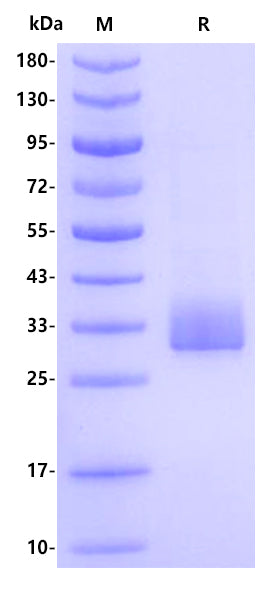
2μg(R: reducing conditions)
Mouse SLAMF8 Protein, His Tag
Mouse SLAMF8 Protein, His Tag
Price:
Regular price
$70 USD
Regular price
Sale price
$70 USD
Unit price
per
For shipping services or bulk orders, you may request a quotation.
Secure checkout with

View full details
Product Details
Product Details
Product Specification
| Species | Mouse |
| Synonyms | SLAM family member 8, B-lymphocyte activator macrophage expressed, CD353, Blame |
| Accession | Q9D3G2 |
| Amino Acid Sequence | Protein sequence (Q9D3G2, Val21-Asp231, with C-His Tag) VQVLSKVGDSELLVAECPPGFQVREAIWRSLWPSEELLATFFRGSLETLYHSRFLGRVQLYDNLSLELGPLKPGDSGNFSVLMVDTGGQTWTQTLYLKVYDAVPKPEVQVFTAAAEETQPLNTCQVFLSCWAPNISDITYSWRWEGTVDFNGEVRSHFSNGQVLSVSLGLGDKDVAFTCIASNPVSWDMTTVTPWESCHHEAASGKASYKD |
| Expression System | HEK293 |
| Molecular Weight | Predicted MW: 25.1 kDaObserved MW: 30-40 kDa |
| Purity | >90% by SDS-PAGE |
| Endotoxin | <1EU/μg |
| Conjugation | Unconjugated |
| Tag | with C-His Tag |
| Physical Appearance | Lyophilized powder |
| Storage Buffer | Lyophilized from a 0.2 μm filtered solution of PBS, pH7.4 with 3% trehalose. |
| Reconstitution | Reconstitute no more than 1 mg/mL according to the size in deionized water after rapid centrifugation. |
| Stability & Storage | 12 months from date of receipt, -20 to -70 °C as supplied. |
Background
SLAMF8 (SLAM Family Member 8), also known as BLAME (B-lymphocyte activator macrophage expressed), is a cell surface receptor belonging to the signaling lymphocyte activation molecule (SLAM) family. Primarily expressed on myeloid cells such as macrophages and dendritic cells, it plays a crucial role in immune regulation. Unlike other SLAM family members, SLAMF8 acts as a negative regulator of inflammatory responses. Research indicates its involvement in macrophage polarization, phagocytosis, and the maintenance of immune homeostasis. It is also implicated in the pathogenesis of inflammatory bowel disease and the tumor microenvironment, making it a potential biomarker for immune-related disorders.
Picture
Picture
SDS-PAGE