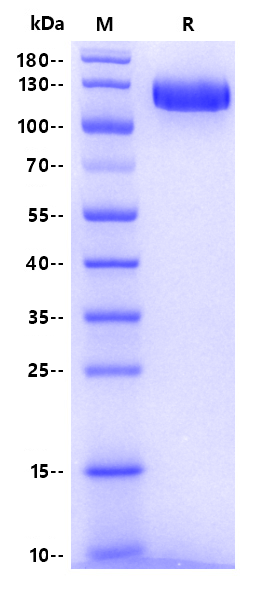
2μg (R: reducing conditions)
Mouse FAP Protein, hFc Tag
Mouse FAP Protein, hFc Tag
Price:
Regular price
$85 USD
Regular price
Sale price
$85 USD
Unit price
per
For shipping services or bulk orders, you may request a quotation.
Secure checkout with

View full details
Product Details
Product Details
Product Specification
| Species | Mouse |
| Accession | P97321 |
| Amino Acid Sequence | Protein sequence (P97321, Val31-Asp761, with N-hFc Tag) VYKPEGNTKRALTLKDILNGTFSYKTYFPNWISEQEYLHQSEDDNIVFYNIETRESYIILSNSTMKSVNATDYGLSPDRQFVYLESDYSKLWRYSYTATYYIYDLQNGEFVRGYELPRPIQYLCWSPVGSKLAYVYQNNIYLKQRPGDPPFQITYTGRENRIFNGIPDWVYEEEMLATKYALWWSPDGKFLAYVEFNDSDIPIIAYSYYGDGQYPRTINIPYPKAGAKNPVVRVFIVDTTYPHHVGPMEVPVPEMIASSDYYFSWLTWVSSERVCLQWLKRVQNVSVLSICDFREDWHAWECPKNQEHVEESRTGWAGGFFVSTPAFSQDATSYYKIFSDKDGYKHIHYIKDTVENAIQITSGKWEAIYIFRVTQDSLFYSSNEFEGYPGRRNIYRISIGNSPPSKKCVTCHLRKERCQYYTASFSYKAKYYALVCYGPGLPISTLHDGRTDQEIQVLEENKELENSLRNIQLPKVEIKKLKDGGLTFWYKMILPPQFDRSKKYPLLIQVYGGPCSQSVKSVFAVNWITYLASKEGIVIALVDGRGTAFQGDKFLHAVYRKLGVYEVEDQLTAVRKFIEMGFIDEERIAIWGWSYGGYVSSLALASGTGLFKCGIAVAPVSSWEYYASIYSERFMGLPTKDDNLEHYKNSTVMARAEYFRNVDYLLIHGTADDNVHFQNSAQIAKALVNAQVDFQAMWYSDQNHGISSGRSQNHLYTHMTHFLKQCFSLSD |
| Expression System | HEK293 |
| Molecular Weight | Predicted MW: 111.6 kDaObserved MW: 110-130 kDa |
| Purity | >95% by SDS-PAGE |
| Endotoxin | <1EU/μg |
| Conjugation | Unconjugated |
| Tag | with N-hFc Tag |
| Physical Appearance | Lyophilized Powder |
| Storage Buffer | Lyophilized from a 0.2 μm filtered solution of PBS, pH7.4 with 3% trehalose. |
| Reconstitution | Reconstitute no more than 1 mg/mL according to the size in deionized water after rapid centrifugation. |
| Stability & Storage | 12 months from date of receipt, -20 to -70 °C as supplied. |
Background
Fibroblast activation protein (FAP), also known as seprase, is a type II transmembrane serine protease encoded by the Fap gene in mice. Structurally, it belongs to the prolyl endopeptidase/dipeptidyl peptidase family and functions as a 170 kDa homodimer, closely related to dipeptidyl peptidase IV (DPP4/CD26). FAP exhibits dual enzymatic activity—dipeptidyl peptidase and endopeptidase—specifically cleaving substrates after proline residues. In normal adult tissues, FAP expression is largely restricted to a subset of fibroblasts within healing wounds; however, it is strongly upregulated on activated fibroblasts, cancer-associated fibroblasts (CAFs), and stromal cells within tumor microenvironments, solid tumors, and fibrotic lesions.
Picture
Picture
SDS-PAGE