Standard curve
Example of Mouse CXCL1 /KC standard curve in Assay Diluent #12.
Mouse CXCL1/KC Onestep ELISA Kit
Mouse CXCL1/KC Onestep ELISA Kit
Price:
Regular price
$500 USD
Regular price
Sale price
$500 USD
Unit price
per
For shipping services or bulk orders, you may request a quotation.
Secure checkout with

View full details
Product Details
Product Details
Product Specification
| Antigen | CXCL1/KC |
| Immunogen | Recombinant Protein |
| Antibody Type | Recombinant mAb |
| Reactivity | Ms |
| Purification | Protein A |
| Stability & Storage | 12 months from date of receipt / reconstitution, 2 to 8'C as supplied. |
Kit
| Precision | Intra-assay: 2.7%; Inter-assay: 3.2% |
| Sample type | Cell culture supernatant, Serum, Plasma |
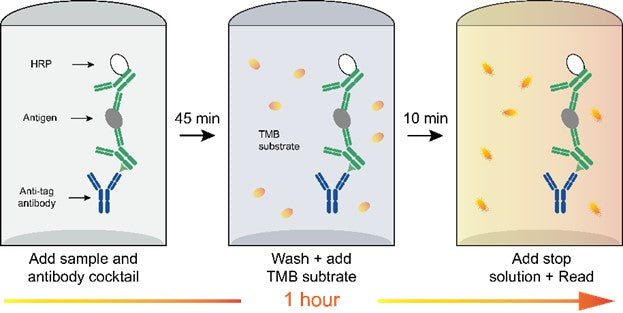
| Assay type | Sandwich (quantitative) |
| Sensitivity | 0.548 pg/mL |
| Range | 1.563 pg/mL – 100 pg/mL |
| Recovery | Cell culture supernatant: 110% Serum: 92% Plasma: 109% |
| Assay time | 60 minutes |
| Species reactivity | Ms |
Background
Mouse CXCL1, also known as KC (keratinocyte-derived chemokine), is a key member of the CXC chemokine family primarily secreted by macrophages, fibroblasts, and endothelial cells in response to pro-inflammatory stimuli such as IL-1β or TNF-α. It functions as a potent chemoattractant by binding to its receptor CXCR2, which is predominantly expressed on neutrophils, thereby orchestrating the rapid recruitment of these immune cells to sites of infection, tissue injury, or inflammation. This protein plays a critical role in acute inflammatory responses, contributing to host defense against bacterial and fungal pathogens. Beyond infection, CXCL1 is also implicated in various pathological processes including cancer progression, where it can promote tumor growth, angiogenesis, and metastasis by modulating the tumor microenvironment. Additionally, it is involved in autoimmune diseases and chronic inflammatory conditions such as rheumatoid arthritis. In experimental models, CXCL1 is widely utilized as a biomarker for neutrophilic inflammation, and it is signaling pathway is considered a potential therapeutic target for mitigating excessive inflammation or disrupting pro-tumorigenic networks.
Picture
Picture
ELISA
Standard curve
Example of Mouse CXCL1/KC standard curve in Assay Diluent #12S4.
Linearity
The concentrations of Mouse CXCL1/KC were measured and interpolated from the target standard curves and corrected for sample dilution.
Sample is undiluted samples are as follows: Mouse serum was 2.5-fold dilution (40%). The interpolated dilution factor corrected values are plotted. The mean target concentration was determined to be 200.43 pg/mL in mouse serum.
Sample is undiluted samples are as follows: Mouse plasma was 2-fold dilution (50%). The interpolated dilution factor corrected values are plotted. The mean target concentration was determined to be 253.68 pg/mL in mouse plasma.
Linearity
The concentrations of Mouse CXCL1 were measured and interpolated from the target standard curves and corrected for sample dilution.
Sample is undiluted samples are as follows: NIH 3T3 supernatant (100%). The interpolated dilution factor corrected values are plotted. The mean target concentration was determined to be 431.83 pg/mL in NIH 3T3 supernatant.
Linearity
The concentrations of Mouse CXCL1/KC were measured and interpolated from the target standard curves and corrected for sample dilution.
Sample is undiluted samples are as follows: Rat serum was 4-fold dilution (25%). The interpolated dilution factor corrected values are plotted. The mean target concentration was determined to be 677.64 pg/mL in rat serum.
Sample is undiluted samples are as follows: Rat plasma was 2-fold dilution (50%). The interpolated dilution factor corrected values are plotted. The mean target concentration was determined to be 100.37 pg/mL in rat plasma.
To assess the linearity of the assay, sample was spiked with high concentrations of Mouse CXCL1/KC in various matrices and diluted with the appropriate Calibrator Diluent to produce samples with values within the dynamic range of the assay.
Specificity
Test the specificity of different serum.
Leading Competitor comparison
Protocol Diagram