Standard Curve
Example of Mouse Complement C3a standard curve in Assay Diluent A1. Plotted are the background-subtracted data.
This standard curve is provided for demonstration only.
Mouse Complement C3a OneStep ELISA Kit
Mouse Complement C3a OneStep ELISA Kit
Price:
Regular price
$985 USD
Regular price
Sale price
$985 USD
Unit price
per
For shipping services or bulk orders, you may request a quotation.
Secure checkout with

View full details
Product Details
Product Details
Product Specification
| Antigen | Complement C3a |
| Immunogen | Recombinant Protein |
| Antibody Type | Recombinant mAb |
| Reactivity | Ms |
| Purification | Protein A |
| Stability & Storage | 12 months from date of receipt / reconstitution, 2 to 8°C as supplied. |
Kit
| Precision | Intra-assay: 2.8%; Inter-assay: 3.6% |
| Sample type | Serum; EDTA Plasma, Heparin Plasma, Citrate Plasma; Cell Culture Supernatant |
| Assay type | Sandwich (quantitative) |
| Sensitivity | 10.26 pg/mL |
| Range | 31.3 pg/mL – 2000 pg/mL |
| Recovery | C57BL/6 Serum: 95% C57BL/6 EDTA Plasma: 84% C57BL/6 Heparin plasma: 97% C57BL/6 Citrate Plasma: 86% BALB/c Serum: 97% BALB/c EDTA Plasma: 80% BALB/c Heparin plasma: 102% BALB/c Citrate Plasma: 96% Cell Culture Supernatant (1640+10%FBS): 88% Cell Culture Supernatant (DMEM+10%FBS): 99% |
| Assay time | 60 minutes |
| Species reactivity | Ms |
Background
Mouse Complement C3a is a small 77-amino-acid peptide generated by proteolytic cleavage of the complement component C3, which is activated during the classical, lectin, or alternative complement pathways. As a potent anaphylatoxin, C3a mediates acute inflammatory responses by binding to its specific G-protein-coupled receptor, C3aR, which is widely expressed on immune cells such as mast cells, macrophages, and eosinophils. Upon receptor activation, C3a induces degranulation of mast cells, release of histamine, and chemotaxis of inflammatory cells, contributing to local vascular permeability and smooth muscle contraction. In mice, C3a also plays a critical role in modulating adaptive immunity by promoting Th2-skewed immune responses and enhancing antigen presentation by dendritic cells. Notably, C3a has been implicated in various mouse models of allergic asthma, sepsis, and ischemia-reperfusion injury, where its excessive activation can exacerbate tissue damage. The biological effects of C3a are tightly regulated by carboxypeptidase N, which removes the C-terminal arginine to generate the less active des-Arg form (C3a-desArg). Therefore, mouse C3a serves as a key mediator at the interface between innate immunity and inflammatory pathology, making it a valuable target for studying complement-related diseases in preclinical models.
Picture
Picture
ELISA
Spike Recovery
The recovery of Mouse Complement C3a was evaluated in activated samples spiked with concentrations spanning the entire assay range.
Spike Recovery
Recovery of Mouse Complement C3a was assessed by spiking a 1000 pg/mL standard into matrix diluted 140,000-fold. Serial dilutions of the spiked sample were prepared, and the percent recovery was calculated for each dilution relative to the expected concentration.
Spike Recovery
Recovery of Mouse Complement C3a was assessed by spiking a 1000 pg/mL standard into matrix diluted 140,000-fold. Serial dilutions of the spiked sample were prepared, and the percent recovery was calculated for each dilution relative to the expected concentration.
Dilution Linearity
The concentrations of Mouse Complement C3a were measured and interpolated from the target standard curves and corrected for sample dilution.
The leftmost bar in the graph shows biological samples diluted in Assay Diluent to 0.001% concentration. "undiluted" was defined as 0.001% biological sample. The subsequent bars represent two-fold serial dilutions of this reference.
The mean target concentration was determined to be 158.1 μg/mL in C57 Serum.
The mean target concentration was determined to be 212.5 μg/mL in C57 EDTA plasma.
The mean target concentration was determined to be 43.5 μg/mL in C57 Heparin plasma.
The mean target concentration was determined to be 30.0 μg/mL in C57 Citrate plasma.
Dilution Linearity
The concentrations of Mouse Complement C3a were measured and interpolated from the target standard curves and corrected for sample dilution.
The leftmost bar in the graph shows biological samples diluted in Assay Diluent to 0.001% concentration. "undiluted" was defined as 0.001% biological sample. The subsequent bars represent two-fold serial dilutions of this reference.
The mean target concentration was determined to be 27.2 μg/mL in BALB/C Serum.
The mean target concentration was determined to be 158.2 μg/mL in BALB/C EDTA plasma.
The mean target concentration was determined to be 128.9 μg/mL in BALB/C Heparin plasma.
The mean target concentration was determined to be 83.2 μg/mL in BALB/C Citrate plasma.
Intra-Assay Precision (Precision within an assay)
Three samples of known concentration were tested fifteen times on one plate to assess intra-assay precision.
Inter-Assay Precision (Precision between assays).
Three samples of known concentration were tested in separate assays to assess inter-assay precision. Assays were performed with at least three lots of components.
Determination of Minimum Detectable Dose (MDD)
The MDD was determined using three independent lots of assay components. For each lot, 19 replicate measurements of the diluent (zero calibrator) were performed. The mean (AVERAGE) and standard deviation (STDEV) of the 19 replicates were calculated. The MDD for each lot was then calculated according to the following formula:
MDD = 2 × STDEV + AVERAGE
Cross‑reactivity
The cross‑reactivity between Mouse Complement C3a and Mouse Complement C3 was assessed by testing both proteins in the same assay system. Serial dilutions of each protein were measured, and the dose‑response curves were compared. No significant cross‑reactivity was observed when Mouse Complement C3 was tested in the Mouse Complement C3a assay, as the signals remained within the background range of the assay.
Cross‑reactivity
The heatmap displays O.D.450 ratios for serum samples from multiple species. Color intensity is proportional to the O.D.450 ratio (test species / reference species). Darker colors indicate higher cross‑reactivity.
HOOK Effect Threshold
The upper limit of the HOOK effect was established at 100× the highest calibrator concentration (equivalent to a 2-log10 increase). No HOOK effect was observed below this threshold, confirming that samples within this concentration range yield reliable quantitative results without signal depression.
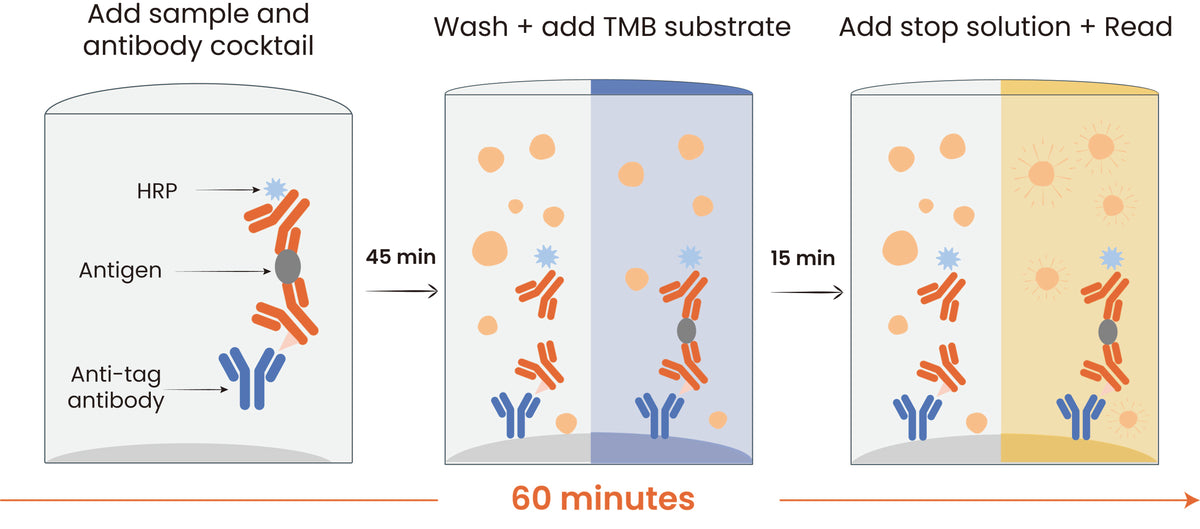
Protocol Diagram