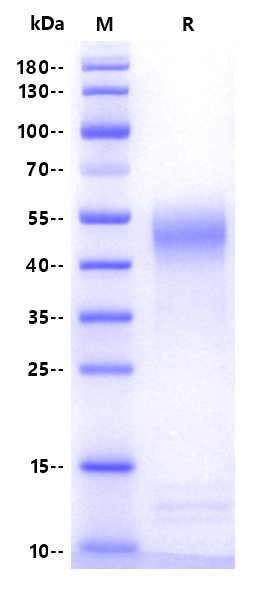
2μg (R: reducing conditions)
Mouse CD1d1 Protein, His Tag
Mouse CD1d1 Protein, His Tag
Price:
Regular price
$80 USD
Regular price
Sale price
$80 USD
Unit price
per
For shipping services or bulk orders, you may request a quotation.
Secure checkout with

View full details
Product Details
Product Details
Product Specification
| Species | Mouse |
| Synonyms | Antigen-presenting glycoprotein CD1d1, CD1d.1, Cd1.1 |
| Accession | P11609 |
| Amino Acid Sequence | Protein sequence (P11609, Gln22-Gly305, with C-His Tag) QQKNYTFRCLQMSSFANRSWSRTDSVVWLGDLQTHRWSNDSATISFTKPWSQGKLSNQQWEKLQHMFQVYRVSFTRDIQELVKMMSPKEDYPIEIQLSAGCEMYPGNASESFLHVAFQGKYVVRFWGTSWQTVPGAPSWLDLPIKVLNADQGTSATVQMLLNDTCPLFVRGLLEAGKSDLEKQEKPVAWLSSVPSSADGHRQLVCHVSGFYPKPVWVMWMRGDQEQQGTHRGDFLPNADETWYLQATLDVEAGEEAGLACRVKHSSLGGQDIILYWDARQAPVG |
| Expression System | HEK293 |
| Molecular Weight | Predicted MW: 33.9 kDaObserved MW: 45-55 kDa |
| Purity | >90% by SDS-PAGE |
| Endotoxin | <1EU/μg |
| Conjugation | Unconjugated |
| Tag | with C-His Tag |
| Physical Appearance | Lyophilized Powder |
| Storage Buffer | Lyophilized from a 0.2 μm filtered solution of PBS, pH7.4 with 3% trehalose. |
| Reconstitution | Reconstitute no more than 1 mg/mL according to the size in deionized water after rapid centrifugation. |
| Stability & Storage | 12 months from date of receipt, -20 to -70 °C as supplied. |
Background
CD1d1 is a major histocompatibility complex (MHC) class I–like glycoprotein encoded by the Cd1d1 gene in mice. It is expressed on antigen-presenting cells, hepatocytes, and intestinal epithelial cells, and is specialized for presenting lipid and glycolipid antigens rather than peptide antigens. Structurally, CD1d1 consists of a heavy chain with an antigen-binding groove flanked by hydrophobic pockets, non-covalently associated with β2-microglobulin. CD1d1–lipid complexes are recognized by invariant natural killer T (iNKT) cells through their semi-invariant αβ T-cell receptors, triggering rapid production of cytokines such as IFN-γ and IL-4, which bridge innate and adaptive immunity. Its best-characterized ligand is the marine sponge–derived glycolipid α-galactosylceramide (α-GalCer).
Picture
Picture
SDS-PAGE