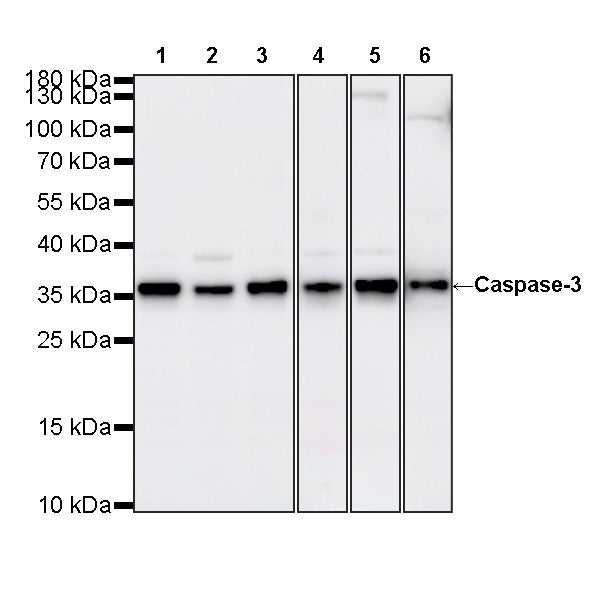
WB result of Mouse Caspase-3 Recombinant mAb
Primary antibody: Mouse Caspase-3 Recombinant mAb at 1/1000 dilution
Lane 1: NIH/3T3 whole cell lysate 20 µg
Lane 2: Raw 264.7 whole cell lysate 20 µg
Lane 3: Neuro-2a whole cell lysate 20 µg
Lane 4: mouse spleen lysate 20 µg
Lane 5: mouse thymus lysate 20 µg
Lane 6: mouse brain lysate 20 µg
Secondary antibody: Goat Anti-Rabbit IgG, (H+L), HRP conjugated at 1/10000 dilution
Predicted MW: 31 kDa
Observed MW: 37 kDa
Mouse Caspase-3 Recombinant mAb (S-3976-60)
Mouse Caspase-3 Recombinant mAb (S-3976-60)
Price:
Regular price
$100 USD
Regular price
Sale price
$100 USD
Unit price
per
For shipping services or bulk orders, you may request a quotation.
Secure checkout with

View full details
Product Details
Product Details
Product Specification
| Host | Rabbit |
| Antigen | Caspase-3 |
| Synonyms | Apopain; Cysteine protease CPP32 (CPP-32); LICE; Protein Yama; SREBP cleavage activity 1 (SCA-1); Cpp32; Casp3 |
| Immunogen | Synthetic Peptide |
| Location | Cytoplasm |
| Accession | P70677 |
| Clone Number | S-3976-60 |
| Antibody Type | Recombinant mAb |
| Isotype | IgG |
| Application | WB |
| Reactivity | Ms |
| Positive Sample | NIH/3T3, RAW264.7, Neura-2a, mouse spleen, mouse thymus, mouse brain |
| Purification | Protein A |
| Concentration | 0.5 mg/ml |
| Conjugation | Unconjugated |
| Physical Appearance | Liquid |
| Storage Buffer | PBS, 40% Glycerol, 0.05% BSA, 0.02% sodium azide |
| Stability & Storage | 12 months from date of receipt / reconstitution, -20 °C as supplied |
Dilution
| application | dilution | species |
| Dot Blot | 1:1000 | Ms |
Background
Caspase-3 (cysteine-aspartic protease 3) is the most critical enzyme in the execution phase of apoptosis (programmed cell death), often referred to as the "death execution protease," and occupies a central hub in the apoptotic cascade. It typically exists in the cytoplasm as an inactive zymogen (pro-caspase-3). Upon receiving intrinsic (such as cytochrome c release from mitochondria) or extrinsic (such as death receptor activation) apoptotic signals, it is activated through proteolytic cleavage by upstream initiator caspases (such as caspase-8 and caspase-9). Activated caspase-3 subsequently cleaves a series of key substrates, including the DNA repair enzyme PARP, structural proteins (such as nuclear lamins), and cytoskeletal proteins, ultimately leading to a series of characteristic apoptotic morphological features including DNA fragmentation, membrane blebbing, and cell shrinkage. This irreversible execution function makes caspase-3 a hallmark molecule in apoptosis research, and its aberrant activity plays a decisive role in various diseases—insufficient activity leads to tumor immune evasion and resistance to chemotherapy, representing a major mechanism of drug resistance in cancer; conversely, excessive activity is closely associated with excessive neuronal death in neurodegenerative diseases (such as Alzheimer's disease and Huntington's disease) and ischemic injury. Therefore, caspase-3 as a drug target—whether as inhibitors for neuroprotection or as activators for cancer therapy—holds significant value in both basic research and clinical translation.
Picture
Picture
Western Blot