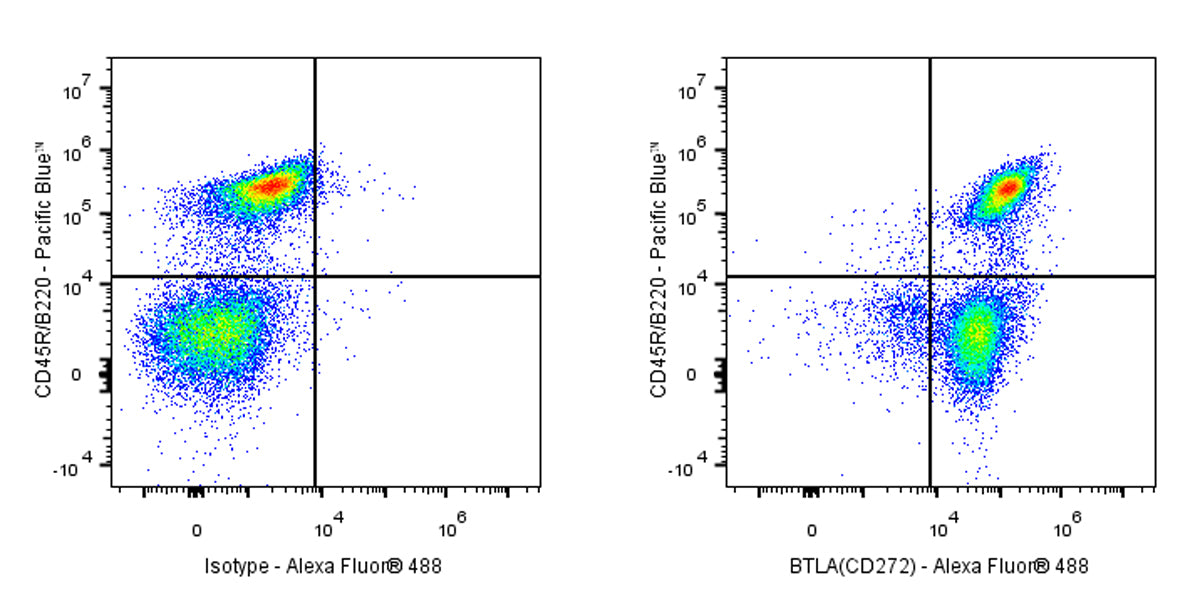
Flow cytometric analysis of C57BL/6 mouse splenocytes labelling Mouse CD272 (BTLA) antibody at 1/200 dilution (1 μg) / (Right panel) compared with a Mouse IgG1 Isotype Control / (Left panel). Goat Anti-Mouse IgG Alexa Fluor® 647 was used as the secondary antibody. Then cells were stained with CD45R/B220 - Pacific Blue™ Antibody separately.
Mouse Anti-Mouse CD272 (BTLA) Antibody (S-3831)
Mouse Anti-Mouse CD272 (BTLA) Antibody (S-3831)
Price:
Regular price
$100 USD
Regular price
Sale price
$100 USD
Unit price
per
For shipping services or bulk orders, you may request a quotation.
Secure checkout with

View full details
Product Details
Product Details
Product Specification
| Host | Mouse |
| Antigen | CD272 (BTLA) |
| Synonyms | B- and T-lymphocyte attenuator; B- and T-lymphocyte-associated protein; Btla |
| Location | Cell membrane |
| Accession | Q7TSA3 |
| Clone Number | S-3831 |
| Antibody Type | Mouse mAb |
| Isotype | IgG1 |
| Application | FCM |
| Reactivity | Ms |
| Positive Sample | C57BL/6 mouse splenocytes |
| Purification | Protein G |
| Concentration | 2 mg/ml |
| Conjugation | Unconjugated |
| Physical Appearance | Liquid |
| Storage Buffer | PBS pH7.4 |
| Stability & Storage | 12 months from date of receipt / reconstitution, 2 to 8 °C as supplied |
Dilution
| application | dilution | species |
| FCM | 1:200 | Ms |
Background
CD272 (BTLA) is a ~34–43 kDa type-I transmembrane glycoprotein of the CD28/CTLA-4 Ig superfamily that is constitutively expressed on T, B, NK and dendritic cells, where it delivers inhibitory signals through two ITIMs and an ITSM in its cytoplasmic tail after binding its ligand HVEM (CD270), thereby attenuating T- and B-cell proliferation, cytokine production and cytolytic activity, recruiting SHP-1/SHP-2 phosphatases to maintain immune homeostasis and self-tolerance, and acting in concert with PD-1 and CTLA-4 as an immune-checkpoint axis whose down-regulation on tumor or autoreactive lymphocytes promotes immune evasion or autoimmune pathologies such as SLE.
Picture
Picture
FC