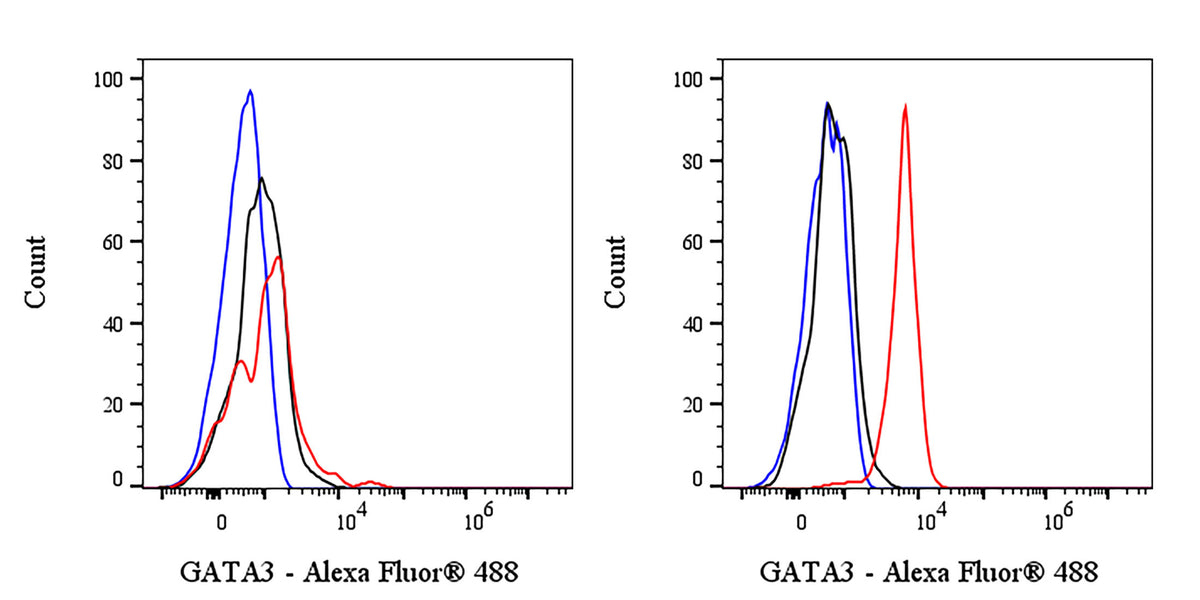
Flow cytometric analysis of 4% PFA fixed 90% methanol permeabilized Ramos (Human Burkitt's lymphoma B lymphocyte, left) / Jurkat (Human T cell leukemia T lymphocyte, right) labeled with Anti-Human/Mouse GATA3 antibody at 1/200 dilution (1 μg) / (red) compared with a Mouse IgG1,k (black) isotype control and an unlabelled control (cells without incubation with primary antibody and secondary antibody) (blue). Goat Anti - Mouse IgG Alexa Fluor® 488 was used as the secondary antibody. Flow cytometry and data analysis were performed using Agilent NovoCyte Quanteon and FlowJo™ software.
Negative control: Ramos
Mouse Anti-Human/Mouse GATA3 Antibody (S-4521)
Mouse Anti-Human/Mouse GATA3 Antibody (S-4521)
Price:
Regular price
$100 USD
Regular price
Sale price
$100 USD
Unit price
per
For shipping services or bulk orders, you may request a quotation.
Secure checkout with

View full details
Product Details
Product Details
Product Specification
| Host | Mouse |
| Antigen | GATA3 |
| Synonyms | Trans-acting T-cell-specific transcription factor GATA-3; GATA-binding factor 3 |
| Location | Nucleus |
| Accession | P23771、P23772 |
| Clone Number | S-4521 |
| Antibody Type | Mouse mAb |
| Isotype | IgG1,k |
| Isotype Control | S0B0617 |
| Application | ICFCM |
| Reactivity | Hu, Ms |
| Positive Sample | Jurkat |
| Purification | Protein G |
| Concentration | 2 mg/ml |
| Conjugation | Unconjugated |
| Physical Appearance | Liquid |
| Storage Buffer | PBS pH7.4 |
| Stability & Storage | 12 months from date of receipt / reconstitution, 2 to 8 °C as supplied |
Dilution
| application | dilution | species |
| ICFCM | 1:200 | Hu, Ms |
Background
GATA3 (GATA-binding protein 3) is a zinc-finger transcription factor encoded by the GATA3 gene on chromosome 10p15 that orchestrates embryogenesis, cell fate, and differentiation across epithelial, endothelial, hematopoietic, and neural lineages by binding the consensus WGATAR DNA motif, and its indispensable roles in mammary luminal specification, T-helper-2 immune responses, parathyroid and inner-ear development are underscored by the severe multi-organ defects seen in Gata3-haploinsufficient HDR syndrome, while in cancer its context-dependent function manifests as an estrogen-receptor-coactivating oncogene in luminal breast tumors and a lineage-survival oncogene in urothelial carcinomas, yet also as a tumor suppressor in some contexts, making immunohistochemical GATA3 positivity a widely used diagnostic biomarker for carcinomas of breast and urothelial origin and a potential therapeutic target whose modulation is being explored with small-molecule inhibitors and epigenetic strategies.
Picture
Picture
FC