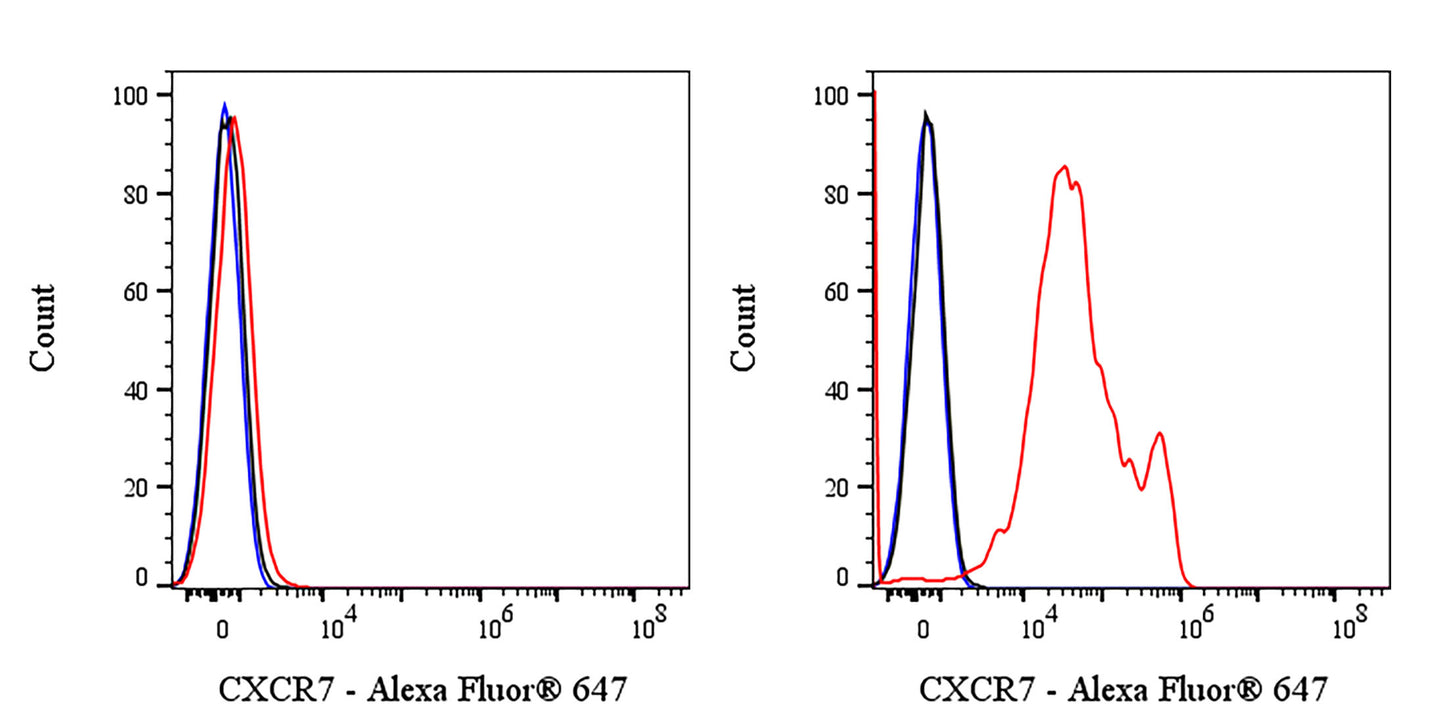
Flow cytometric analysis of 293F (Human embryonic kidney epithelial cell, left) / CXCR7 transfected 293F (Human T cell leukemia T lymphocyte, right) labelling CXCR7 antibody at 1/400 dilution (0.5 μg) / (red) compared with a Mouse monoclonal IgG (black) Isotype Control and an unlabelled control (cells without incubation with primary antibody and secondary antibody) (blue). Goat Anti - Mouse IgG Alexa Fluor® 647 was used as the secondary antibody.Flow cytometry and data analysis were performed using Agilent NovoCyte Quanteon and FlowJo™ software.
Negative control: 293F
Mouse Anti-Human/Mouse CXCR7 Antibody (S-3127)
Mouse Anti-Human/Mouse CXCR7 Antibody (S-3127)
Price:
Regular price
$100 USD
Regular price
Sale price
$100 USD
Unit price
per
For shipping services or bulk orders, you may request a quotation.
Secure checkout with

View full details
Product Details
Product Details
Product Specification
| Host | Mouse |
| Antigen | CXCR7 |
| Synonyms | Atypical chemokine receptor 3; C-X-C chemokine receptor type 7 (CXC-R7; CXCR-7); Chemokine orphan receptor 1; G-protein coupled receptor 159; G-protein coupled receptor RDC1 homolog (RDC-1); CMKOR1; GPR159; RDC1; ACKR3 |
| Location | Endosome, Cell membrane |
| Accession | P25106、P56485 |
| Clone Number | S-3127 |
| Antibody Type | Mouse mAb |
| Isotype | IgG2b,k |
| Application | FCM |
| Reactivity | Hu, Ms |
| Positive Sample | 293F |
| Purification | Protein A |
| Concentration | 2 mg/ml |
| Conjugation | Unconjugated |
| Physical Appearance | Liquid |
| Storage Buffer | PBS pH7.4 |
| Stability & Storage | 12 months from date of receipt / reconstitution, 2 to 8 °C as supplied |
Dilution
| application | dilution | species |
| FCM | 0.5μg per million cells in 100μl volume | Hu, Ms |
Background
CXCR7, also known as ACKR3, is an atypical chemokine receptor that binds the inflammatory ligands CXCL11 and CXCL12 with high affinity but signals through β-arrestin rather than classical G-proteins, thereby functioning as a scavenger to shape chemokine gradients and modulate CXCR4-mediated responses; it is broadly expressed in vascular endothelium, tumor cells, and immune tissues, where it regulates angiogenesis, tumor metastasis, stem-cell trafficking, and cardiac development, and its dysregulation has been implicated in cancer progression, autoimmune disorders, and cardiovascular disease, making it a promising diagnostic marker and therapeutic target.
Picture
Picture
FC