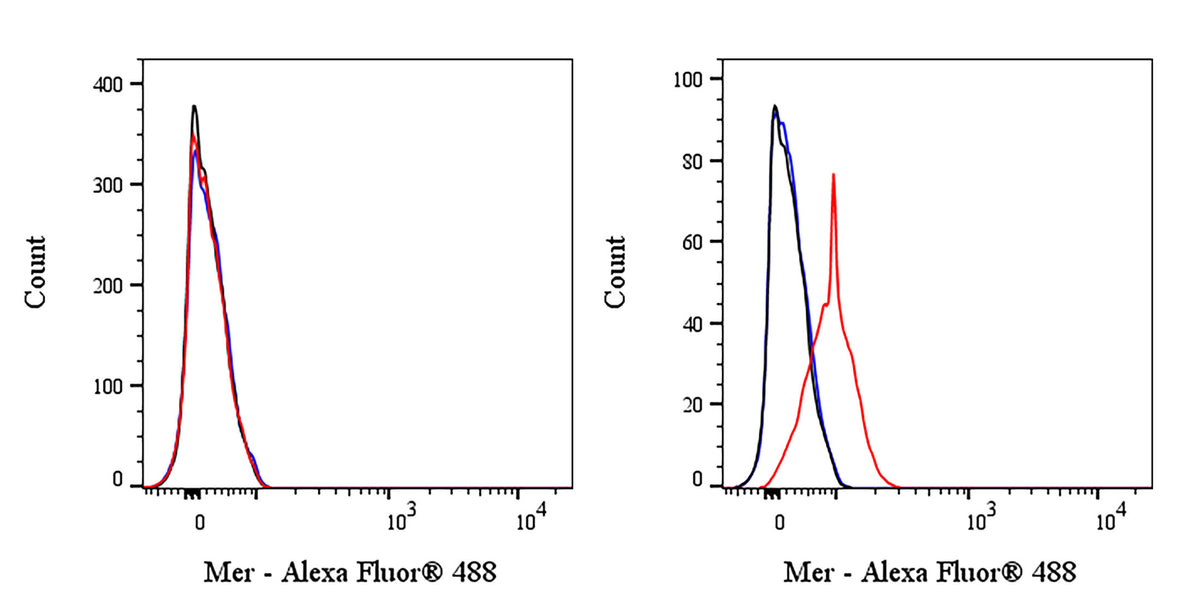
Flow cytometric analysis of MCF7 (Human breast adenocarcinoma epithelial cell, left) / U-937 (Human histiocytic lymphoma monocyte, right) labeled with Mer antibody at 1/200 dilution (1 μg) / (red) compared with a Mouse IgG2b, k (black) Isotype Control and an unlabelled control (cells without incubation with primary antibody and secondary antibody) (blue). Goat Anti - Mouse IgG Alexa Fluor® 488 was used as the secondary antibody. Flow cytometry and data analysis were performed using BD FACSymphony™ A1 and FlowJo™ software.
Negative control:MCF7
Mouse Anti-Human Mer Antibody (S-4830)
Mouse Anti-Human Mer Antibody (S-4830)
Price:
Regular price
$100 USD
Regular price
Sale price
$100 USD
Unit price
per
For shipping services or bulk orders, you may request a quotation.
Secure checkout with

View full details
Product Details
Product Details
Product Specification
| Host | Mouse |
| Antigen | Mer |
| Synonyms | Tyrosine-protein kinase Mer; Proto-oncogene c-Mer; Receptor tyrosine kinase MerTK; MERTK |
| Location | Cell membrane |
| Accession | Q12866 |
| Clone Number | S-4830 |
| Antibody Type | Mouse mAb |
| Isotype | IgG2b,k |
| Isotype Control | S0B0618 |
| Application | FCM |
| Reactivity | Hu |
| Positive Sample | U-937 |
| Purification | Protein A |
| Concentration | 2 mg/ml |
| Conjugation | Unconjugated |
| Physical Appearance | Liquid |
| Storage Buffer | PBS pH7.4 |
| Stability & Storage | 12 months from date of receipt / reconstitution, 2 to 8 °C as supplied |
Dilution
| application | dilution | species |
| FCM | 1:200 | Hu |
Background
Mer, full name tyrosine-protein kinase Mer (MerTK), is an important member of the TAM receptor tyrosine kinase subfamily (comprising Axl, Tyro3, and Mer), named after its expression pattern initially observed in monocytes, epithelial cells, and reproductive tissues. This protein is a transmembrane receptor featuring two immunoglobulin-like domains and two fibronectin type III repeats in its extracellular region for ligand recognition and binding, including growth arrest-specific protein 6 (Gas6) and protein S; its intracellular portion contains a catalytically active tyrosine kinase domain. Upon ligand binding, Mer undergoes dimerization and autophosphorylation, thereby activating downstream signaling pathways such as PI3K-AKT and MAPK/ERK, mediating various physiological processes including cell survival, proliferation, migration, and cytoskeletal rearrangement. In the immune system, the most critical functions of Mer are mediating the clearance of apoptotic cells by phagocytes (i.e., efferocytosis) and inducing SOCS1 and SOCS3 production through STAT1 activation, thereby suppressing Toll-like receptor-mediated inflammatory responses and playing a central role in maintaining immune homeostasis. In the retina, Mer is essential for the phagocytosis of shed photoreceptor outer segment fragments by retinal pigment epithelial cells, and its gene mutations are closely associated with retinitis pigmentosa type 38 in humans. Furthermore, aberrant high expression of Mer is associated with the development, progression, and chemotherapy resistance of various malignancies (such as leukemia, lymphoma, gastric cancer, and breast cancer), making it a promising anti-tumor target.
Picture
Picture
FC