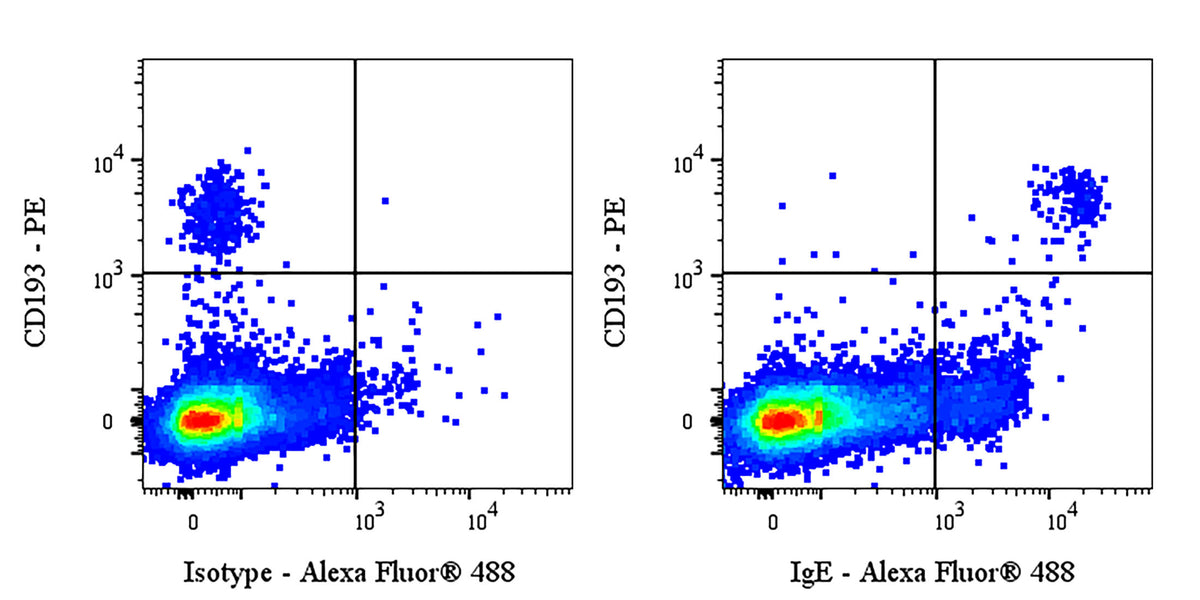
Flow cytometric analysis of Human PBMCs (peripheral blood mononuclear cells) labeled with Anti-Human IgE antibody at 1/200 dilution (1 μg) / (right panel) compared with a Mouse IgG1, κ Isotype Control / (left panel). Goat Anti-Mouse IgG Alexa Fluor® 488 was used as the secondary antibody. Then cells were stained with CD193 – PE antibody separately. Flow cytometry and data analysis were performed using BD FACSymphony™ A1 and FlowJo™ software.
Mouse Anti-Human IgE Antibody (S-5486)
Mouse Anti-Human IgE Antibody (S-5486)
Price:
Regular price
$100 USD
Regular price
Sale price
$100 USD
Unit price
per
For shipping services or bulk orders, you may request a quotation.
Secure checkout with

View full details
Product Details
Product Details
Product Specification
| Host | Mouse |
| Antigen | IgE |
| Synonyms | Immunoglobulin epsilon heavy chain |
| Location | Secreted, Cell membrane |
| Accession | P0DOX4 |
| Clone Number | S-5486 |
| Antibody Type | Mouse mAb |
| Isotype | IgG1,k |
| Isotype Control | S0B0617 |
| Application | FCM |
| Reactivity | Hu |
| Positive Sample | Human PBMCs |
| Purification | Protein A |
| Concentration | 2 mg/ml |
| Conjugation | Unconjugated |
| Physical Appearance | Liquid |
| Storage Buffer | PBS pH7.4 |
| Stability & Storage | 12 months from date of receipt / reconstitution, 2 to 8 °C as supplied |
Dilution
| application | dilution | species |
| FCM | 1:200 | Hu |
Background
IgE (immunoglobulin E) is the least abundant of the five major classes of immunoglobulins in humans, yet it possesses remarkably potent biological activity and plays a central role in type I hypersensitivity reactions and anti-parasitic immunity. IgE is primarily produced and secreted by plasma cells in the lamina propria of mucosal tissues, and its unique Fc region enables it to bind with extremely high affinity to the high-affinity receptor FcεRI on the surface of mast cells and basophils. When specific antigens (allergens) re-enter the body and cross-link with IgE already bound to the cell surface, they trigger rapid degranulation of these effector cells, releasing inflammatory mediators such as histamine, leukotrienes, and prostaglandins, which in turn induce vasodilation, smooth muscle contraction, and increased mucus secretion—classic allergic symptoms ranging from mild allergic rhinitis and urticaria to life-threatening anaphylactic shock. In an evolutionary context, IgE-mediated responses originally evolved to defend against parasitic infections (e.g., helminths) by promoting the recruitment and activation of eosinophils to eliminate pathogens. Abnormally elevated IgE levels are commonly observed in patients with atopic diseases (such as asthma and eczema) and parasitic infections, while monoclonal antibody drugs targeting IgE (e.g., omalizumab) neutralize free IgE and block its binding to FcεRI, and have become effective biologics for the treatment of moderate-to-severe allergic asthma and chronic spontaneous urticaria. Furthermore, IgE may also exert bidirectional modulatory effects in anti-tumor immune surveillance, with some studies suggesting that it may exhibit anti-tumor activity through antibody-dependent cell-mediated cytotoxicity (ADCC) or by promoting tumor antigen presentation, although the underlying mechanisms require further elucidation.
Picture
Picture
FC