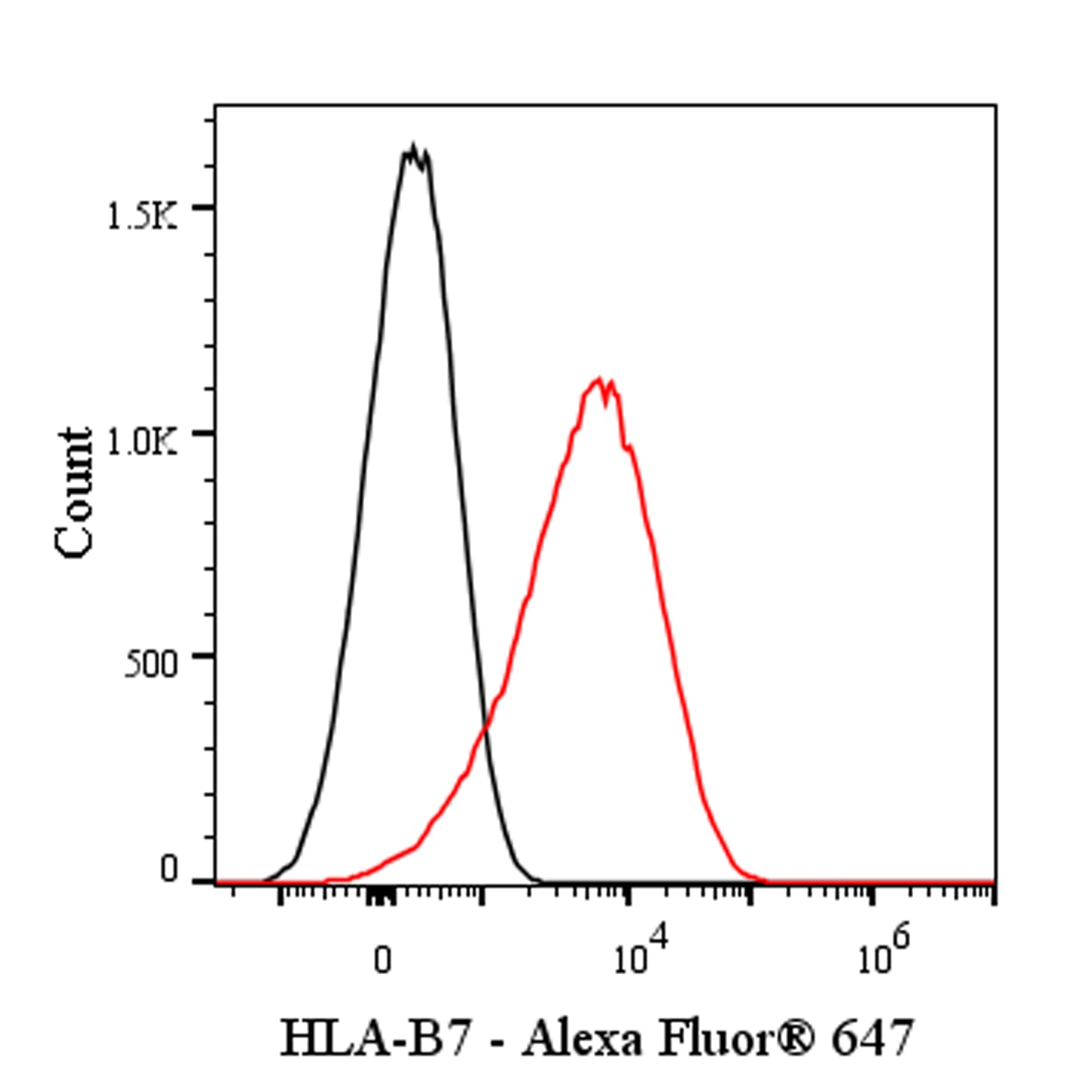
Flow cytometric analysis of Human HLA-B7 expression on Jurkat (Human T cell leukemia T lymphocyte.Cells were labeled with either Mouse IgG1a, κ Isotype Control (black line histogram) or SDT Mouse Anti-Human HLA-B7 antibody (red line histogram) at 1/200 dilution (1·μg). Goat Anti - Mouse IgG Alexa Fluor® 647 was used as the secondary antibody. Total viable cells, as determined by Fixable Viability Dye 545 (S0B88802), were used for analysis. Flow cytometry and data analysis were performed using Agilent NovoCyte Quanteon and FlowJo™ software.
Mouse Anti-Human HLA-B7 Antibody (BB7.1)
Mouse Anti-Human HLA-B7 Antibody (BB7.1)
Price:
Regular price
$45 USD
Regular price
Sale price
$45 USD
Unit price
per
For shipping services or bulk orders, you may request a quotation.
Secure checkout with

View full details
Product Details
Product Details
Product Specification
| Host | Mouse |
| Antigen | HLA-B7 |
| Synonyms | HLA class I histocompatibility antigen, B alpha chain; HLAB; HLA-B |
| Location | Cell membrane, Endoplasmic reticulum membrane |
| Accession | P01889 |
| Clone Number | BB7.1 |
| Antibody Type | Mouse mAb |
| Isotype | IgG1,k |
| Application | FCM |
| Reactivity | Hu |
| Positive Sample | Jurkat |
| Purification | Protein G |
| Concentration | 2 mg/ml |
| Conjugation | Unconjugated |
| Physical Appearance | Liquid |
| Storage Buffer | PBS pH7.4 |
| Stability & Storage | 12 months from date of receipt / reconstitution, 2 to 8 °C as supplied |
Dilution
| application | dilution | species |
| FCM | 1:200 | Hu |
Background
HLA-B7, also known as HLA-B*07:02, is a specific allele of the human leukocyte antigen B (HLA-B) gene located on the short arm of chromosome 6, encoding a major histocompatibility complex (MHC) class I cell surface receptor that plays a pivotal role in the adaptive immune system by presenting endogenous peptide fragments to CD8+ cytotoxic T cells for immune surveillance. This highly polymorphic protein consists of a heavy chain non-covalently associated with beta-2 microglobulin, forming a groove that binds and displays intracellular peptides derived from normal cellular metabolism or pathogenic infections, thereby enabling the immune system to distinguish self from non-self. Clinically, HLA-B7 is significant not only for its involvement in transplant rejection scenarios due to alloimmune responses but also for its well-documented associations with various autoimmune disorders, such as multiple sclerosis and psoriasis, as well as its potential influence on susceptibility to certain viral infections and cancer progression, making it a critical marker in immunogenetics, personalized medicine, and vaccine development research.
Picture
Picture
FC