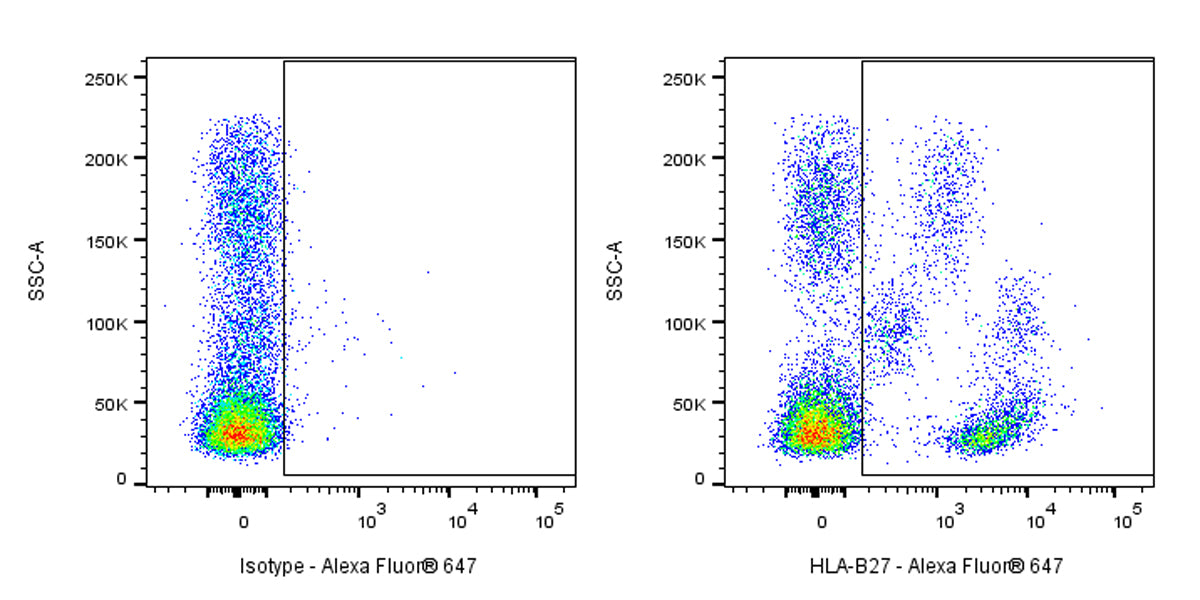
Flow cytometric analysis of human peripheral blood leukocytes labelling Human HLA-B27 antibody at 1/200 (1 μg) dilution/ (Right panel) compared with a Mouse IgG2a Isotype Control / (left panel). Goat Anti-Mouse IgG Alexa Fluor® 647 was used as the secondary antibody.
Mouse Anti-Human HLA-B27 Antibody (HLA-ABC-m3)
Mouse Anti-Human HLA-B27 Antibody (HLA-ABC-m3)
Price:
Regular price
$100 USD
Regular price
Sale price
$100 USD
Unit price
per
For shipping services or bulk orders, you may request a quotation.
Secure checkout with

View full details
Product Details
Product Details
Product Specification
| Host | Mouse |
| Antigen | HLA-B27 |
| Synonyms | HLA class I histocompatibility antigen, B alpha chain; Human leukocyte antigen B (HLA-B); HLAB; HLA-B |
| Location | Cell membrane, Endoplasmic reticulum membrane |
| Accession | P03989 |
| Clone Number | HLA-ABC-m3 |
| Antibody Type | Mouse mAb |
| Isotype | IgG2a |
| Application | FCM |
| Reactivity | Hu |
| Positive Sample | human peripheral blood leukocytes |
| Purification | Protein A |
| Concentration | 2 mg/ml |
| Conjugation | Unconjugated |
| Physical Appearance | Liquid |
| Storage Buffer | PBS pH7.4 |
| Stability & Storage | 12 months from date of receipt / reconstitution, 2 to 8 °C as supplied |
Dilution
| application | dilution | species |
| FCM | 1:200 | Hu |
Background
HLA-B27 is a highly polymorphic class I major histocompatibility complex (MHC-I) molecule expressed on virtually all nucleated cells that folds in the endoplasmic reticulum with β2-microglobulin to form a peptide-binding groove preferentially anchoring arginine at position 2, transports these peptides to the cell surface for surveillance by CD8⁺ cytotoxic T lymphocytes, and—through mechanisms still debated encompassing presentation of “arthritogenic” self or microbial peptides, heavy-chain misfolding that triggers endoplasmic-reticulum stress and autophagy, and aberrant homodimer formation that activates innate killer receptors—confers the strongest known genetic risk for the spondyloarthritis family (ankylosing spondylitis, reactive arthritis, psoriatic arthritis, juvenile enthesitis-related arthritis) and acute anterior uveitis while paradoxically protecting against several viral infections, with disease-associated subtypes such as B27:05 and B27:04 differing from non-associated or protective subtypes by only one or two amino acids lining the antigen-binding cleft that alter peptide repertoire and surface stability.
Picture
Picture
FC