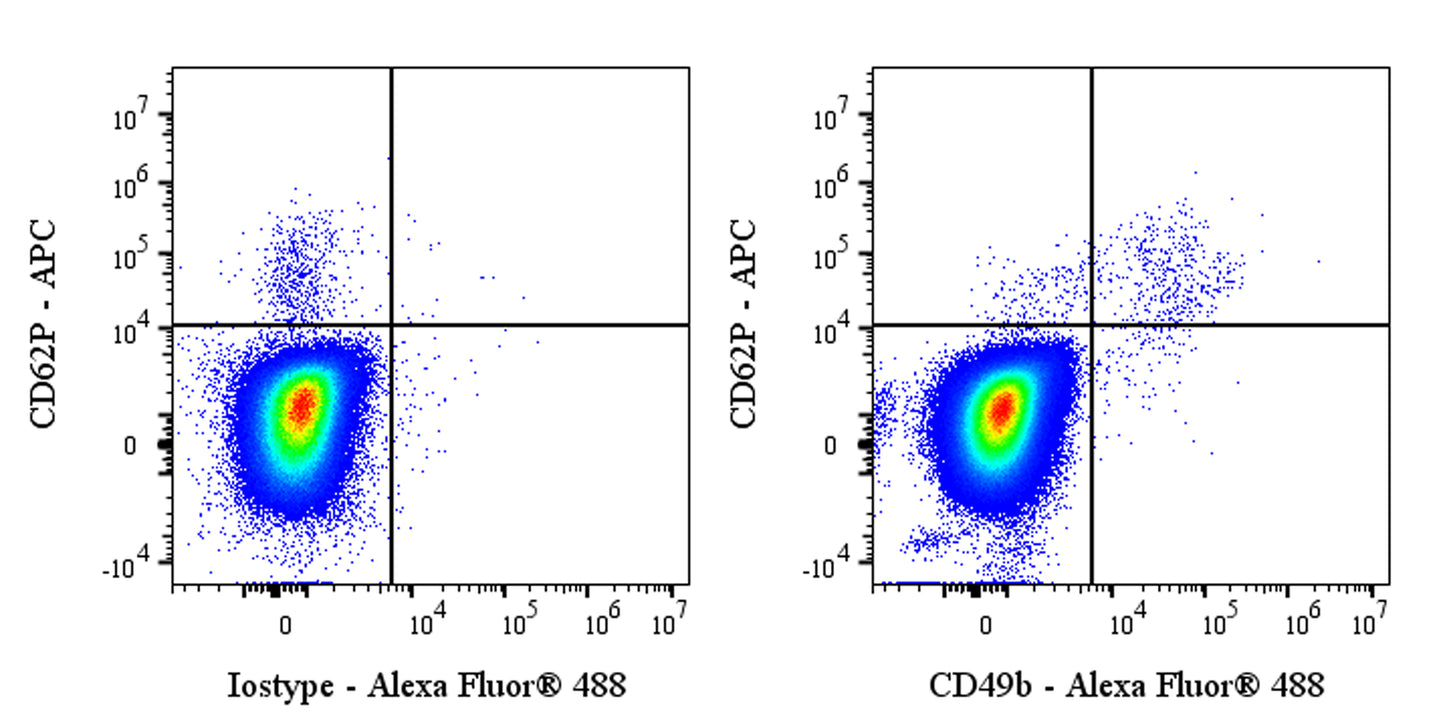
Flow cytometric analysis of fresh human peripheral blood cells labeled with anti - Human CD49b antibody at 1/200 dilution (1 μg) / (right panel) compared with a Mouse IgG1, κ Isotype Control / (left panel). Goat Anti-Mouse IgG Alexa Fluor® 488 was used as the secondary antibody. Then cells were stained with CD62P – APC antibody separately. Total viable cells, as determined by Fixable Viability Dye 452 (S0B88801), were used for analysis.Flow cytometry and data analysis were performed using Agilent NovoCyte Quanteon and FlowJo™ software.
Mouse Anti-Human CD49b Antibody (AK-7)
Mouse Anti-Human CD49b Antibody (AK-7)
Price:
Regular price
$100 USD
Regular price
Sale price
$100 USD
Unit price
per
For shipping services or bulk orders, you may request a quotation.
Secure checkout with

View full details
Product Details
Product Details
Product Specification
| Host | Mouse |
| Antigen | CD49b |
| Synonyms | Integrin alpha-2; CD49 antigen-like family member B; Collagen receptor; Platelet membrane glycoprotein Ia (GPIa); VLA-2 subunit alpha; ITGA2; CD49B |
| Location | Membrane |
| Accession | P17301 |
| Clone Number | AK-7 |
| Antibody Type | Mouse mAb |
| Isotype | IgG1,k |
| Isotype Control | S0B0617 |
| Application | FCM |
| Reactivity | Hu |
| Positive Sample | Fresh human peripheral blood cells |
| Purification | Protein G |
| Concentration | 2 mg/ml |
| Conjugation | Unconjugated |
| Physical Appearance | Liquid |
| Storage Buffer | PBS pH7.4 |
| Stability & Storage | 12 months from date of receipt / reconstitution, 2 to 8 °C as supplied |
Dilution
| application | dilution | species |
| FCM | 1:200 | Hu |
Background
CD49b, also known as integrin alpha-2 subunit or platelet GPIa, is a type I transmembrane glycoprotein whose core function is to non-covalently associate with the integrin beta-1 subunit (CD29) to form the heterodimeric complex VLA-2 (Very Late Antigen-2). Structurally, its extracellular domain contains a unique folded structure homologous to the collagen-binding domain of von Willebrand factor, conferring the molecule with the ability to bind to extracellular matrix components including type I, type II, and type XI collagens as well as laminin. Functionally, CD49b not only serves as the primary collagen receptor in the extracellular matrix, playing a critical role in platelet adhesion, aggregation, and hemostasis, but also deeply participates in immune cell migration and localization. For instance, it is essential for the homing of memory T cell precursors to the bone marrow to establish the resting memory T cell pool, and its expression level can define functionally distinct memory helper T cell subsets. Furthermore, in the tumor microenvironment, the dynamic expression of CD49b on tumor-infiltrating CD8+ T cells is closely associated with T cell dysfunction and spatial distribution. Its differential expression on platelets and various immune cells (including activated T lymphocytes and NK cells) makes it a key molecule in immune regulation and cancer research, as well as a potential therapeutic target.
Picture
Picture
FC