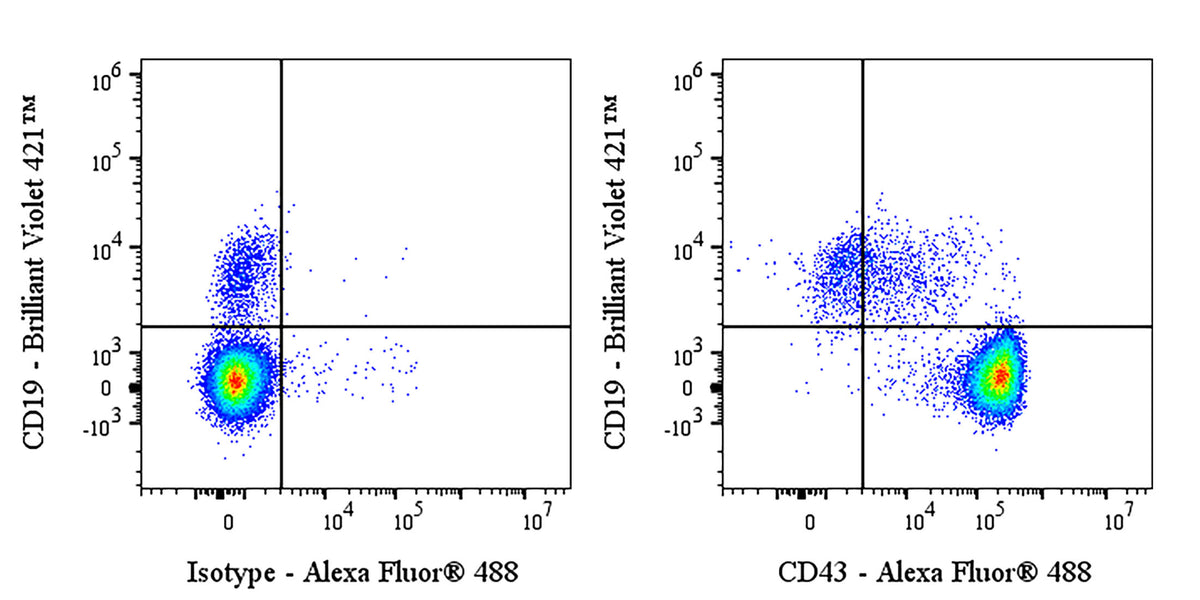
Flow cytometric analysis of human PBMC labeled with anti-human CD43 antibody at 1/400 dilution (0.5 μg) / (right panel) compared with a Mouse IgG21, κ Isotype Control / (left panel). Goat Anti-Mouse IgG Alexa Fluor® 488 was used as the secondary antibody. Then cells were stained with CD19 - Brilliant Violet 421™ antibody separately. Flow cytometry and data analysis were performed using Agilent NovoCyte Quanteon and FlowJo™ software.
Mouse Anti-Human CD43 Antibody (S-4602)
Mouse Anti-Human CD43 Antibody (S-4602)
Price:
Regular price
$45 USD
Regular price
Sale price
$45 USD
Unit price
per
For shipping services or bulk orders, you may request a quotation.
Secure checkout with

View full details
Product Details
Product Details
Product Specification
| Host | Mouse |
| Antigen | CD43 |
| Synonyms | Leukosialin; GPL115; Galactoglycoprotein (GALGP); Leukocyte sialoglycoprotein; Sialophorin; SPN |
| Location | Membrane |
| Accession | P16150 |
| Clone Number | S-4602 |
| Antibody Type | Mouse mAb |
| Isotype | IgG1,k |
| Application | FCM |
| Reactivity | Hu |
| Positive Sample | Human PBMC |
| Purification | Protein G |
| Concentration | 2 mg/ml |
| Conjugation | Unconjugated |
| Physical Appearance | Liquid |
| Storage Buffer | PBS pH7.4 |
| Stability & Storage | 12 months from date of receipt / reconstitution, 2 to 8 °C as supplied |
Dilution
| application | dilution | species |
| FCM | 1:400 | Hu |
Background
CD43, also known as leukosialin or sialophorin and encoded by the SPN gene, is a highly glycosylated type I transmembrane sialoglycoprotein predominantly expressed on the surface of most hematopoietic cells, including T lymphocytes, monocytes, macrophages, granulocytes, and platelets, but notably absent on normal resting B cells. Structurally characterized by an extended extracellular domain rich in serine, threonine, and proline residues that are heavily O-glycosylated, CD43 functions primarily as an anti-adhesive molecule due to its large size and negative charge, which creates a steric and electrostatic barrier that prevents non-specific cell-cell interactions and facilitates cell motility during immune surveillance and inflammation. Beyond its physical role in modulating cell adhesion, CD43 acts as a critical signal transduction molecule; upon ligation or cross-linking, it triggers intracellular signaling cascades involving tyrosine kinases such as Lck and Fyn, thereby influencing T-cell activation, proliferation, apoptosis, and cytoskeletal reorganization. Clinically, CD43 serves as an important diagnostic marker in hematopathology, particularly for distinguishing certain T-cell neoplasms and myeloid disorders from B-cell malignancies, while its aberrant expression patterns have also been implicated in various pathological conditions, including autoimmune diseases and cancer metastasis, highlighting its multifaceted role in both physiological immune regulation and disease pathogenesis.
Picture
Picture
FC