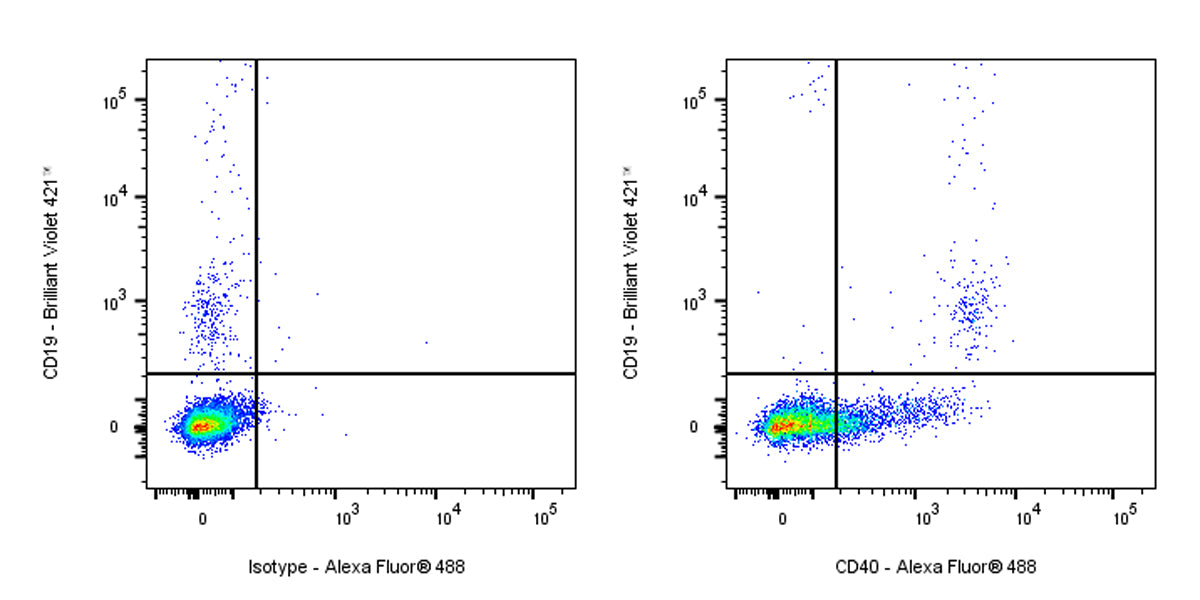
Flow cytometric analysis of human peripheral blood leukocytes labelling Human CD40 antibody at 1/200 dilution (1 μg) / (Right panel) compared with a Mouse IgG1, κ Isotype Control / (Left panel). Goat Anti-Mouse IgG Alexa Fluor® 488 was used as the secondary antibody. Then cells were stained with CD19 - Brilliant Violet 421™ Antibody separately.
Mouse Anti-Human CD40 Antibody (G28.5)
Mouse Anti-Human CD40 Antibody (G28.5)
Price:
Regular price
$100 USD
Regular price
Sale price
$100 USD
Unit price
per
For shipping services or bulk orders, you may request a quotation.
Secure checkout with

View full details
Product Details
Product Details
Product Specification
| Host | Mouse |
| Antigen | CD40 |
| Synonyms | Tumor necrosis factor receptor superfamily member 5; B-cell surface antigen CD40; Bp50; CD40L receptor; CDw40; TNFRSF5 |
| Location | Secreted, Cell membrane |
| Accession | P25942 |
| Clone Number | G28.5 |
| Antibody Type | Mouse mAb |
| Isotype | IgG1,k |
| Application | FCM |
| Reactivity | Hu |
| Positive Sample | human peripheral blood leukocytes |
| Purification | Protein G |
| Concentration | 2 mg/ml |
| Conjugation | Unconjugated |
| Physical Appearance | Liquid |
| Storage Buffer | PBS pH7.4 |
| Stability & Storage | 12 months from date of receipt / reconstitution, 2 to 8 °C as supplied |
Dilution
| application | dilution | species |
| FCM | 1:200 | Hu |
Background
CD40, also known as TNFRSF5 or Bp50, is a 48 kDa type I membrane glycoprotein belonging to the tumor necrosis factor receptor superfamily. It is widely expressed on various immune cells, including B cells, dendritic cells, and macrophages. The interaction between CD40 and its ligand, CD40L, is crucial for immune cell activation and regulation. Structurally, CD40 consists of a 62 amino acid cytoplasmic tail, a 22 amino acid transmembrane domain, and a 173 amino acid extracellular domain. This co-stimulatory protein plays a key role in B cell activation, proliferation, and differentiation, and is also involved in immune responses against infections and tumors. Due to its significant role in the immune system, CD40 has become an important therapeutic target, with various agonistic and antagonistic antibodies being developed to modulate its activity.
Picture
Picture
FC