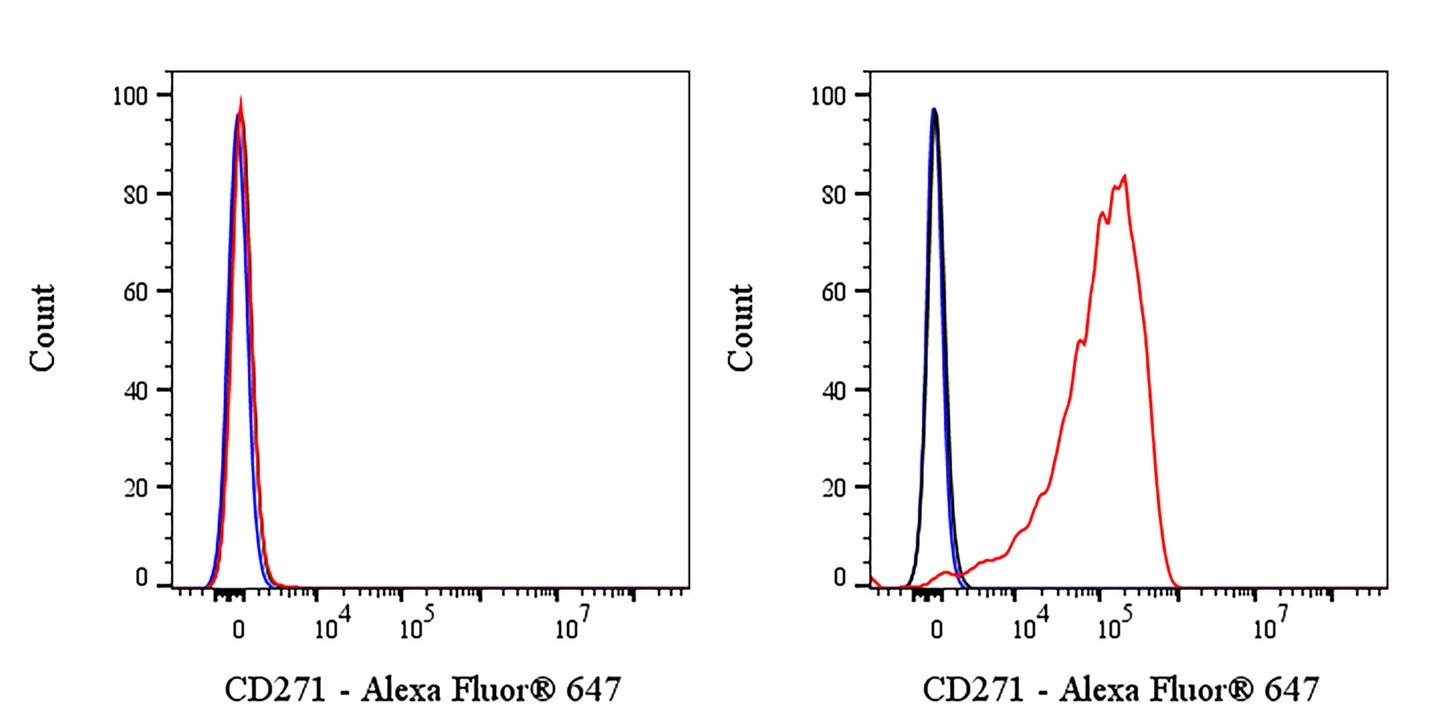
Flow cytometric analysis of PC-3 (Human prostate adenocarcinoma epithelial cell, left) / SW480 (Human colorectal adenocarcinoma epithelial cell, right) labelling CD271 antibody at 1/2000 dilution (0.1 μg) / (red) compared with a Mouse monoclonal IgG (black) Isotype Control and an unlabelled control (cells without incubation with primary antibody and secondary antibody) (blue). Goat Anti - Mouse IgG Alexa Fluor® 647 was used as the secondary antibody.Flow cytometry and data analysis were performed using Agilent NovoCyte Quanteon and FlowJo™ software.
Negative control: PC-3
Mouse Anti-Human CD271 Antibody (S-2902)
Mouse Anti-Human CD271 Antibody (S-2902)
Price:
Regular price
$100 USD
Regular price
Sale price
$100 USD
Unit price
per
For shipping services or bulk orders, you may request a quotation.
Secure checkout with

View full details
Product Details
Product Details
Product Specification
| Host | Mouse |
| Antigen | CD271 |
| Synonyms | Tumor necrosis factor receptor superfamily member 16; Gp80-LNGFR; Low affinity neurotrophin receptor p75NTR; Low-affinity nerve growth factor receptor (NGF receptor); Low-affinity nerve growth factor receptor p75NGFR; Low-affinity nerve growth factor receptor p75NGR; p75 ICD; TNFRSF16; NGFR |
| Location | Cytoplasm, Cell membrane, Synapse |
| Accession | P08138 |
| Clone Number | S-2902 |
| Antibody Type | Mouse mAb |
| Isotype | IgG1,k |
| Application | FCM |
| Reactivity | Hu |
| Positive Sample | SW480 |
| Purification | Protein G |
| Concentration | 2 mg/ml |
| Conjugation | Unconjugated |
| Physical Appearance | Liquid |
| Storage Buffer | PBS pH7.4 |
| Stability & Storage | 12 months from date of receipt / reconstitution, 2 to 8 °C as supplied |
Dilution
| application | dilution | species |
| FCM | 1:2000 | Hu |
Background
CD271 (also termed p75NTR or NGFR) is a low-affinity neurotrophin receptor that functions as a context-dependent molecular switch, promoting either differentiation and apoptosis in normal tissues or survival, stemness and metastasis in cancers by activating MEK/ERK, RhoA/ROCK and other downstream cascades, and its expression marks therapy-resistant melanoma-initiating cells, drives phenotype switching in cutaneous squamous cell carcinoma, correlates with aggressive disease in medulloblastoma and neurofibromatosis tumors, and orchestrates osteogenic commitment of ectomesenchymal stem cells during craniofacial bone development.
Picture
Picture
FC