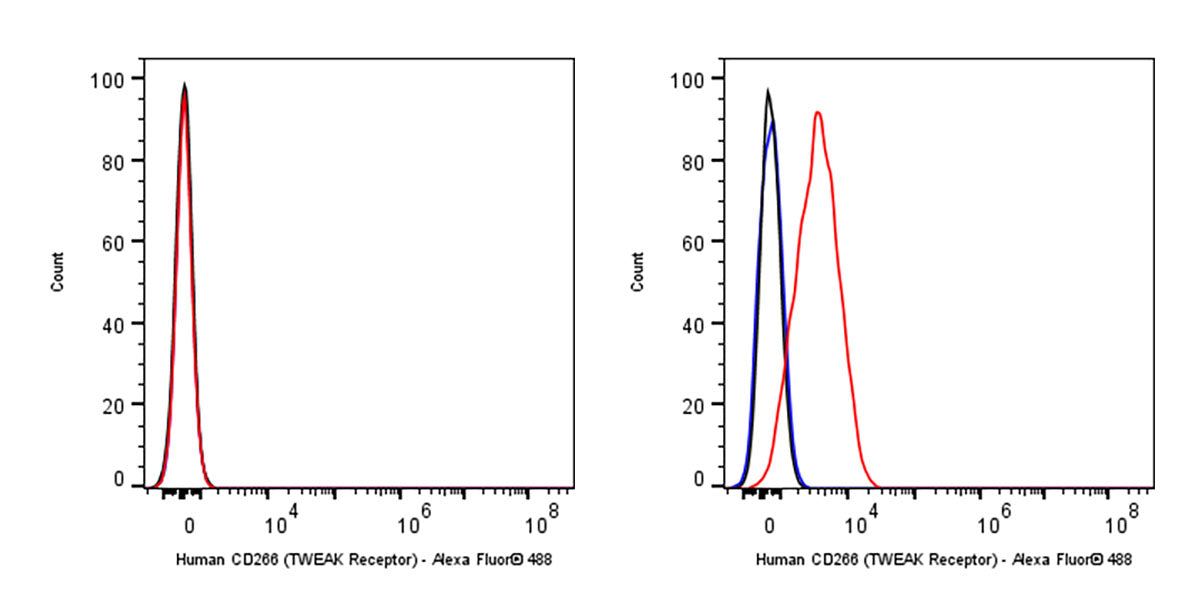
Flow cytometric analysis of Daudi ( Human Burkitt's lymphoma lymphoblast, left) / HeLa (Human cervix adenocarcinoma epithelial cell, right) labeled with anti-CD266 antibody at 1/400 dilution (0.5 μg) / (red) compared with a Mouse IgG2b, κ (black) isotype control and an unlabelled control (cells without incubation with primary antibody and secondary antibody) (blue). Goat Anti - Mouse IgG Alexa Fluor® 488 was used as the secondary antibody. Negative control: Daudi
Mouse Anti-Human CD266 (TWEAK Receptor) Antibody (S-3902)
Mouse Anti-Human CD266 (TWEAK Receptor) Antibody (S-3902)
Price:
Regular price
$100 USD
Regular price
Sale price
$100 USD
Unit price
per
For shipping services or bulk orders, you may request a quotation.
Secure checkout with

View full details
Product Details
Product Details
Product Specification
| Host | Mouse |
| Antigen | CD266 (TWEAK Receptor) |
| Synonyms | Tumor necrosis factor receptor superfamily member 12A; Fibroblast growth factor-inducible immediate-early response protein 14 (FGF-inducible 14); Tweak-receptor (TweakR); FN14; TNFRSF12A |
| Location | Membrane |
| Accession | Q9NP84 |
| Clone Number | S-3902 |
| Antibody Type | Mouse mAb |
| Isotype | IgG2b,k |
| Application | FCM |
| Reactivity | Hu |
| Positive Sample | HeLa |
| Purification | Protein A |
| Concentration | 2 mg/ml |
| Conjugation | Unconjugated |
| Physical Appearance | Liquid |
| Storage Buffer | PBS pH7.4 |
| Stability & Storage | 12 months from date of receipt / reconstitution, 2 to 8 °C as supplied |
Dilution
| application | dilution | species |
| FCM | 1:400 | Hu |
Background
CD266, also known as the TWEAK receptor (TWEAK-R) or fibroblast growth factor–inducible 14 (Fn14), is a ~14 kDa type I transmembrane glycoprotein of the TNF receptor superfamily (TNFRSF12A) that contains no death domain but is expressed at low levels in many normal tissues (heart, placenta, lung, muscle, pancreas) and at high levels on activated endothelial cells and multiple tumor lines, where it binds the cytokine TWEAK (CD255) and recruits cytoplasmic TRAF1, TRAF2 and TRAF3 to activate canonical and non-canonical NF-κB pathways, thereby regulating context-dependent processes including inflammation, endothelial proliferation and angiogenesis, hepatocyte growth during liver regeneration, and either survival or apoptosis of epithelial and malignant cells.
Picture
Picture
FC