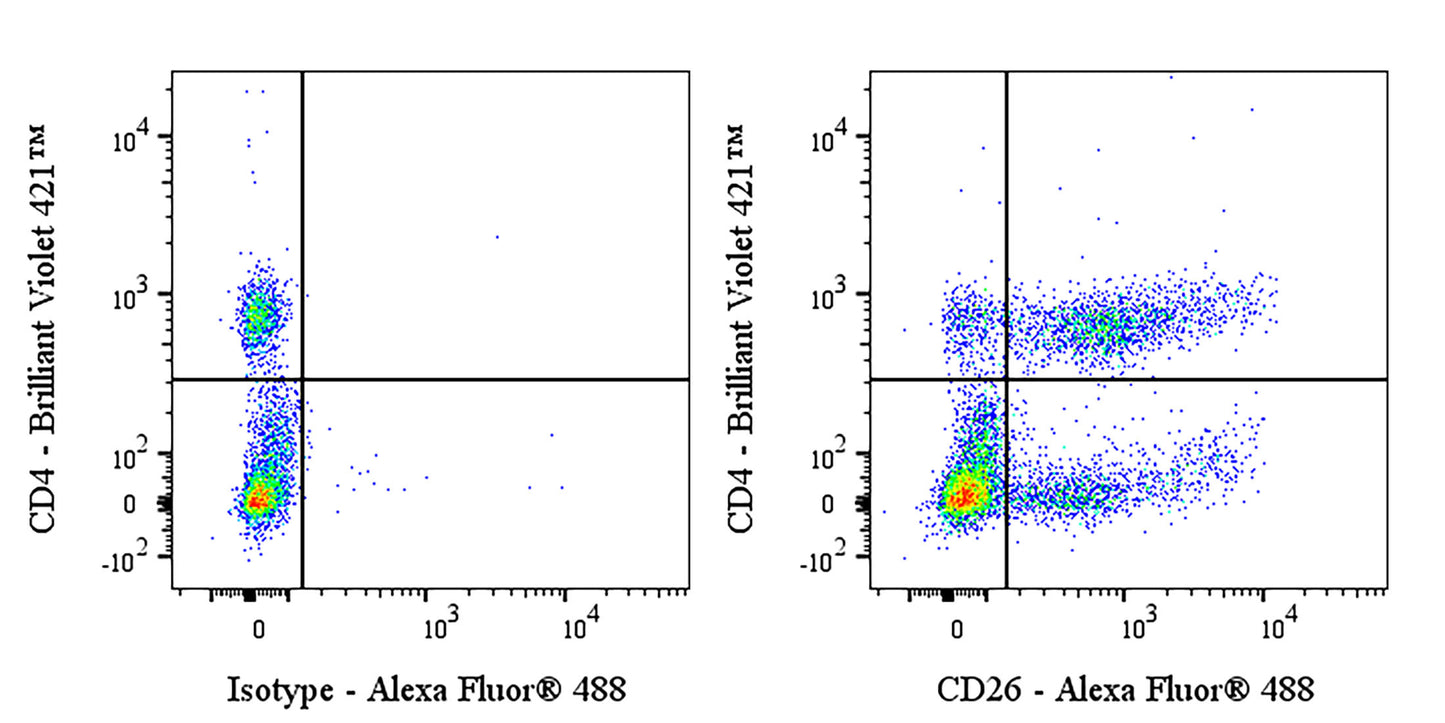
Flow cytometric analysis of human peripheral blood cells labeled with anti-human CD26 antibody at 1/100 dilution (2 μg) / (right panel) compared with a Mouse IgG1, κ Isotype Control / (left panel). Goat Anti-Mouse IgG Alexa Fluor® 488 was used as the secondary antibody. Then cells were stained with CD4 - Brilliant Violet 421™ antibody separately. Flow cytometry and data analysis were performed using BD FACSymphony™ A1 and FlowJo™ software.
Mouse Anti-Human CD26 Antibody (M-A261)
Mouse Anti-Human CD26 Antibody (M-A261)
Price:
Regular price
$45 USD
Regular price
Sale price
$45 USD
Unit price
per
For shipping services or bulk orders, you may request a quotation.
Secure checkout with

View full details
Product Details
Product Details
Product Specification
| Host | Mouse |
| Antigen | CD26 |
| Synonyms | Dipeptidyl peptidase 4; ADABP; Adenosine deaminase complexing protein 2 (ADCP-2); Dipeptidyl peptidase IV (DPP IV); T-cell activation antigen CD26; TP103; ADCP2; DPP4 |
| Location | Cell membrane |
| Accession | P27487 |
| Clone Number | M-A261 |
| Antibody Type | Mouse mAb |
| Isotype | IgG1,k |
| Application | FCM |
| Reactivity | Hu |
| Positive Sample | Human peripheral blood cells |
| Purification | Protein G |
| Concentration | 2 mg/ml |
| Conjugation | Unconjugated |
| Physical Appearance | Liquid |
| Storage Buffer | PBS pH7.4 |
| Stability & Storage | 12 months from date of receipt / reconstitution, 2 to 8 °C as supplied |
Dilution
| application | dilution | species |
| FCM | 1:100 | Hu |
Background
CD26, also known as dipeptidyl peptidase-4 (DPP-4), is a widely expressed type II transmembrane glycoprotein that functions primarily as a serine exopeptidase responsible for cleaving N-terminal dipeptides from polypeptides containing proline or alanine at the penultimate position, thereby playing a critical regulatory role in glucose homeostasis by inactivating incretin hormones such as glucagon-like peptide-1 (GLP-1) and glucose-dependent insulinotropic polypeptide (GIP). Beyond its enzymatic activity, CD26 serves as a multifunctional cell surface receptor involved in various physiological and pathological processes, including T-cell activation, immune regulation, apoptosis, and tumor progression, and it notably acts as the primary cellular receptor for certain coronaviruses, facilitating viral entry into host cells. Due to its pivotal role in degrading incretins, CD26 has become a major therapeutic target in the management of type 2 diabetes, with DPP-4 inhibitors (gliptins) widely used to enhance endogenous insulin secretion and lower blood glucose levels, while ongoing research continues to explore its implications in cancer biology, immunology, and infectious diseases.
Picture
Picture
FC