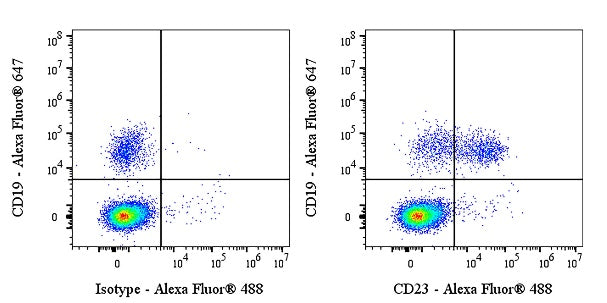
Flow cytometric analysis of human PBMC (human peripheral blood mononuclear cells) labeled Human CD23 antibody at 1/400 dilution (0.5 μg) / (right panel) compared with a Mouse IgG1, κ Isotype Control / (left panel). Goat Anti-Mouse IgG Alexa Fluor® 488 was used as the secondary antibody. Then cells were stained with CD19 - Alexa Fluor® 647 antibody separately. Flow cytometry and data analysis were performed using Agilent NovoCyte Quanteon and FlowJo™ software.
Mouse Anti-Human CD23 Antibody (EBVCS-5)
Mouse Anti-Human CD23 Antibody (EBVCS-5)
Price:
Regular price
$100 USD
Regular price
Sale price
$100 USD
Unit price
per
For shipping services or bulk orders, you may request a quotation.
Secure checkout with

View full details
Product Details
Product Details
Product Specification
| Host | Mouse |
| Antigen | CD23 |
| Synonyms | Low affinity immunoglobulin epsilon Fc receptor; BLAST-2; C-type lectin domain family 4 member J; Fc-epsilon-RII; Immunoglobulin E-binding factor; Lymphocyte IgE receptor; CD23A; CLEC4J; FCE2; IGEBF; FCER2 |
| Location | Secreted, Cell membrane |
| Accession | P06734 |
| Clone Number | EBVCS-5 |
| Antibody Type | Mouse mAb |
| Isotype | IgG1,k |
| Application | FCM |
| Reactivity | Hu |
| Positive Sample | Human PBMC |
| Purification | Protein G |
| Concentration | 2 mg/ml |
| Conjugation | Unconjugated |
| Physical Appearance | Liquid |
| Storage Buffer | PBS pH7.4 |
| Stability & Storage | 12 months from date of receipt / reconstitution, 2 to 8 °C as supplied |
Dilution
| application | dilution | species |
| FCM | 1:400 | Hu |
Background
CD23, also known as the low-affinity IgE receptor (FcεRII), is a type II transmembrane glycoprotein belonging to the C-type lectin superfamily that plays a pivotal and multifaceted role in regulating immune responses, particularly those involving Immunoglobulin E (IgE). Unlike the high-affinity receptor FcεRI found on mast cells and basophils, CD23 is primarily expressed on B cells, follicular dendritic cells, monocytes, macrophages, eosinophils, and platelets, where it exists in two isoforms: CD23a, which is constitutively expressed on activated B cells, and CD23b, whose expression is induced by interleukin-4 (IL-4). Functionally, CD23 acts as a critical regulator of IgE synthesis through a feedback mechanism where membrane-bound CD23 binds IgE-allergen complexes and presents them to CD21 on B cells to modulate antibody production, while its soluble form (sCD23), generated via proteolytic cleavage by ADAM10, can either enhance or suppress IgE synthesis depending on the context and act as a growth factor for B cells and monocytes. Beyond allergy and asthma pathogenesis, where elevated CD23 levels correlate with disease severity, this protein is involved in antigen presentation, cytokine release (such as IL-6 and TNF-α), cell adhesion via interactions with integrins like CD11b/CD18, and has been implicated in the progression of certain malignancies like chronic lymphocytic leukemia (CLL), making it a significant therapeutic target for monoclonal antibodies aimed at disrupting IgE-mediated pathways or inhibiting tumor growth.
Picture
Picture
FC