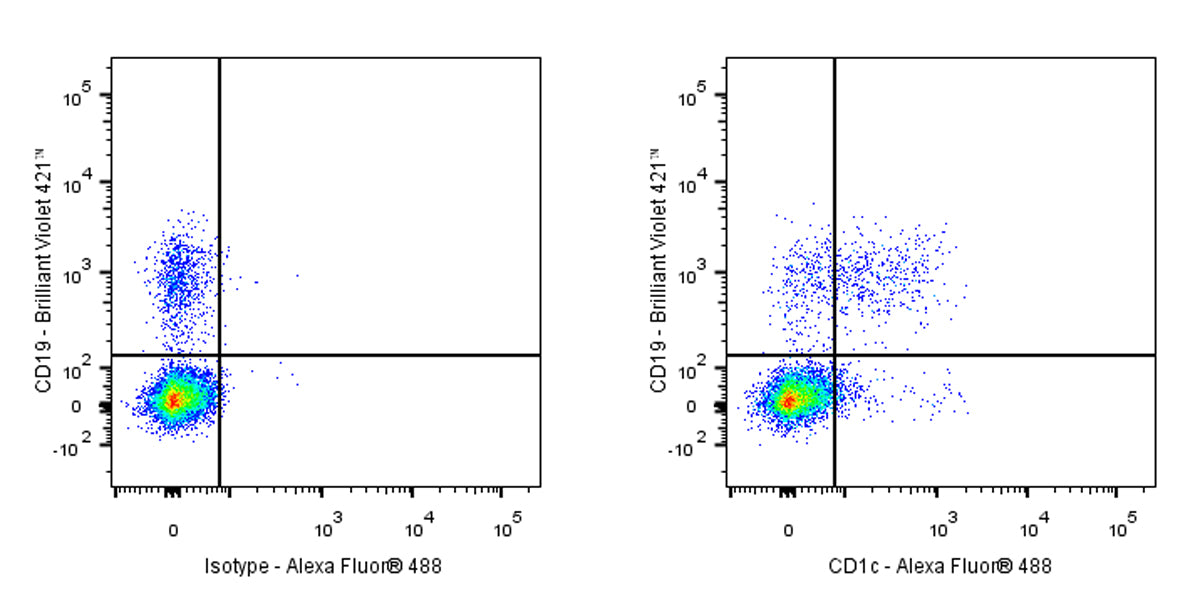
Flow cytometric analysis of Human PBMC (human peripheral blood mononuclear cells) labelling Human CD1c antibody at 1/200 dilution (1 μg) / (Right panel) compared with a Mouse IgG1, κ Isotype Control / (Left panel). Goat Anti-Mouse IgG Alexa Fluor® 488 was used as the secondary antibody. Then cells were stained with CD19 - Brilliant Violet 421™ Antibody separately.
Mouse Anti-Human CD1c Antibody (L161)
Mouse Anti-Human CD1c Antibody (L161)
Price:
Regular price
$100 USD
Regular price
Sale price
$100 USD
Unit price
per
For shipping services or bulk orders, you may request a quotation.
Secure checkout with

View full details
Product Details
Product Details
Product Specification
| Host | Mouse |
| Antigen | CD1c |
| Synonyms | T-cell surface glycoprotein CD1c; CD1C |
| Location | Cell membrane |
| Accession | P29017 |
| Clone Number | L161 |
| Antibody Type | Mouse mAb |
| Isotype | IgG1,k |
| Application | FCM |
| Reactivity | Hu |
| Positive Sample | Human PBMC |
| Purification | Protein G |
| Concentration | 2 mg/ml |
| Conjugation | Unconjugated |
| Physical Appearance | Liquid |
| Storage Buffer | PBS pH7.4 |
| Stability & Storage | 12 months from date of receipt / reconstitution, 2 to 8 °C as supplied |
Dilution
| application | dilution | species |
| FCM | 1:200 | Hu |
Background
CD1c is a lipid-presenting, MHC class I-like glycoprotein expressed on dendritic cells and B cells that binds both self and foreign lipids/glycolipids within its deep hydrophobic groove and shuttles them through endosomal compartments to display them to αβ and γδ T cells, thereby bridging innate and adaptive immunity; uniquely, its open F′ pocket can accommodate both lipid tails and peptide moieties of lipopeptides, enabling recognition of mycobacterial antigens such as mannosyl-β1-phosphomycoketide and driving potent IFN-γ responses essential for controlling intracellular pathogens like Mycobacterium tuberculosis.
Picture
Picture
FC