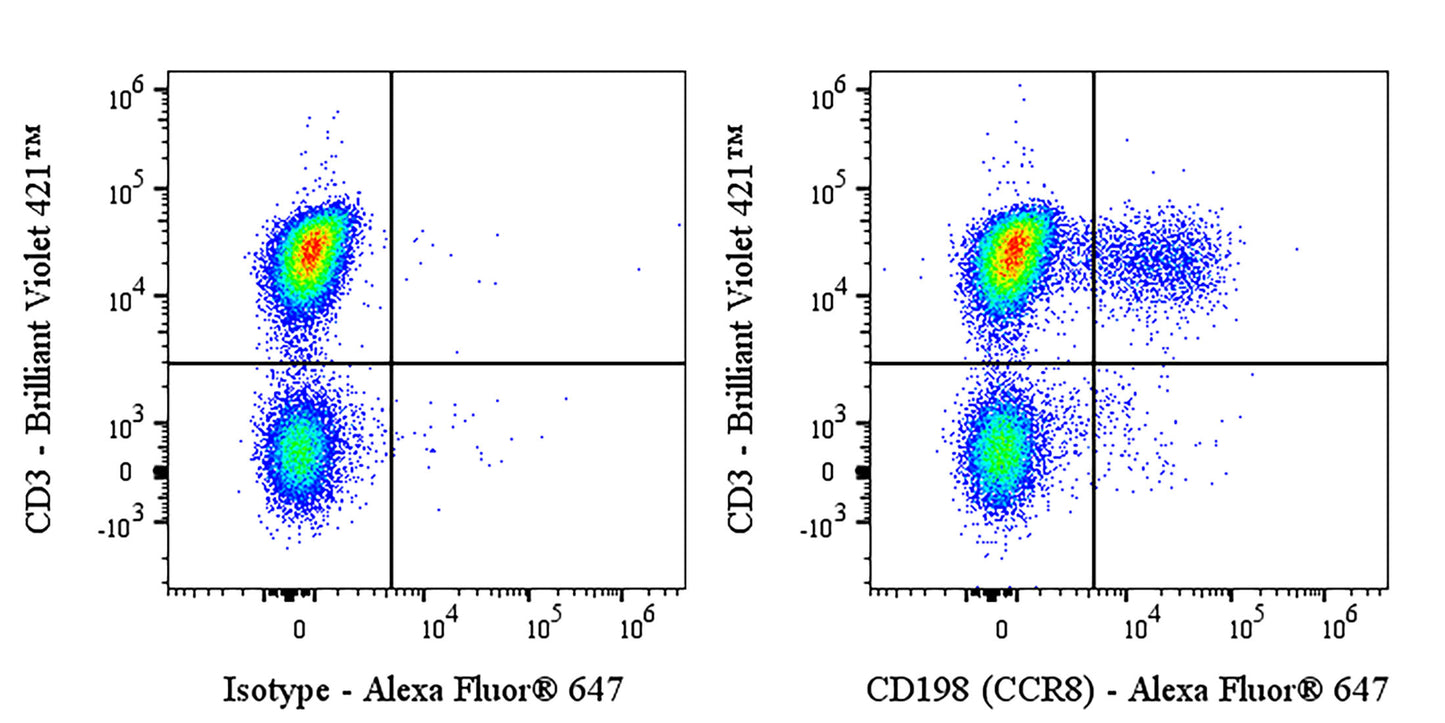
Flow cytometric analysis of human peripheral blood lymphocytes labeled with anti - Human CD198 antibody at 1/400 dilution (0.5 μg) / (Right panel) compared with a Mouse IgG2a, κ Isotype Control / (left panel). Goat Anti-Mouse IgG Alexa Fluor® 647 was used as the secondary antibody. Then cells were stained with CD3 - Brilliant Violet 421™ antibody separately. Total viable cells, as determined by Fixable Viability Dye 515 (S0D0013), were used for analysis. Flow cytometry and data analysis were performed using Agilent NovoCyte Quanteon and FlowJo™ software.
Mouse Anti-Human CD198 (CCR8) Antibody (S-4829)
Mouse Anti-Human CD198 (CCR8) Antibody (S-4829)
Price:
Regular price
$100 USD
Regular price
Sale price
$100 USD
Unit price
per
For shipping services or bulk orders, you may request a quotation.
Secure checkout with

View full details
Product Details
Product Details
Product Specification
| Host | Mouse |
| Antigen | CD198 (CCR8) |
| Synonyms | C-C chemokine receptor type 8; C-C CKR-8; CC-CKR-8; CCR-8; CC chemokine receptor CHEMR1; CMKBRL2; Chemokine receptor-like 1 (CKR-L1); GPR-CY6 (GPRCY6); TER1; CDw198; CKRL1; CMKBR8 |
| Location | Cell membrane |
| Accession | P51685 |
| Clone Number | S-4829 |
| Antibody Type | Mouse mAb |
| Isotype | IgG2a,k |
| Isotype Control | S0B0678 |
| Application | FCM |
| Reactivity | Hu |
| Positive Sample | Human peripheral blood lymphocytes |
| Purification | Protein A |
| Concentration | 2 mg/ml |
| Conjugation | Unconjugated |
| Physical Appearance | Liquid |
| Storage Buffer | PBS pH7.4 |
| Stability & Storage | 12 months from date of receipt / reconstitution, 2 to 8 °C as supplied |
Dilution
| application | dilution | species |
| FCM | 1:400 | Hu |
Background
CD198, also known as C-C chemokine receptor type 8 (CCR8) or CDw198, is a seven-transmembrane G protein-coupled receptor (GPCR) encoded by a gene located on human chromosome 3p21.3, with a molecular weight of approximately 41 kDa. This receptor is primarily expressed on the surface of regulatory T cells (Tregs), thymocytes, Th2-polarized cells, NKT cells, as well as some monocytes/macrophages and dendritic cells. Its high-affinity ligand is CCL1, and upon binding, it mediates chemotaxis to recruit immune cells to inflammatory sites and participates in the regulation of thymocyte apoptosis. In terms of pathophysiology, CD198 exhibits specific high expression on Treg cells within the tumor microenvironment, while its expression is very low in peripheral blood and normal tissues, making it an important target for selectively depleting tumor-infiltrating Tregs and relieving tumor immunosuppression. Additionally, CD198 plays a role in allergic diseases and can serve as a co-receptor for HIV-1 infection. Therefore, antibody drugs targeting CD198—particularly monoclonal antibodies that selectively deplete tumor-infiltrating Tregs through Fc-mediated ADCC activity—are being widely developed as an emerging strategy for next-generation cancer immunotherapy.
Picture
Picture
FC