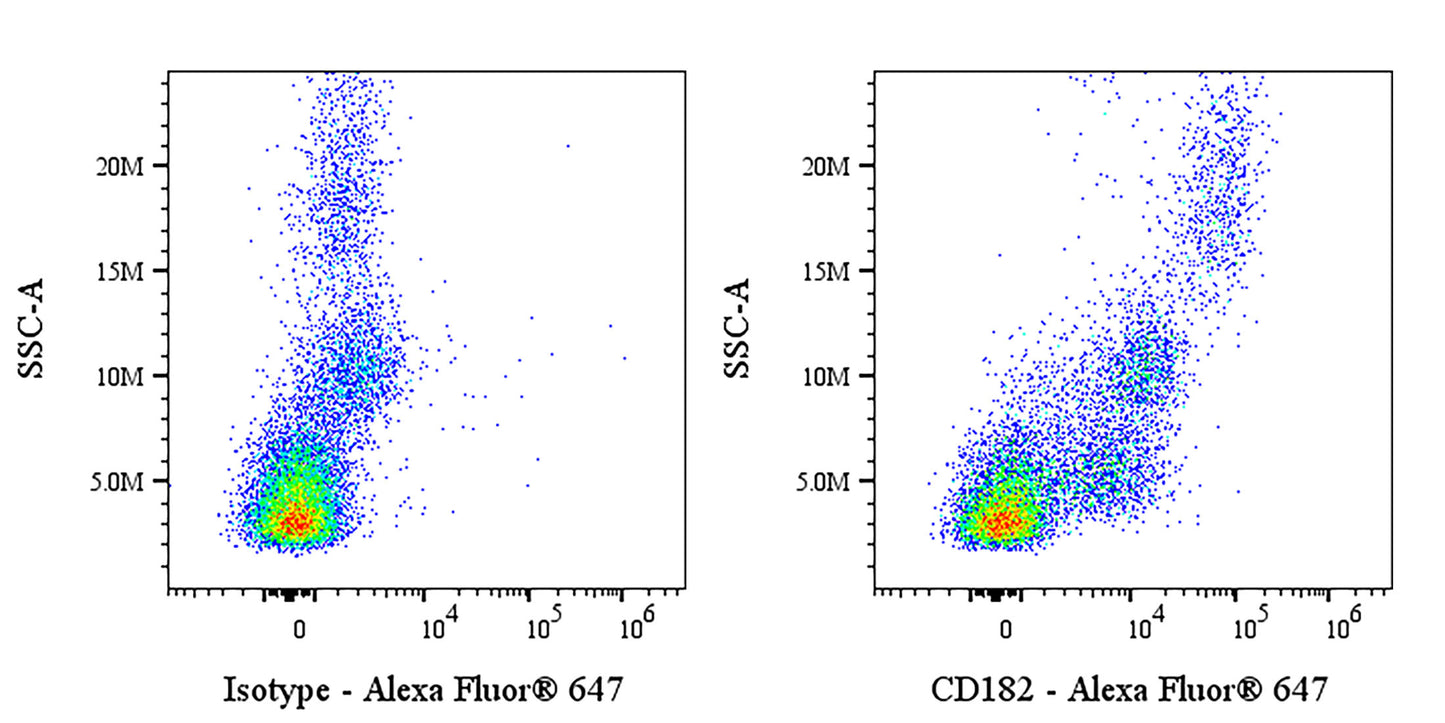
Flow cytometric analysis of human peripheral blood cells labeled with anti - Human CD182 antibody at 1/400 dilution (0.5 μg) / (right panel) compared with a Mouse IgG1,λ Isotype Control / (left panel). Goat Anti-Mouse IgG Alexa Fluor® 647 was used as the secondary antibody. Flow cytometry and data analysis were performed using Agilent NovoCyte Quanteon and FlowJo™ software.
Mouse Anti-Human CD182 Antibody (S-4787)
Mouse Anti-Human CD182 Antibody (S-4787)
Price:
Regular price
$100 USD
Regular price
Sale price
$100 USD
Unit price
per
For shipping services or bulk orders, you may request a quotation.
Secure checkout with

View full details
Product Details
Product Details
Product Specification
| Host | Mouse |
| Antigen | CD182 |
| Synonyms | C-X-C chemokine receptor type 2; CXC-R2; CXCR-2; CDw128b; GRO/MGSA receptor; High affinity interleukin-8 receptor B (IL-8R B); IL-8 receptor type 2; IL8RB; CXCR2 |
| Location | Cell membrane |
| Accession | P25025 |
| Clone Number | S-4787 |
| Antibody Type | Mouse mAb |
| Isotype | IgG1,λ |
| Application | FCM |
| Reactivity | Hu |
| Positive Sample | Human peripheral blood cells |
| Purification | Protein G |
| Concentration | 2 mg/ml |
| Conjugation | Unconjugated |
| Physical Appearance | Liquid |
| Storage Buffer | PBS pH7.4 |
| Stability & Storage | 12 months from date of receipt / reconstitution, 2 to 8 °C as supplied |
Dilution
| application | dilution | species |
| FCM | 1:400 | Hu |
Background
CD182, also known as C-X-C chemokine receptor type 2 (CXCR2) or IL-8 receptor beta, is a seven-transmembrane G protein-coupled receptor (GPCR) encoded by 11 exons, located on human chromosome 2q35, with a molecular weight of approximately 67-70 kDa. This receptor is primarily expressed on the surface of neutrophils, NK cells, monocytes, mast cells, and some T cells, and binds to its high-affinity ligands (such as IL-8, CXCL1, CXCL2, CXCL3, etc.). Upon activation, CD182 mediates intracellular signaling via G proteins, primarily driving the chemotactic migration of neutrophils and other immune cells to sites of inflammation, while also playing key roles in regulating cell activation, proliferation, and angiogenesis. In terms of pathophysiology, CD182 is not only involved in host immune surveillance against infections but also closely associated with tumor immune escape—within the tumor microenvironment, the CXCR2 signaling axis promotes the recruitment of immunosuppressive cells such as myeloid-derived suppressor cells (MDSCs) and regulates the polarization of tumor-associated macrophages (TAMs), thereby inhibiting anti-tumor immune responses and promoting tumor growth and metastasis. Therefore, CD182 has become an important potential target for drug development in cancer immunotherapy and chronic inflammatory diseases.
Picture
Picture
FC