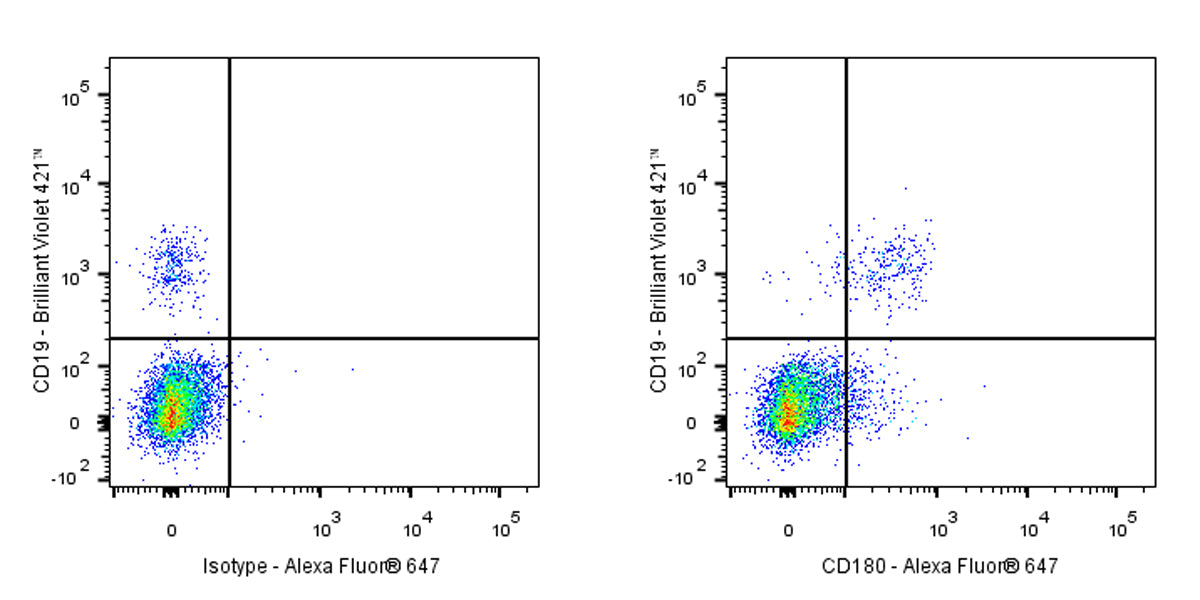
Flow cytometric analysis of human peripheral blood leukocytes labelling Human CD180 antibody at 1/200 dilution (1 μg) / (Right panel) compared with a Mouse IgG1, κ Isotype Control / (Left panel). Goat Anti-Mouse IgG Alexa Fluor® 647 was used as the secondary antibody. Then cells were stained with CD19 - Brilliant Violet 421™ Antibody separately.
Mouse Anti-Human CD180 Antibody (G28-8)
Mouse Anti-Human CD180 Antibody (G28-8)
Price:
Regular price
$100 USD
Regular price
Sale price
$100 USD
Unit price
per
For shipping services or bulk orders, you may request a quotation.
Secure checkout with

View full details
Product Details
Product Details
Product Specification
| Host | Mouse |
| Antigen | CD180 |
| Synonyms | CD180 antigen; Lymphocyte antigen 64; Radioprotective 105 kDa protein; LY64; RP105 |
| Location | Cell membrane |
| Accession | Q99467 |
| Clone Number | G28-8 |
| Antibody Type | Mouse mAb |
| Isotype | IgG1,k |
| Application | FCM |
| Reactivity | Hu |
| Positive Sample | Human peripheral blood leukocytes |
| Purification | Protein G |
| Concentration | 2 mg/ml |
| Conjugation | Unconjugated |
| Physical Appearance | Liquid |
| Storage Buffer | PBS pH7.4 |
| Stability & Storage | 12 months from date of receipt / reconstitution, 2 to 8 °C as supplied |
Dilution
| application | dilution | species |
| FCM | 1:200 | Hu |
Background
CD180, also known as RP105, is a cell-surface glycoprotein of the Toll-like receptor (TLR) family that consists of extracellular leucine-rich repeats and a short cytoplasmic tail, and, when paired with its accessory molecule MD-1, forms the RP105/MD-1 receptor complex that collaborates with TLR4 to recognize bacterial lipopolysaccharide and regulate innate immune signaling in B cells, leading to NF-κB activation, control of B-cell proliferation, and modulation of life-or-death decisions, while its dysfunction is implicated in diseases such as chronic lymphocytic leukemia and Kawasaki disease.
Picture
Picture
FC