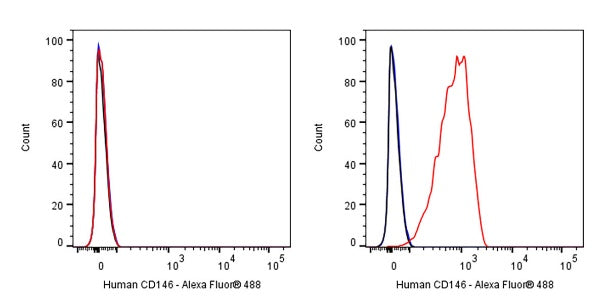
Flow cytometric analysis of LNCAP (Human prostate carcinoma epithelial cell, left) / HeLa (Human cervix adenocarcinoma epithelial cell, right) labelling CD146 antibody at 1/2000 dilution (0.1 μg) / (Red) compared with a Mouse IgG1, κ IgG (Black) isotype control and an unlabelled control (cells without incubation with primary antibody and secondary antibody) (Blue). Goat Anti - Mouse IgG Alexa Fluor® 488 was used as the secondary antibody.
Negative control: LNCAP
Mouse Anti-Human CD146 Antibody (S-3679)
Mouse Anti-Human CD146 Antibody (S-3679)
Price:
Regular price
$100 USD
Regular price
Sale price
$100 USD
Unit price
per
For shipping services or bulk orders, you may request a quotation.
Secure checkout with

View full details
Product Details
Product Details
Product Specification
| Host | Mouse |
| Antigen | CD146 |
| Synonyms | Cell surface glycoprotein MUC18; Cell surface glycoprotein P1H12; Melanoma cell adhesion molecule; Melanoma-associated antigen A32; Melanoma-associated antigen MUC18; S-endo 1 endothelial-associated antigen; MUC18; MCAM |
| Location | Membrane |
| Accession | P43121 |
| Clone Number | S-3679 |
| Antibody Type | Mouse mAb |
| Isotype | IgG1,k |
| Application | FCM |
| Reactivity | Hu |
| Positive Sample | HeLa |
| Purification | Protein G |
| Concentration | 2 mg/ml |
| Conjugation | Unconjugated |
| Physical Appearance | Liquid |
| Storage Buffer | PBS pH7.4 |
| Stability & Storage | 12 months from date of receipt / reconstitution, 2 to 8 °C as supplied |
Dilution
| application | dilution | species |
| FCM | 1:2000 | Hu |
Background
CD146, also known as melanoma cell adhesion molecule (MCAM), is a 113-kDa, heavily glycosylated type-I transmembrane glycoprotein of the immunoglobulin superfamily that consists of five Ig-like domains (V-V-C2-C2-C2), a single transmembrane segment and a cytoplasmic tail existing in a long and a short splice isoform; initially identified on melanoma cells, it now is recognized as a multifunctional adhesion and signaling receptor widely expressed on endothelial cells, pericytes, smooth muscle, activated T cells and various stem cells that, through homophilic interactions and ligands such as laminin-411, Wnt5a and galectin-1, orchestrates angiogenesis, vascular integrity, cell migration, immune-cell trafficking and epithelial–mesenchymal transition, while its overexpression and elevated glycosylation in melanoma, renal, prostate, lung, pancreatic and other cancers correlate with tumor progression, metastasis and poor prognosis, and its soluble ectodomain (sCD146) released by metalloprotease shedding functions as a circulating biomarker, making CD146 a valuable diagnostic and therapeutic target in oncology and inflammatory diseases.
Picture
Picture
FC