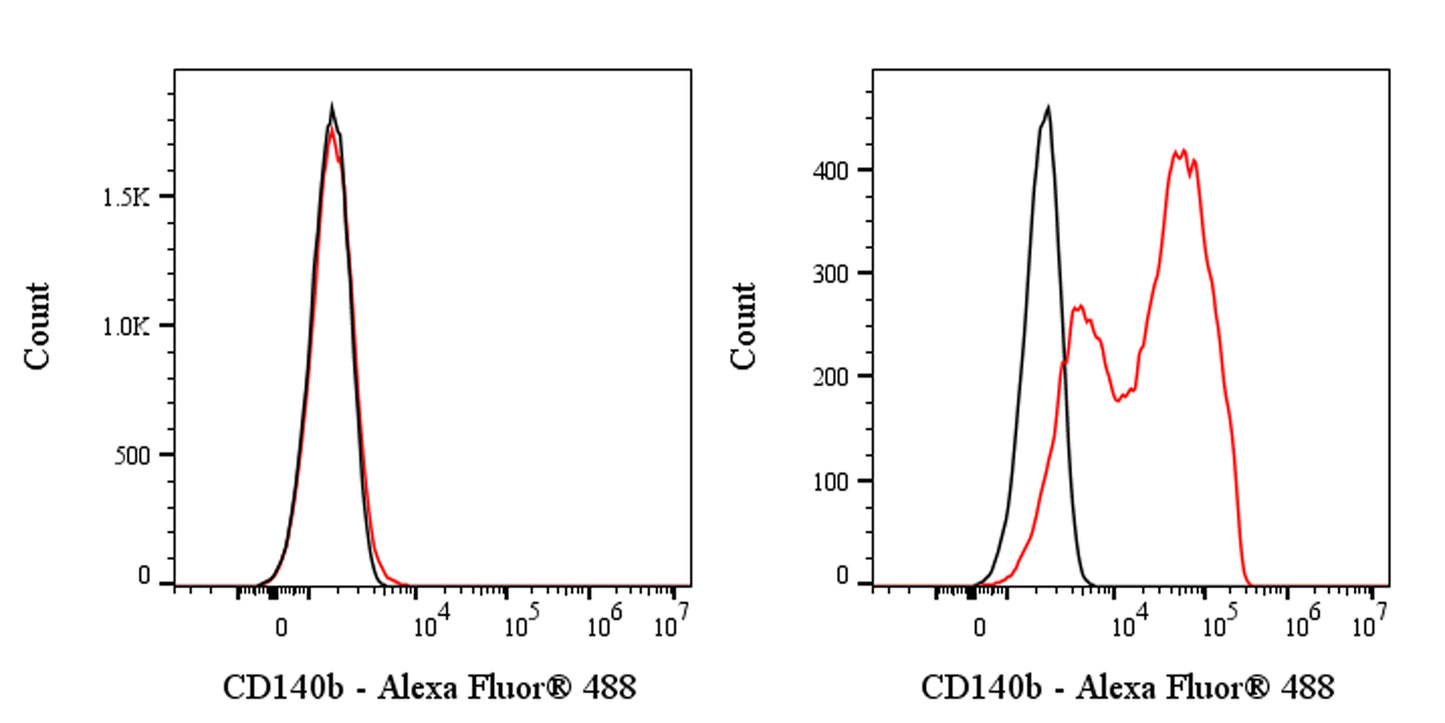
Flow cytometric analysis of 293F (Human embryonic kidney epithelial cell, left) / CD140b transfected 293F (right) labelled with CD140b antibody at 1/200 dilution (1 μg) / (red) compared with a Mouse IgG2a, κ(black) Isotype Control. Goat Anti - Mouse IgG Alexa Fluor® 488 was used as the secondary antibody. Flow cytometry and data analysis were performed using Agilent NovoCyte Quanteon and FlowJo™ software.
Negative control: 293F
Mouse Anti-Human CD140b Antibody (S-3078)
Mouse Anti-Human CD140b Antibody (S-3078)
Price:
Regular price
$45 USD
Regular price
Sale price
$45 USD
Unit price
per
For shipping services or bulk orders, you may request a quotation.
Secure checkout with

View full details
Product Details
Product Details
Product Specification
| Host | Mouse |
| Antigen | CD140b |
| Synonyms | Platelet-derived growth factor receptor beta; PDGF-R-beta; PDGFR-beta; Beta platelet-derived growth factor receptor; Beta-type platelet-derived growth factor receptor; CD140 antigen-like family member B; Platelet-derived growth factor receptor 1 (PDGFR-1); PDGFR; PDGFR1; PDGFRB |
| Location | Cell membrane |
| Accession | P09619 |
| Clone Number | S-3078 |
| Antibody Type | Mouse mAb |
| Isotype | IgG2a,k |
| Application | FCM |
| Reactivity | Hu |
| Positive Sample | CD104b transfected 293F |
| Purification | Protein A |
| Concentration | 2 mg/ml |
| Conjugation | Unconjugated |
| Physical Appearance | Liquid |
| Storage Buffer | PBS pH7.4 |
| Stability & Storage | 12 months from date of receipt / reconstitution, 2 to 8 °C as supplied |
Dilution
| application | dilution | species |
| FCM | 1:200 | Hu |
Background
CD140b, also known as Platelet-Derived Growth Factor Receptor Beta (PDGFR-β), is a transmembrane receptor tyrosine kinase encoded by the PDGFRB gene in humans, playing a pivotal role in regulating cell proliferation, migration, survival, and differentiation, particularly within mesenchymal lineages such as vascular smooth muscle cells, pericytes, and fibroblasts. Structurally, it consists of an extracellular ligand-binding domain, a single transmembrane helix, and an intracellular tyrosine kinase domain that becomes activated upon binding to specific dimeric isoforms of platelet-derived growth factor (primarily PDGF-BB and PDGF-DD), triggering autophosphorylation and the subsequent recruitment of downstream signaling molecules involved pathways like PI3K/AKT, RAS/MAPK, and PLCγ. This receptor is essential for normal embryonic development, especially in the formation of the cardiovascular system and kidney, while its dysregulation or overexpression is strongly implicated in various pathological conditions, including atherosclerosis, pulmonary hypertension, fibrotic diseases, and certain malignancies such as gliomas and chronic myelomonocytic leukemia, making it a significant therapeutic target for tyrosine kinase inhibitors like imatinib.
Picture
Picture
FC