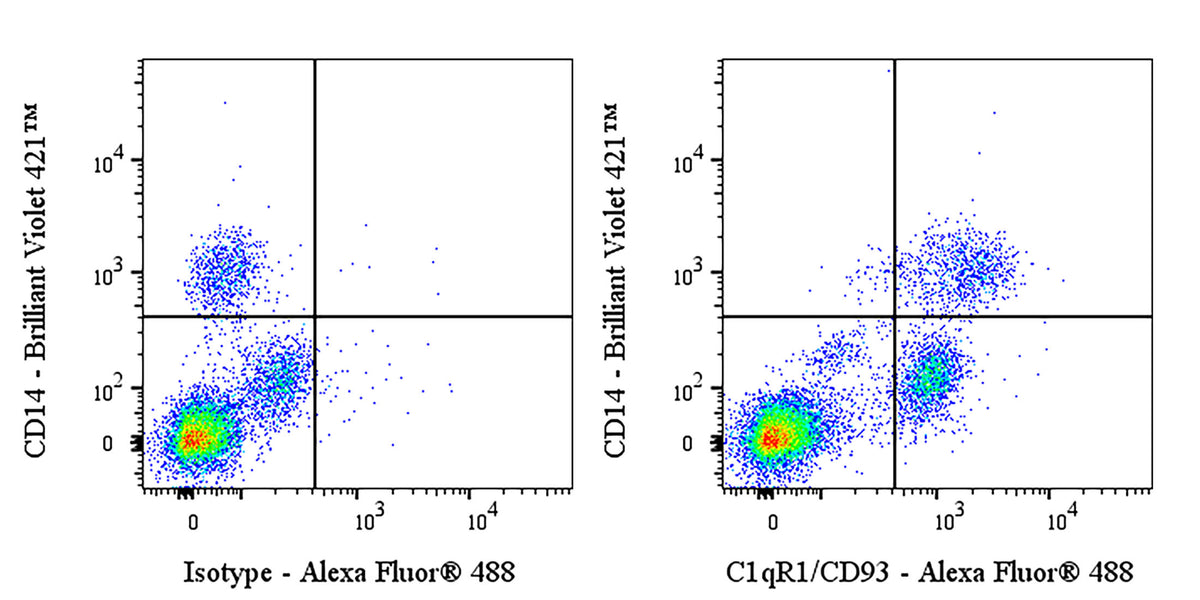
Flow cytometric analysis of human peripheral blood cells labeled with Anti-Human C1qR1/CD93 antibody at 1/200 dilution (1 μg) / (right panel) compared with a Mouse IgG1 Isotype Control / (left panel). Goat Anti-Mouse IgG Alexa Fluor® 488 was used as the secondary antibody. Then cells were stained with CD14 - Brilliant Violet 421™ antibody separately. Flow cytometry and data analysis were performed using BD FACSymphony™ A1 and FlowJo™ software.
Mouse Anti-Human C1qR1/CD93 Antibody (VIMD)
Mouse Anti-Human C1qR1/CD93 Antibody (VIMD)
Price:
Regular price
$100 USD
Regular price
Sale price
$100 USD
Unit price
per
For shipping services or bulk orders, you may request a quotation.
Secure checkout with

View full details
Product Details
Product Details
Product Specification
| Host | Mouse |
| Antigen | C1qR1/CD93 |
| Synonyms | Complement component C1q receptor; C1q/MBL/SPA receptor (C1qR; C1qR(p); C1qRp); CDw93; Complement component 1 q subcomponent receptor 1; Matrix-remodeling-associated protein 4; C1QR1; MXRA4 |
| Location | Cell membrane |
| Accession | Q9NPY3 |
| Clone Number | VIMD |
| Antibody Type | Mouse mAb |
| Isotype | IgG1 |
| Isotype Control | S0B0617 |
| Application | FCM |
| Reactivity | Hu |
| Positive Sample | Human peripheral blood cells |
| Purification | Protein A |
| Concentration | 2 mg/ml |
| Conjugation | Unconjugated |
| Physical Appearance | Liquid |
| Storage Buffer | PBS pH7.4 |
| Stability & Storage | 12 months from date of receipt / reconstitution, 2 to 8 °C as supplied |
Dilution
| application | dilution | species |
| FCM | 1:200 | Hu |
Background
C1qR1, also known as CD93, is a type I transmembrane glycoprotein primarily expressed on the surface of myeloid cells, endothelial cells, platelets, and hematopoietic stem cells. This protein was initially identified as a receptor for complement C1q, but subsequent studies have suggested that its binding to C1q may only occur under non-physiological conditions, and its more core functional roles involve cell–cell adhesion, clearance of apoptotic cells, and maintenance of plasma cells within the bone marrow niche. As a highly glycosylated protein, the molecular weight of C1qR1 is considerably higher than its predicted value based on amino acid sequence (approximately 66 kDa), with an observed apparent molecular weight of 120–140 kDa in experiments. Its structure comprises a C-type lectin-like domain responsible for ligand binding and multiple epidermal growth factor-like domains, and its cytoplasmic tail can interact with moesin—a cytoskeleton-linking protein—participating in cytoskeletal remodeling. Due to its expression profile and functional characteristics, C1qR1 not only serves as a marker for various cell types but also represents an important molecule in regulating innate immune responses and hematopoietic homeostasis.
Picture
Picture
FC