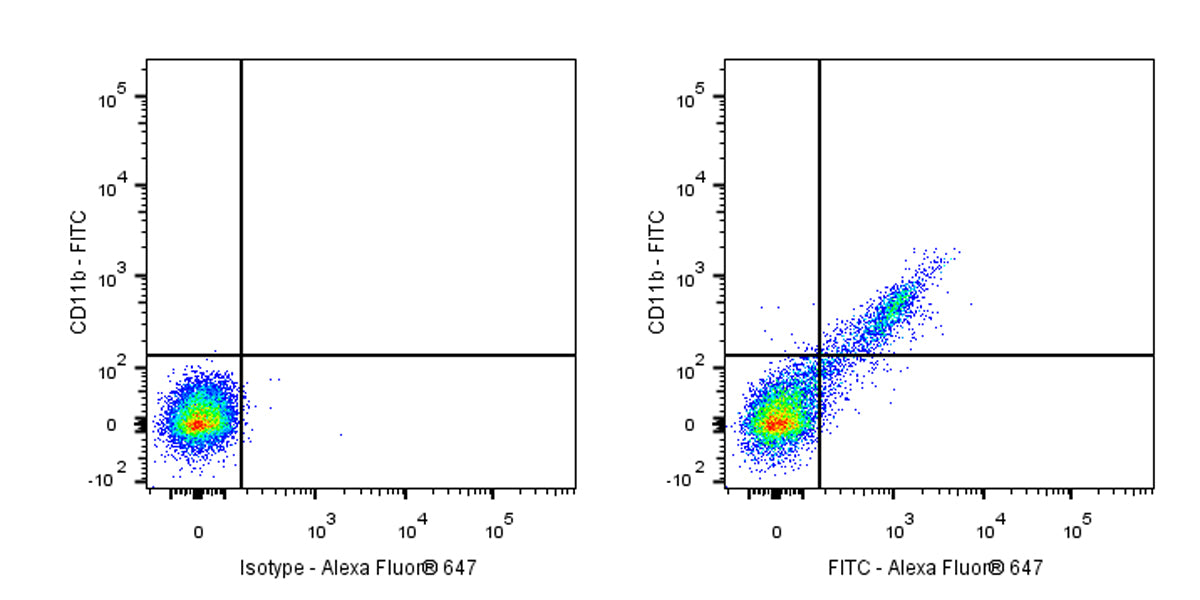
Human peripheral blood leukocytes labelled FITC Mouse Anti-Human CD11b Antibody (S0B5859) antibody and then stained with Mouse Anti-FITC Antibody at 1/200 dilution (1 μg) / (Right panel) compared with a Mouse IgG1, λ Isotype Control / (Left panel). Goat Anti-Mouse IgG Alexa Fluor® 647 was used as the tertiary antibody.
Mouse Anti-FITC Antibody (S-3491)
Mouse Anti-FITC Antibody (S-3491)
Price:
Regular price
$45 USD
Regular price
Sale price
$45 USD
Unit price
per
For shipping services or bulk orders, you may request a quotation.
Secure checkout with

View full details
Product Details
Product Details
Product Specification
| Host | Mouse |
| Antigen | FITC |
| Clone Number | S-3491 |
| Antibody Type | Mouse mAb |
| Isotype | IgG1,λ |
| Application | FCM, ICFCM |
| Reactivity | Species Independent |
| Purification | Protein G |
| Concentration | 2 mg/ml |
| Conjugation | Unconjugated |
| Physical Appearance | Liquid |
| Storage Buffer | PBS pH7.4 |
| Stability & Storage | 12 months from date of receipt / reconstitution, 2 to 8 °C as supplied |
Dilution
| application | dilution | species |
| ICFCM | 1:200 | Species Independent |
| FCM | 1:200 | Species Independent |
Background
Anti-FITC antibody is a highly specific immunoglobulin designed to recognize and bind with high affinity to fluorescein isothiocyanate (FITC), a commonly used small-molecule fluorescent dye. This antibody does not directly target natural biomolecules but serves as a universal "bridge" or "capture" tool, playing a central role in biological research and detection. Its mechanism relies on covalently conjugating the FITC molecule in advance to any target molecule (such as proteins, nucleic acids, or cell surface antigens), thereby "labeling" the target as FITC-tagged. Subsequently, the anti-FITC antibody can precisely capture these FITC-labeled complexes via its antigen-binding site. This property makes it widely applicable in flow cytometry, immunofluorescence, Western blot, ELISA, and emerging super-resolution microscopy techniques. It can be used not only for detection but also for signal conversion and amplification by conjugating the anti-FITC antibody to enzymes, magnetic beads, or other fluorophores (for signal cascading). Since it targets a stable artificial hapten (FITC) rather than variable natural epitopes, this antibody typically demonstrates exceptional batch-to-batch consistency, high affinity, and low background noise, making it a key reagent in multiplex detection (when paired with differently dye-labeled anti-FITC antibodies) and the construction of universal detection platforms.
Picture
Picture
FC