Standard curve
Example of Monkey IL-1β standard curve in Assay Diluent GB4E5.
Monkey IL-1β OneStep ELISA Kit
Monkey IL-1β OneStep ELISA Kit
Price:
Regular price
$500 USD
Regular price
Sale price
$500 USD
Unit price
per
For shipping services or bulk orders, you may request a quotation.
Secure checkout with

View full details
Product Details
Product Details
Product Specification
| Antigen | IL-1β |
| Immunogen | Recombinant Protein |
| Antibody Type | Recombinant mAb |
| Reactivity | Mk |
| Purification | Protein A |
| Stability & Storage | 12 months from date of receipt / reconstitution, 2 to 8°C as supplied. |
Kit
| Precision | Intra-assay: 1.5% Inter-assay: 2.0% |
| Sample type | Cell culture supernatant; Serum; Plasma |
| Assay type | Sandwich (quantitative) |
| Sensitivity | 0.170 ng/mL |
| Range | 0.31 ng/mL – 20 ng/mL |
| Recovery | Cell culture supernatant: 116% Monkey Serum: 93% EDTA Plasma: 100% Heparin Plasma: 109% |
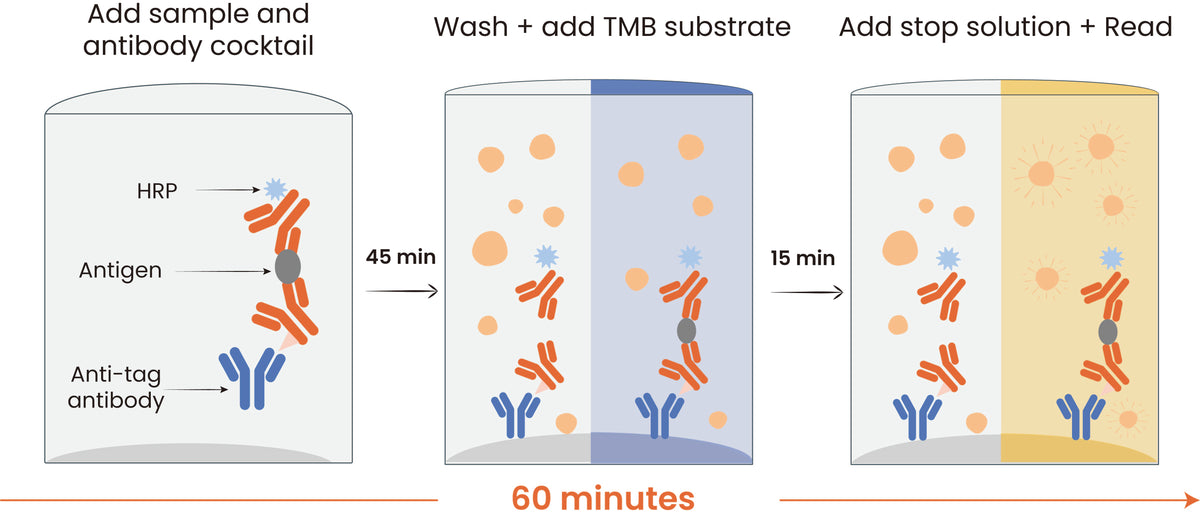
| Assay time | 60 minutes |
| Species reactivity | Mk; Hu |
Background
Monkey IL-1β (interleukin-1 beta) is a recombinant cytokine derived from non-human primates such as cynomolgus or rhesus macaques. As a key mediator of innate immunity, it plays a central role in promoting inflammatory responses to infection, tissue damage, and autoimmune stimuli. Due to its high structural and functional homology with human IL-1β, monkey IL-1β serves as a critical tool in translational research. It is widely used in immune cell activation assays, inflammasome studies, and preclinical evaluation of anti-inflammatory biologics. The protein’s strong cross-reactivity with human IL-1 receptors enables accurate modeling of human inflammatory diseases in primate systems, providing essential insights into drug efficacy and safety prior to clinical trials.
Picture
Picture
ELISA
Linearity
#1 sample is undiluted samples are as follows: Monkey PBMC cells stimulated with 10ug/ml PHA for 5days (100%). #2 sample is undiluted samples are as follows: Monkey PBMC cells culture for 5 days (100%).
Specificity
Example of Monkey IL-1β, Human IL-1β and Mouse IL-1β standard curve in Assay Diluent GB4E5.
Specificity
Test the specificity of different serum.
To assess the linearity of the assay, three samples were spiked with high concentrations of Monkey IL-1β in various matrices and diluted with the appropriate Calibrator Diluent to produce samples with values within the dynamic range of the assay.
Protocol Diagram