Standard curve
Example of Monkey IFN-γ standard curve in Assay Diluent EA4.
Monkey IFN-γ Serum & Plasma & Tissue Extracts OneStep ELISA Kit
Monkey IFN-γ Serum & Plasma & Tissue Extracts OneStep ELISA Kit
Price:
Regular price
$500 USD
Regular price
Sale price
$500 USD
Unit price
per
For shipping services or bulk orders, you may request a quotation.
Secure checkout with

View full details
Product Details
Product Details
Product Specification
| Antigen | IFN-γ |
| Immunogen | Recombinant Protein |
| Antibody Type | Recombinant mAb |
| Reactivity | Mk |
| Purification | Protein A |
| Stability & Storage | 12 months from date of receipt / reconstitution, 2 to 8°C as supplied. |
Kit
| Precision | Intra-assay: 4.0%; Inter-assay: 4.5% |
| Sample type | Serum; Plasma; Tissue Extracts |
| Assay type | Sandwich (quantitative) |
| Sensitivity | 4.867 pg/mL |
| Range | 15.63 pg/mL – 1000 pg/mL |
| Recovery | Serum: 105% EDTA Plasma: 118% Tissue Extracts: 100% |
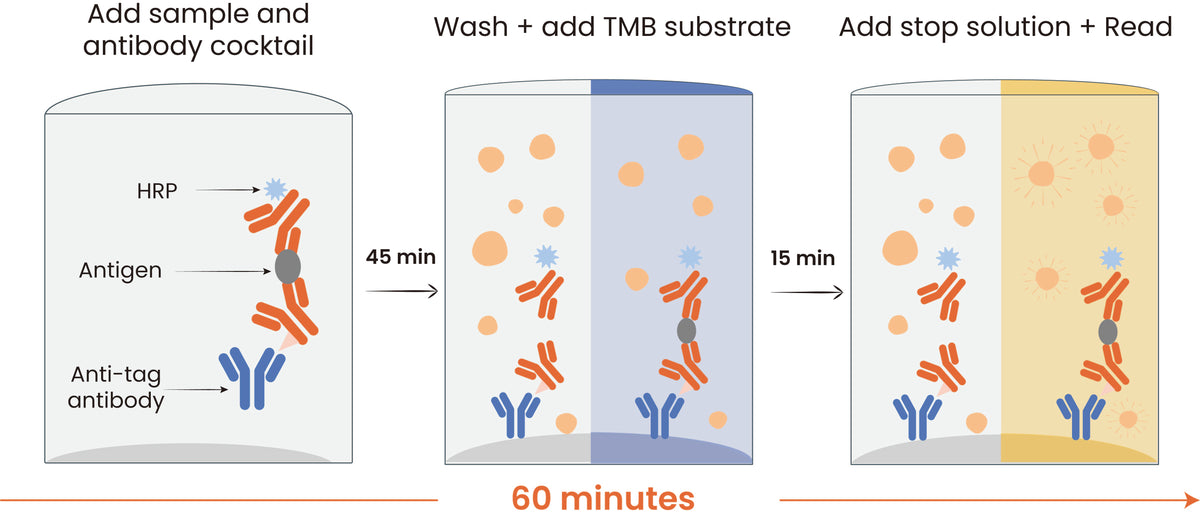
| Assay time | 60 minutes |
| Species reactivity | Mk |
Background
Monkey Interferon-gamma (IFN-γ) is a critical type II interferon that serves as a master regulator of innate and adaptive immunity; it is a dimerized cytokine produced predominantly by activated T lymphocytes and natural killer (NK) cells, and as the primary macrophage-activating factor, its central biological function is to promote cellular immunity against intracellular pathogens, particularly viruses and certain bacteria. Monkey IFN-γ exerts its effects by binding to a specific receptor complex, which leads to the upregulation of major histocompatibility complex (MHC) class I and II molecules to enhance antigen presentation, while also directly inhibiting viral replication, activating macrophages to kill phagocytosed pathogens, and promoting the differentiation of naïve T cells towards a Th1 phenotype. Due to the high genetic and physiological similarity between non-human primates and humans, monkey IFN-γ is widely used in preclinical research, particularly in vaccine development, infectious disease models (such as SIV), and immunotherapy studies, where its activity serves as a key biomarker for cellular immune responses.
Picture
Picture
ELISA
Specificity
Test the specificity of different serum.
Leading Competitor comparison
Protocol Diagram