Standard Curve
Example of Monkey GM-CSF standard curve in Assay Diluent E1. Plotted are the background-subtracted data.
This standard curve is provided for demonstration only.
Monkey GM-CSF Serum OneStep ELISA Kit
Monkey GM-CSF Serum OneStep ELISA Kit
Price:
Regular price
$670 USD
Regular price
Sale price
$670 USD
Unit price
per
For shipping services or bulk orders, you may request a quotation.
Secure checkout with

View full details
Product Details
Product Details
Product Specification
| Antigen | GM-CSF |
| Immunogen | Recombinant Protein |
| Antibody Type | Recombinant mAb |
| Reactivity | Mk |
| Purification | Protein A |
| Stability & Storage | 12 months from date of receipt / reconstitution, 2 to 8°C as supplied. |
Kit
| Precision | Intra-assay: 3.3% Inter-assay: 5.5% |
| Sample type | Serum |
| Assay type | Sandwich (quantitative) |
| Sensitivity | 1.50 pg/mL |
| Range | 10.9 pg/mL – 700 pg/mL |
| Recovery | Serum: 107% |
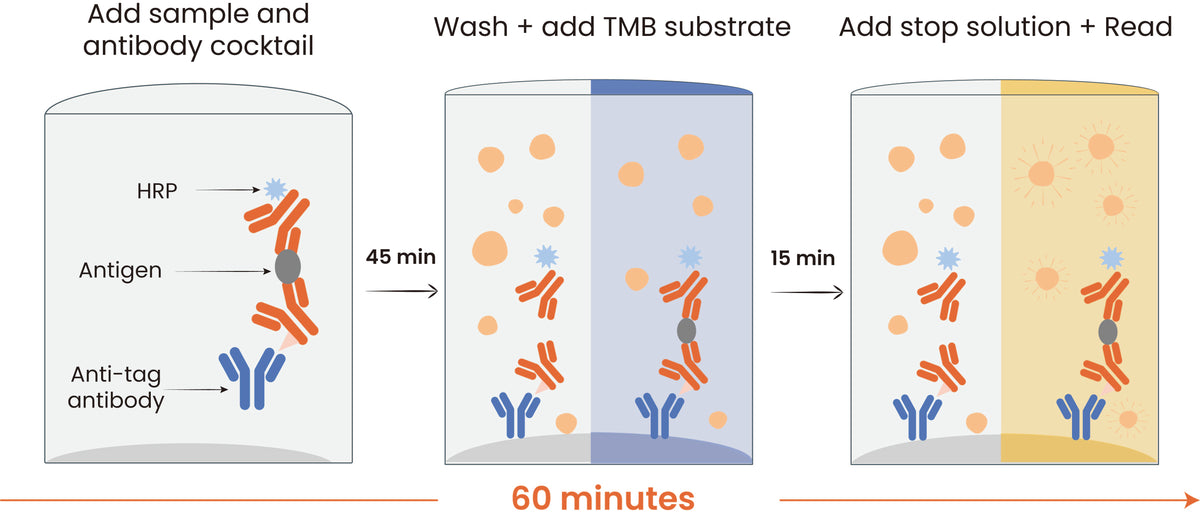
| Assay time | 60 minutes |
Background
Monkey granulocyte-macrophage colony-stimulating factor (GM-CSF) is a crucial cytokine that regulates the production, differentiation, and function of granulocytes and macrophages from hematopoietic progenitor cells. It is secreted by various cell types, including activated T cells, B cells, macrophages, mast cells, endothelial cells, and fibroblasts, in response to immune or inflammatory stimuli. The biologically active form of the protein exists extracellularly as a homodimer. Recombinant monkey GM-CSF, derived from species like cynomolgus or rhesus macaques, is typically a non-glycosylated polypeptide chain consisting of approximately 127 amino acids with a molecular weight of about 14.4 kDa. It is commonly produced in expression systems such as E. coli or yeast for research applications. The biological activity of these recombinant proteins is often confirmed by their ability to stimulate the proliferation of human TF-1 cells, with an ED50 typically less than 0.1 ng/mL. Due to its essential role in myelopoiesis and immune modulation, monkey GM-CSF serves as a valuable tool for studying hematopoietic development and inflammatory responses in non-human primate models.
Picture
Picture
ELISA
Spike Recovery
The recovery of Monkey GM-CSF was evaluated in activated samples spiked with concentrations spanning the entire assay range.
Cross-reactivity
The heatmap displays OD450 ratios for serum samples from multiple species. Color intensity is proportional to the O.D.450 ratio (test species / reference species). Darker colors indicate higher cross-reactivity.
Spike-and-dilution Linearity
To evaluate assay linearity, serum sample was spiked with high levels of Monkey GM-CSF in different matrices and serially diluted with the corresponding Calibrator Diluent to fall within the assay's dynamic range.
Cross-reactivity
The cross-reactivity among Mouse GM-CSF, Monkey GM-CSF, and Human GM-CSF was evaluated by testing them in the same assay system. Serial dilutions of each protein were measured, and the dose-response curves were compared. When Mouse GM-CSF was tested in the Monkey GM-CSF assay, no significant cross-reactivity was observed, and the signal remained within the background range of the assay. When Human GM-CSF was tested in the Monkey GM-CSF assay, significant cross-reactivity was observed.
Intra-Assay Precision (Precision within an assay)
Three samples of known concentration were tested fifteen times on one plate to assess intra-assay precision.
Inter-Assay Precision (Precision between assays)
Three samples of known concentration were tested in separate assays to assess inter-assay precision. Assays were performed with at least three lots of components.
Dilution Linearity
The concentrations of Monkey GM-CSF were measured and interpolated from the target standard curves and corrected for sample dilution.
The leftmost bar in the graph shows biological samples diluted in Assay Diluent to 25% concentration. "undiluted" was defined as 25% biological sample. The subsequent bars represent two-fold serial dilutions of this reference. The mean target concentration was determined to be 171.2 pg/mL in Monkey GM-CSF.
HOOK Effect Threshold
The upper limit of the HOOK effect was established at 100× the highest calibrator concentration (equivalent to a 2-log10 increase). No HOOK effect was observed below this threshold, confirming that samples within this concentration range yield reliable quantitative results without signal depression.
Determination of Minimum Detectable Dose (MDD)
The MDD was determined using three independent lots of assay components. For each lot, 19 replicate measurements of the diluent (zero calibrator) were performed. The mean (AVERAGE) and standard deviation (STDEV) of the 19 replicates were calculated. The MDD for each lot was then calculated according to the following formula:
MDD = 2 × STDEV + AVERAGE
Comparison of Standard Curves from Two Kits
Standard curves from Company A and Starter Onestep were compared.
Protocol Diagram