1μg (R: reducing condition, N: non-reducing condition).
MMP-9 His Tag Protein, Mouse
MMP-9 His Tag Protein, Mouse
Price:
Regular price
$270 USD
Regular price
Sale price
$270 USD
Unit price
per
For shipping services or bulk orders, you may request a quotation.
Secure checkout with

View full details
Product Details
Product Details
Product Specification
| Species | Mouse |
| Synonyms | MMP9, CLG4B, GELB, MANDP2, Gelatinase B |
| Accession | P41245 |
| Amino Acid Sequence | Ala20-Pro730 with His Tag at C-Terminus |
| Expression System | HEK293 |
| Molecular Weight | 100-130kDa (Reducing) |
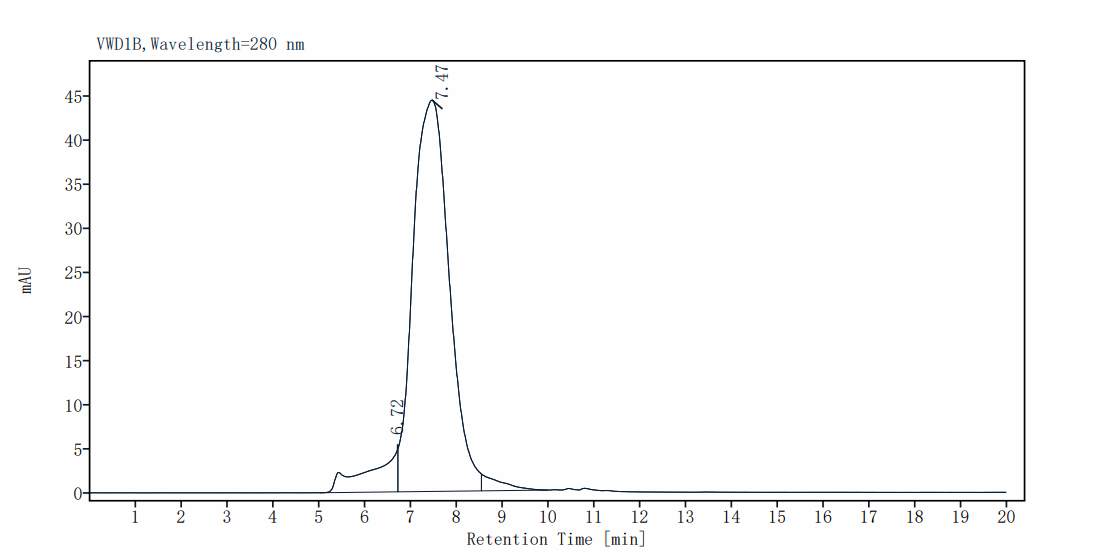
| Purity | > 95% by SDS-PAGE,>90% by HPLC |
| Endotoxin | <0.1EU/μg |
| Conjugation | Unconjugated |
| Tag | His Tag |
| Physical Appearance | Lyophilized powder |
| Storage Buffer | PBS, pH7.4, 5% trehalose |
| Reconstitution | Reconstitute at 0.1-1 mg/ml according to the size in ultrapure water after rapid centrifugation. |
| Stability & Storage | · 12 months from date of receipt, lyophilized powder stored at -20 to -80℃. |
| Reference | 1.Ji Y, Gao Q, Ma Y, Wang F, Tan X, Song D, Hoo RLC, Wang Z, Ge X, Han H, Guo F, Chang J. An MMP-9 exclusive neutralizing antibody attenuates blood-brain barrier breakdown in mice with stroke and reduces stroke patient-derived MMP-9 activity. Pharmacol Res. 2023 Apr;190:106720. |
Background
Matrix metalloproteinase 9 (MMP-9), also known as 92 kDa type IV collagenase, 92 kDa gelatinase, gelatinase B (GELB), or CLG4B, is secreted by neutrophils, macrophages, and various transformed cells. It is the most complex member of the MMP family in terms of domain structure and activity regulation.Structurally, MMP-9 can be divided into five distinct domains: a prodomain that is cleaved upon activation, a gelatin-binding domain consisting of three contiguous fibronectin type II units, a catalytic domain with the zinc-binding site, a proline-rich linker region, and a carboxyl-terminal hemopexin-like domain. This enzyme degrades various substrates, including gelatin, collagen types IV and V, and elastin.MMP-9 is implicated in a variety of autoimmune diseases, such as systemic lupus erythematosus, rheumatoid arthritis, and multiple sclerosis, and is considered a potential therapeutic target.
Protocol
Assay protocol
Principle: Measured by its ability to cleave a peptide substrate, Mca-PLGL-Dpa-AR-NH2.
Materials
1.Assay Buffer: 50 mM Tris, 10 mM CaCl2, 150 mM NaCl, 0.05% (w/v) Brij 35, pH 7.5 (TCNB)
2.MMP-9 His Tag Protein, Mouse
3.p-aminophenylmercuric acetate (APMA) (Aladdin, Catalog # P649286)
4.Fluorogenic Peptide Substrate: MCA-Pro-Leu-Gly-Leu-DPA-Ala-Arg-NH2 (R&D, ES001)
5.Calibration standard: MCA-Pro-Leu-OH (Shyuanye, T77046)
6.96 ELISA Removable Plate, Black, High binding (GENEVER, Catalog # GMO2-96H)
7.Plate Reader (PerkinElmer, excitation 320 nm, and emission 405 nm)
Produce
1.Activate MMP-9 at 100 μg/mL with 1 mM APMA in Assay Buffer. Incubate at 37 ℃ for 1 hour.
2.Dilute activated MMP-9 (From the step 2) to 0.8, 0.4 and 0.2 μg/mL in Assay Buffer.
3.Dilute Substrate to 20 μM in Assay Buffer.
4.Load 50 μL of the dilute MMP-9 Protein (From the step 2) into a black well plate and start the reaction by adding 50 μL of 20 μM Substrate. Include a Substrate with Assay Buffer as Blank.
5.Read at excitation and emission wavelengths of 320 nm and 405 nm, kinetic mode, 60s/cycle, 20 cycles.
6.Calculate specific activity.
• Standard Curve
1. Dilute Calibration standard to 10 μM in Assay Buffer and prepare serial dilutions.
2. Add 100 μL of each serially diluted standard and blank (Assay buffer) into appropriate wells of a 96-well, the standard curve has a range of 1000, 500, 250, 125, 62.5, 31.25, 15.625 pmol per well.
3. Read at excitation and emission wavelengths of 320 nm and 405 nm, respectively in endpoint mode.
4. Linear Regression of MCA-Pro-Leu-OH (pmol)(y) – RFU-Blank(x).
Specific Activity (pmol/min/µg) = |
Adjusted Vmax (RFU/min) x Conversion Factor (pmol/RFU) |
amount of enzyme (µg) |
Picture
Picture
SDS-PAGE
SEC-HPLC
The purity of MMP-9 His Tag Protein, Mouse is more than 90 % as determined by SEC-HPLC.