2μg (R: reducing condition, N: non-reducing condition).
MMP-8 His Tag Protein, Human
MMP-8 His Tag Protein, Human
Price:
Regular price
$215 USD
Regular price
Sale price
$215 USD
Unit price
per
For shipping services or bulk orders, you may request a quotation.
Secure checkout with

View full details
Product Details
Product Details
Product Specification
| Species | Human |
| Synonyms | MMP8, Matrix metalloproteinase-8, PMNL-CL, CLG1 |
| Accession | P22894 |
| Amino Acid Sequence | Phe21-Gly467 with His Tag at C-Terminus |
| Expression System | HEK293 |
| Molecular Weight | 60-75kDa (Reducing) |
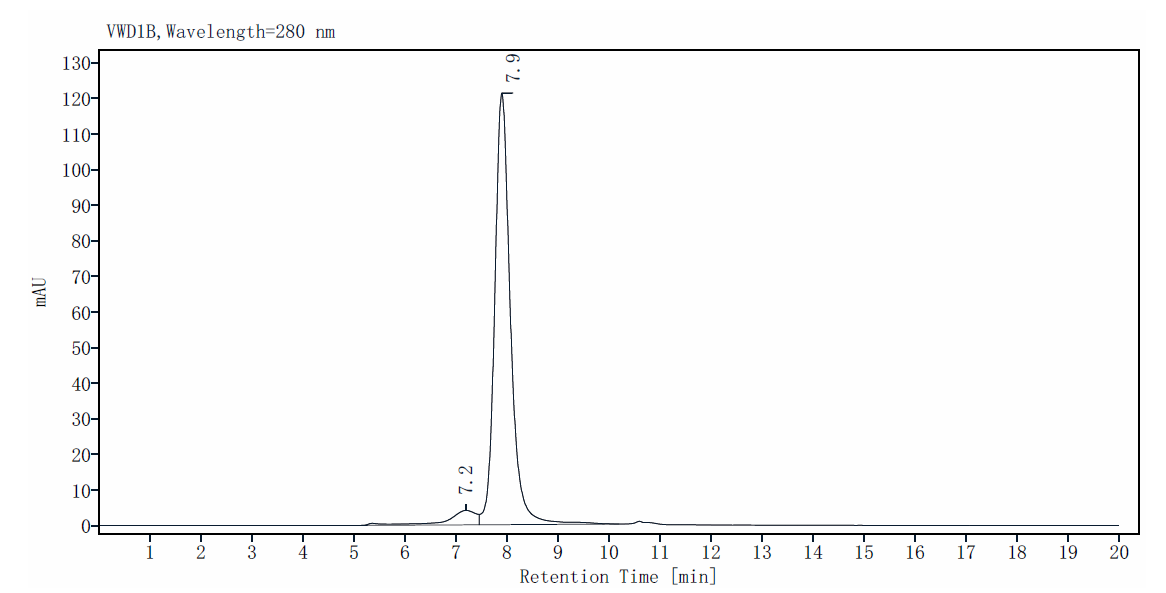
| Purity | > 95% by SDS-PAGE,90% by HPLC |
| Endotoxin | <0.1EU/μg |
| Conjugation | Unconjugated |
| Tag | His Tag |
| Physical Appearance | Lyophilized powder |
| Storage Buffer | PBS, pH7.4, 5% trehalose |
| Reconstitution | Reconstitute at 0.1-1 mg/ml according to the size in ultrapure water after rapid centrifugation. |
| Stability & Storage | · 12 months from date of receipt, lyophilized powder stored at -20 to -80℃. |
| Reference | 1.Cathomas, F., Lin, HY., Chan, K.L. et al. Circulating myeloid-derived MMP8 in stress susceptibility and depression. Nature 626, 1108–1115 (2024). |
Background
MMP-8, also known as matrix metalloproteinase-8 or neutrophil collagenase, is primarily synthesized by neutrophils and stored within their specific granules, from which it can be rapidly released upon inflammatory stimulation. This protein belongs to the zinc-dependent endopeptidase family and exhibits a highly conserved structure comprising a signal peptide, a pro-peptide (containing the "cysteine switch" that maintains zymogen stability), a catalytic domain harboring the zinc-binding motif (HEXXHXXGXXH), and a hemopexin-like domain involved in substrate recognition; upon extracellular cleavage of the pro-peptide by proteases such as plasmin, the zymogen is converted into its active form (aMMP-8) with potent collagenolytic activity. Functionally, aMMP-8 primarily acts to specifically cleave type I, II, and III collagens, thereby participating in tissue remodeling and repair under physiological conditions, whereas under pathological states it serves as a key effector molecule mediating inflammatory tissue destruction in periodontitis, arthritis, and other inflammatory diseases; recent studies have further revealed that circulating myeloid-derived MMP-8 can traverse the blood–brain barrier to modulate neuroinflammation, contributing to the pathogenesis of psychiatric disorders such as depression, and has garnered growing attention as a novel target for chronic inflammatory pain. Clinically, salivary or gingival crevicular fluid levels of aMMP-8 have been established as one of the most reliable biomarkers for the early diagnosis, disease activity assessment, and therapeutic monitoring of periodontitis, with chairside point-of-care testing technologies developed on this basis now being maturely applied in clinical practice; concurrently, its roles as a risk predictor for periodontitis complicated by obesity and for periodontal complications following radiotherapy in head and neck cancer patients, as well as a potential therapeutic target for pain management and neuropsychiatric interventions, are propelling its translational application from stomatology toward precision diagnostics and therapeutics in systemic diseases
Protocol
Assay protocol
Principle: Measured by its ability to cleave a peptide substrate, Mca-PLGL-Dpa-AR-NH2.
Materials
1.Assay Buffer: 50 mM Tris, 10 mM CaCl2, 150 mM NaCl, 0.05% (w/v) Brij 35, pH 7.5 (TCNB)
2.MMP-8 His Tag Protein, Human
3.p-aminophenylmercuric acetate (APMA) (Aladdin, Catalog # P649286)
4.Fluorogenic Peptide Substrate: MCA-Pro-Leu-Gly-Leu-DPA-Ala-Arg-NH2 (R&D, ES001)
5.Calibration standard: MCA-Pro-Leu-OH (Shyuanye, T77046)
6.96 ELISA Removable Plate, Black, High binding (GENEVER, Catalog # GMO2-96H)
7.Plate Reader (PerkinElmer, excitation 320 nm, and emission 405 nm)
Produce
1.Activate MMP-8 at 100 μg/mL with 1 mM APMA in Assay Buffer. Incubate at 37 ℃ for 1 hour.
2.Dilute activated MMP-8 (From the step 1) to 2, 1 and 0.5 μg/mL in Assay Buffer.
3.Dilute Substrate to 20 μM in Assay Buffer.
4.Load 50 μL of the dilute MMP-8 Protein (From the step 2) into a black well plate and start the reaction by adding 50 μL of 20 μM Substrate. Include a Substrate with Assay Buffer as Blank.
5.Read at excitation and emission wavelengths of 320 nm and 405 nm, kinetic mode, 60s/cycle, 10 cycles.
6.Calculate specific activity.
• Standard Curve
1. Dilute Calibration standard to 10 μM in Assay Buffer and prepare serial dilutions.
2. Add 100 μL of each serially diluted standard and blank (Assay buffer) into appropriate wells of a 96-well, the standard curve has a range of 500, 250, 125, 62.5, 31.25, 15.63, 7.81, 3.91, 1.95 pmol per well.
3. Read at excitation and emission wavelengths of 320 nm and 405 nm, respectively in endpoint mode.
4. Linear Regression of MCA-Pro-Leu-OH (pmol)(y) – RFU-Blank(x).
Specific Activity (pmol/min/µg) = |
Adjusted Vmax (RFU/min) x Conversion Factor (pmol/RFU) |
amount of enzyme (µg) |
Picture
Picture
SDS-PAGE
SEC-HPLC
The purity of MMP-9 His Tag Protein, Mouse is more than 90 % as determined by SEC-HPLC.