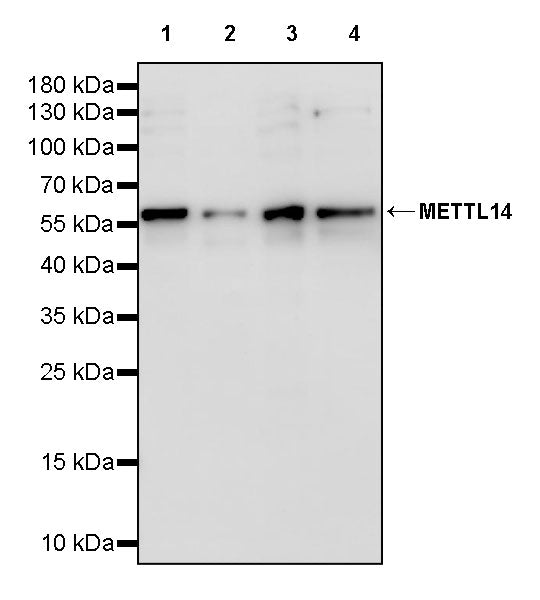
WB result of METTL14 Recombinant Rabbit mAb
Primary antibody: METTL14 Recombinant Rabbit mAb at 1/1000 dilution
Lane 1: 293T whole cell lysate 20 µg
Lane 2: HeLa whole cell lysate 20 µg
Lane 3: NCCIT whole cell lysate 20 µg
Lane 4: Raji whole cell lysate 20 µg
Secondary antibody: Goat Anti- rabbit IgG, (H+L), HRP conjugated at 1/10000 dilution
Predicted MW: 52 kDa
Observed MW: 58 kDa
METTL14 Recombinant Rabbit mAb (S-3246-105)
METTL14 Recombinant Rabbit mAb (S-3246-105)
Price:
Regular price
$100 USD
Regular price
Sale price
$100 USD
Unit price
per
For shipping services or bulk orders, you may request a quotation.
Secure checkout with

View full details
Product Details
Product Details
Product Specification
| Host | Rabbit |
| Antigen | METTL14 |
| Synonyms | N(6)-adenosine-methyltransferase non-catalytic subunit METTL14; KIAA1627; METTL14 |
| Immunogen | Synthetic Peptide |
| Location | Nucleus |
| Accession | Q9HCE5 |
| Clone Number | S-3246-105 |
| Antibody Type | Recombinant mAb |
| Isotype | IgG |
| Application | WB |
| Reactivity | Hu |
| Positive Sample | 293T, HeLa, NCCIT, Raji |
| Purification | Protein A |
| Concentration | 0.5 mg/ml |
| Conjugation | Unconjugated |
| Physical Appearance | Liquid |
| Storage Buffer | PBS, 40% Glycerol, 0.05% BSA, 0.03% Proclin 300 |
| Stability & Storage | 12 months from date of receipt / reconstitution, -20 °C as supplied |
Dilution
| application | dilution | species |
| WB | 1:1000 | Hu |
Background
METTL14 (Methyltransferase-like 14) is a critical catalytic component of the N6-methyladenosine (m6A) methyltransferase complex, which serves as the most abundant internal modification in eukaryotic messenger RNA and plays a pivotal role in post-transcriptional gene regulation. Unlike its partner METTL3, which possesses the primary catalytic active site, METTL14 functions primarily as an allosteric activator that stabilizes the complex and enhances substrate RNA recognition through its unique RNA-binding interface, thereby facilitating the precise deposition of m6A marks on specific consensus sequences (typically RRACH motifs). This heterodimeric complex, often associated with WTAP and other regulatory factors, influences diverse biological processes including mRNA splicing, nuclear export, translation efficiency, and stability, making METTL14 essential for normal embryonic development, hematopoietic stem cell differentiation, and neurogenesis; furthermore, dysregulation of METTL14 expression has been extensively linked to various pathological conditions, particularly acting as a tumor suppressor in acute myeloid leukemia while potentially functioning as an oncogene in other cancer types, thus highlighting its significance as a promising therapeutic target for epigenetic interventions.
Picture
Picture
Western Blot