ICC shows positive staining in NIH/3T3 cells. Anti- MDH2 antibody was used at 1/500 dilution (Green) and incubated overnight at 4°C. Goat polyclonal Antibody to Mouse IgG - H&L (Alexa Fluor® 488) was used as secondary antibody at 1/1000 dilution. The cells were fixed with 4% PFA and permeabilized with 0.1% PBS-Triton X-100. Nuclei were counterstained with DAPI (Blue). Counterstain with tubulin (Red).
MDH2 Recombinant Mouse mAb (S-5411)
MDH2 Recombinant Mouse mAb (S-5411)
Price:
Regular price
$100 USD
Regular price
Sale price
$100 USD
Unit price
per
For shipping services or bulk orders, you may request a quotation.
Secure checkout with

View full details
Product Details
Product Details
Product Specification
| Host | Mouse |
| Antigen | MDH2 |
| Synonyms | Malate dehydrogenase, mitochondrial; Mor1; Mdh2 |
| Location | Mitochondrion |
| Accession | P08249 |
| Clone Number | S-5411 |
| Antibody Type | Recombinant mAb |
| Isotype | IgG1,k |
| Application | ICC, IF |
| Reactivity | Ms |
| Predicted Reactivity | / |
| Purification | Protein A |
| Concentration | 2 mg/ml |
| Conjugation | Unconjugated |
| Physical Appearance | Liquid |
| Storage Buffer | PBS, 40% Glycerol, 0.05% BSA, 0.02% sodium azide |
| Stability & Storage | 12 months from date of receipt / reconstitution, -20 °C as supplied |
Dilution
| application | dilution | species |
| ICC | 1:500 | Ms |
| IF | 1:100 | Ms |
Background
MDH2 (malate dehydrogenase 2) is an NAD⁺-dependent dehydrogenase encoded by the nuclear gene MDH2 and localized to the mitochondrial matrix, where it plays a central role in eukaryotic energy metabolism. It catalyzes the reversible redox reaction between L-malate and oxaloacetate, serving as a key node connecting the tricarboxylic acid cycle with the malate-aspartate shuttle system—the former drives aerobic respiration for energy production, while the latter transports reducing equivalents from the cytosol into mitochondria for oxidation. Human MDH2 consists of approximately 337 amino acids and functions as a homodimer; its active site contains a critical proton-accepting residue (such as Arg102), and phosphate group binding can induce closure of the active loop, thereby stabilizing the substrate and cofactor to promote catalysis. Notably, MDH2 activity is positively regulated by acetylation, a mechanism involved in the dynamic regulation of metabolic networks. At the clinical level, the dual role of MDH2 has attracted increasing attention: on the one hand, its germline mutations can cause pediatric neurological disorders such as developmental and epileptic encephalopathy; on the other hand, MDH2 is upregulated in various tumors and is regarded as a promising anticancer target, while its mutations are also associated with the metabolic disturbances of recurrent focal segmental glomerulosclerosis.
Picture
Picture
Immunocytochemistry
Immunofluorescence
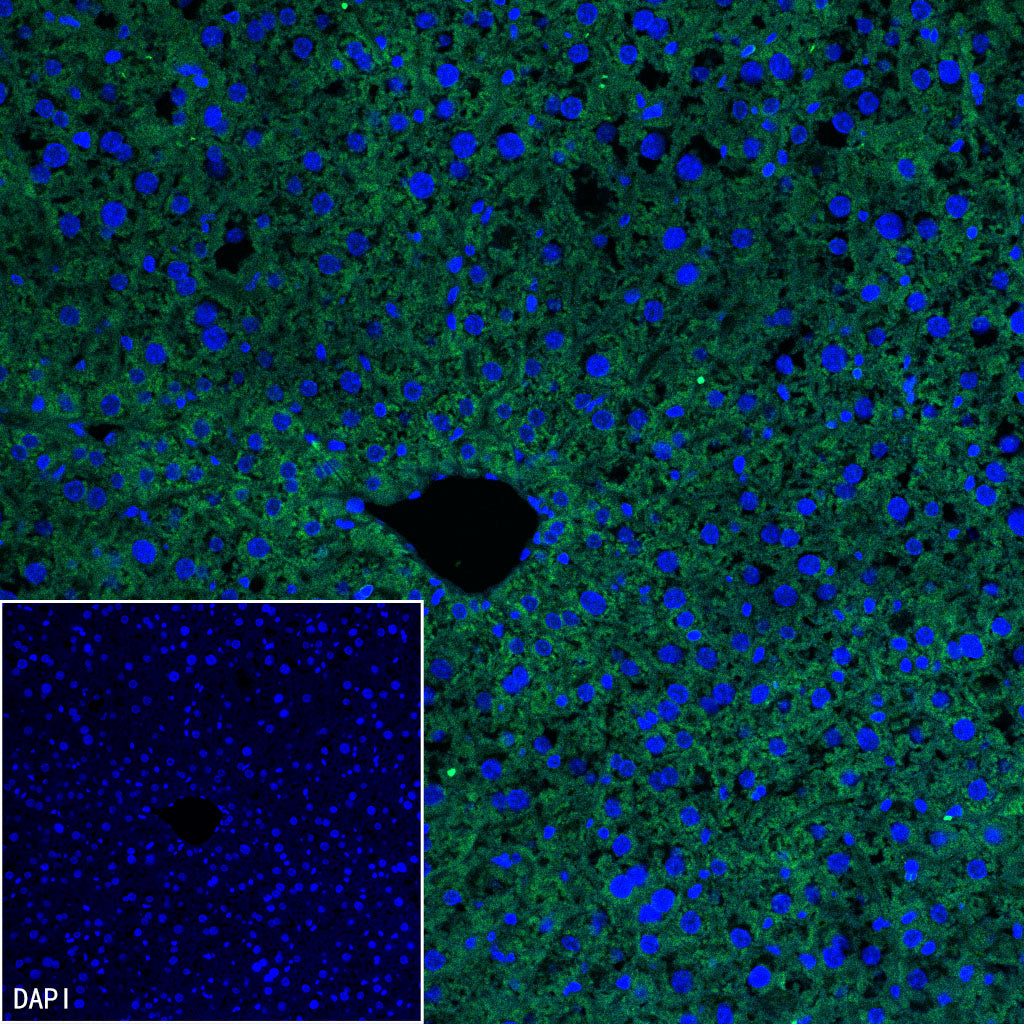
IF shows positive staining in paraffin-embedded mouse liver. Anti-MDH2 antibody was used at 1/100 dilution (Green) and incubated overnight at 4°C. Goat polyclonal Antibody to Mouse IgG - H&L (Alexa Fluor® 488) was used as secondary antibody at 1/1000 dilution. Counterstained with DAPI (Blue). Heat mediated antigen retrieval with EDTA buffer pH9.0 was performed before commencing with IF staining protocol.