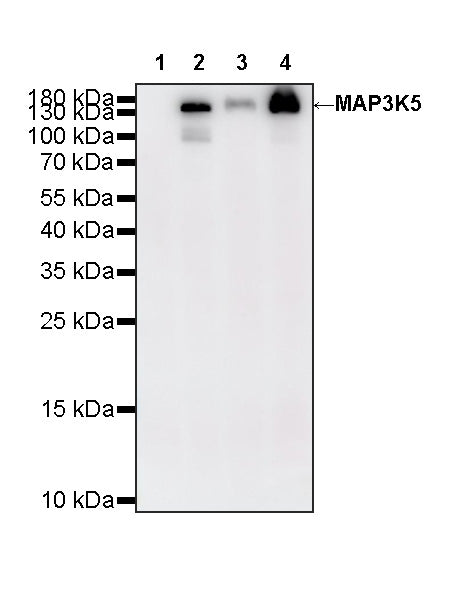
WB result of MAP3K5 Recombinant Rabbit mAb
Primary antibody: MAP3K5 Recombinant Rabbit mAb at 1/1000 dilution
Lane 1: HepG2 whole cell lysate 20 µg
Lane 2: BxPC-3 whole cell lysate 20 µg
Lane 3: HeLa whole cell lysate 20 µg
Lane 4: A431 whole cell lysate 20 µg
Low expression control: HepG2 whole cell lysate
Secondary antibody: Goat Anti-Rabbit IgG (H+L), HRP conjugated at 1/10000 dilution
Predicted MW: 154 kDa
Observed MW: 154 kDa
MAP3K5 Recombinant Rabbit mAb (S-4566-31)
MAP3K5 Recombinant Rabbit mAb (S-4566-31)
Price:
Regular price
$100 USD
Regular price
Sale price
$100 USD
Unit price
per
For shipping services or bulk orders, you may request a quotation.
Secure checkout with

View full details
Product Details
Product Details
Product Specification
| Host | Rabbit |
| Antigen | MAP3K5 |
| Synonyms | Mitogen-activated protein kinase kinase kinase 5; Apoptosis signal-regulating kinase 1 (ASK-1); MAPK/ERK kinase kinase 5 (MEK kinase 5; MEKK 5); ASK1; MAPKKK5; MEKK5 |
| Immunogen | Synthetic Peptide |
| Location | Cytoplasm, Endoplasmic reticulum |
| Accession | Q99683 |
| Clone Number | S-4566-31 |
| Antibody Type | Recombinant mAb |
| Isotype | IgG |
| Application | WB |
| Reactivity | Hu |
| Positive Sample | BxPC-3, HeLa, A431 |
| Purification | Protein A |
| Concentration | 1 mg/ml |
| Conjugation | Unconjugated |
| Physical Appearance | Liquid |
| Storage Buffer | PBS, 40% Glycerol, 0.05% BSA, 0.02% sodium azide |
| Stability & Storage | 12 months from date of receipt / reconstitution, -20 °C as supplied |
Dilution
| application | dilution | species |
| WB | 1:1000 | Hu |
Background
MAP3K5, also known as apoptosis signal-regulating kinase 1 (ASK1), is a ubiquitously expressed mitogen-activated protein kinase kinase kinase that plays a critical role in signal integration in response to various stress signals, including oxidative stress, endoplasmic reticulum stress, TNF-α, and lipopolysaccharides. This protein consists of 1,374 amino acids and contains an N-terminal inhibitory domain, which binds to thioredoxin (Trx) under resting conditions to maintain a self-inhibitory conformation. Upon stimulation by elevated reactive oxygen species or calcium influx, thioredoxin undergoes oxidative dissociation, allowing MAP3K5 to be activated through oligomerization and phosphorylation at key sites (such as Thr-838). Activated MAP3K5 subsequently phosphorylates downstream MKK4/MKK7 and MKK3/MKK6, initiating the JNK and p38 MAPK classical signaling cascade pathways, ultimately regulating diverse biological processes including apoptosis, autophagy, differentiation, and inflammatory cytokine expression. The activity of MAP3K5 is finely regulated by phosphorylation, ubiquitination, and various chaperone proteins. Dysregulation of MAP3K5 function is closely associated with the pathogenesis and progression of neurodegenerative diseases (such as Parkinson's disease and amyotrophic lateral sclerosis), cardiovascular diseases (such as myocardial ischemia-reperfusion injury), metabolic diseases (such as non-alcoholic steatohepatitis), and multiple types of tumors. Consequently, MAP3K5 is considered a potential therapeutic target for numerous major diseases, and several small-molecule MAP3K5 inhibitors have already entered preclinical or clinical trial stages.
Picture
Picture
Western Blot