WB result of MAGE-A4 Recombinant Rabbit mAb
Primary antibody: MAGE-A4 Recombinant Rabbit mAb at 1/1000 dilution
Lane 1: MCF-7 whole cell lysate 20 µg
Lane 2: U-2 OS whole cell lysate 20 µg
Lane 3: A431 whole cell lysate 20 µg
Negative control: MCF-7 whole cell lysate
Secondary antibody: Goat Anti-rabbit IgG, (H+L), HRP conjugated at 1/10000 dilution
Predicted MW: 39 kDa
Observed MW: 40 kDa
MAGE-A4 Recombinant Rabbit mAb (S-3868-66)
MAGE-A4 Recombinant Rabbit mAb (S-3868-66)
Price:
Regular price
$100 USD
Regular price
Sale price
$100 USD
Unit price
per
For shipping services or bulk orders, you may request a quotation.
Secure checkout with

View full details
Product Details
Product Details
Product Specification
| Host | Rabbit |
| Antigen | MAGE-A4 |
| Synonyms | Melanoma-associated antigen 4; Cancer/testis antigen 1.4 (CT1.4); MAGE-4 antigen; MAGE-41 antigen; MAGE-X2 antigen; MAGE4; MAGEA4 |
| Immunogen | Synthetic Peptide |
| Location | Nucleus |
| Accession | P43358 |
| Clone Number | S-3868-66 |
| Antibody Type | Recombinant mAb |
| Isotype | IgG |
| Application | WB, IHC-P |
| Reactivity | Hu |
| Purification | Protein A |
| Concentration | 0.5 mg/ml |
| Conjugation | Unconjugated |
| Physical Appearance | Liquid |
| Storage Buffer | PBS, 40% Glycerol, 0.05% BSA, 0.03% Proclin 300 |
| Stability & Storage | 12 months from date of receipt / reconstitution, -20 °C as supplied |
Dilution
| application | dilution | species |
| WB | 1:1000 | Hu |
| IHC-P | 1:2000 | Hu |
Background
MAGE-A4 (Melanoma-Associated Antigen A4) is a cancer-testis antigen belonging to the MAGE-A family, which is normally expressed exclusively in immune-privileged sites such as the testis and placenta but is aberrantly reactivated in a wide variety of malignant tumors including synovial sarcoma, lung squamous cell carcinoma, head and neck cancers, and melanoma. As an intracellular protein processed and presented on the cell surface by Major Histocompatibility Complex (MHC) class I molecules, MAGE-A4 serves as a highly specific tumor-associated antigen that is largely absent from normal somatic tissues, making it an attractive target for immunotherapeutic strategies such as T-cell receptor (TCR)-engineered T cells, peptide vaccines, and antibody-drug conjugates. Its expression is often correlated with tumor progression and poor prognosis in certain cancers, and because of its restricted normal tissue distribution, therapies targeting MAGE-A4 aim to maximize tumor killing while minimizing off-target toxicity, although careful monitoring is required due to potential low-level expression in some normal tissues or the risk of cross-reactivity with other MAGE family members.
Picture
Picture
Western Blot
Immunohistochemistry
IHC shows positive staining in paraffin-embedded human testis. Anti-MAGE-A4 antibody was used at 1/2000 dilution, followed by a HRP Polymer for Rabbit IgG (ready to use). Counterstained with hematoxylin. Heat mediated antigen retrieval with Tris/EDTA buffer pH9.0 was performed before commencing with IHC staining protocol.
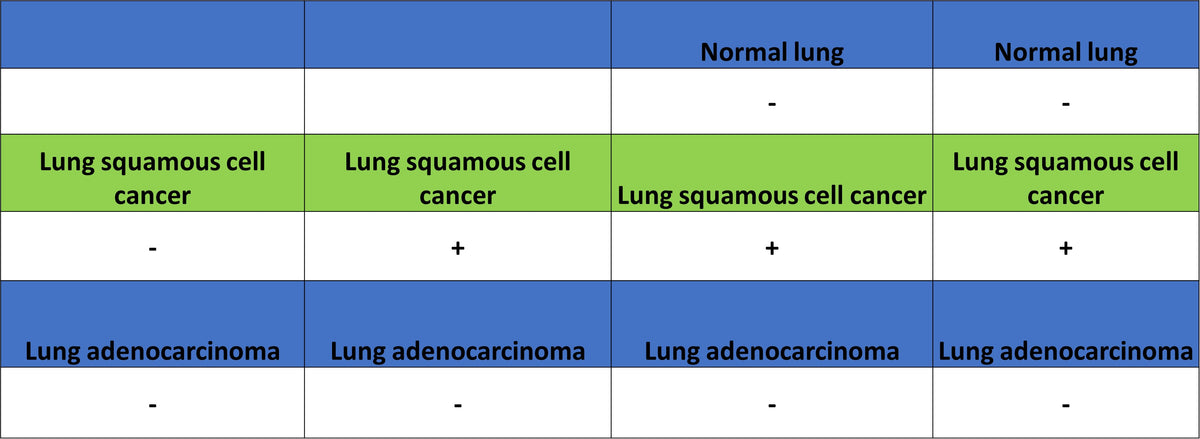
IHC shows positive staining in paraffin-embedded human lung squamous cell carcinoma. Anti-MAGE-A4 antibody was used at 1/2000 dilution, followed by a HRP Polymer for Rabbit IgG (ready to use). Counterstained with hematoxylin. Heat mediated antigen retrieval with Tris/EDTA buffer pH9.0 was performed before commencing with IHC staining protocol.
Negative control: IHC shows negative staining in paraffin-embedded human colon. Anti- MAGE-A4 antibody was used at 1/2000 dilution, followed by a HRP Polymer for Rabbit IgG (ready to use). Counterstained with hematoxylin. Heat mediated antigen retrieval with Tris/EDTA buffer pH9.0 was performed before commencing with IHC staining protocol.
Negative control: IHC shows negative staining in paraffin-embedded human lung. Anti- MAGE-A4 antibody was used at 1/2000 dilution, followed by a HRP Polymer for Rabbit IgG (ready to use). Counterstained with hematoxylin. Heat mediated antigen retrieval with Tris/EDTA buffer pH9.0 was performed before commencing with IHC staining protocol.