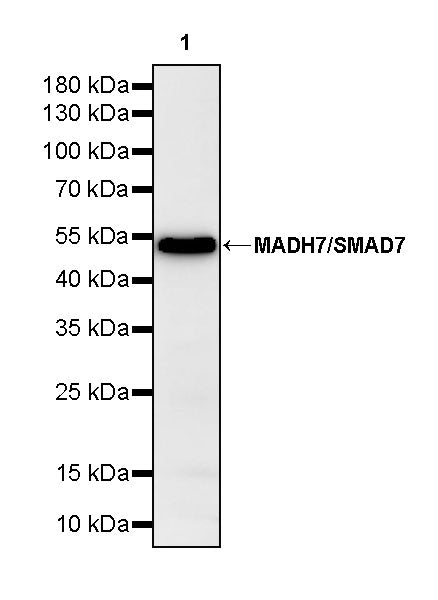
WB result of MADH7/SMAD7 Recombinant Rabbit mAb
Primary antibody: MADH7/SMAD7 Recombinant Rabbit mAb at 1/1000 dilution
Lane 1: SH-SY5Y whole cell lysate 20 µg
Secondary antibody: Goat Anti- rabbit IgG, (H+L), HRP conjugated at 1/10000 dilution
Predicted MW: 46 kDa
Observed MW: 52 kDa
MADH7/SMAD7 Recombinant Rabbit mAb (S-2930-74)
MADH7/SMAD7 Recombinant Rabbit mAb (S-2930-74)
Price:
Regular price
$100 USD
Regular price
Sale price
$100 USD
Unit price
per
For shipping services or bulk orders, you may request a quotation.
Secure checkout with

View full details
Product Details
Product Details
Product Specification
| Host | Rabbit |
| Antigen | MADH7/SMAD7 |
| Synonyms | SMAD family member 7; SMAD 7 Curated; hSMAD7; Mothers against decapentaplegic homolog 7 (MAD homolog 7; Mothers against DPP homolog 7); Mothers against decapentaplegic homolog 8 (MAD homolog 8; Mothers against DPP homolog 8); MADH8 |
| Immunogen | Synthetic Peptide |
| Location | Cytoplasm, Nucleus |
| Accession | O15105 |
| Clone Number | S-2930-74 |
| Antibody Type | Recombinant mAb |
| Isotype | IgG |
| Application | WB |
| Reactivity | Hu, Ms, Rt |
| Positive Sample | SH-SY5Y, mouse brain, rat brain |
| Purification | Protein A |
| Concentration | 2 mg/ml |
| Conjugation | Unconjugated |
| Physical Appearance | Liquid |
| Storage Buffer | PBS, 40% Glycerol, 0.05% BSA, 0.03% Proclin 300 |
| Stability & Storage | 12 months from date of receipt / reconstitution, -20 °C as supplied |
Dilution
| application | dilution | species |
| WB | 1:1000 | Hu, Ms, Rt |
Background
The MADH7 protein (also known as SMAD7) is a key inhibitory regulatory molecule in the transforming growth factor-β (TGF-β) signaling pathway. Unlike other receptor-activated SMAD proteins, MADH7 functions by stably binding to the TGF-β type I receptor (TβRI), preventing the phosphorylation of receptor-activated SMADs (such as SMAD2/3), thereby blocking canonical SMAD-dependent signal transduction at the source in a negative feedback manner. Additionally, it recruits E3 ubiquitin ligases (such as Smurf1 and Smurf2) to promote the degradation of signaling components including TβRI and SMAD2, and is also involved in regulating non-SMAD signaling pathways. The expression of MADH7 itself is rapidly induced by TGF-β signaling, forming a tight negative feedback loop. Through these mechanisms, MADH7 plays critical roles in embryonic development, immune homeostasis maintenance, inhibition of fibrosis, and regulation of epithelial-mesenchymal transition (EMT). Dysregulation or abnormal expression of MADH7 is closely associated with various human diseases, including tissue fibrosis, inflammatory bowel disease, and multiple malignancies (where it exhibits dual tumor-suppressive or tumor-promoting roles in cancers such as prostate cancer and pancreatic cancer).
Picture
Picture
Western Blot
WB result of MADH7/SMAD7 Recombinant Rabbit mAb
Primary antibody: MADH7/SMAD7 Recombinant Rabbit mAb at 1/1000 dilution
Lane 1: mouse brain lysate 20 µg
Secondary antibody: Goat Anti- rabbit IgG, (H+L), HRP conjugated at 1/10000 dilution
Predicted MW: 46 kDa
Observed MW: 52 kDa
WB result of MADH7/SMAD7 Recombinant Rabbit mAb
Primary antibody: MADH7/SMAD7 Recombinant Rabbit mAb at 1/1000 dilution
Lane 1: rat brain lysate 20 µg
Secondary antibody: Goat Anti- rabbit IgG, (H+L), HRP conjugated at 1/10000 dilution
Predicted MW: 46 kDa
Observed MW: 52 kDa