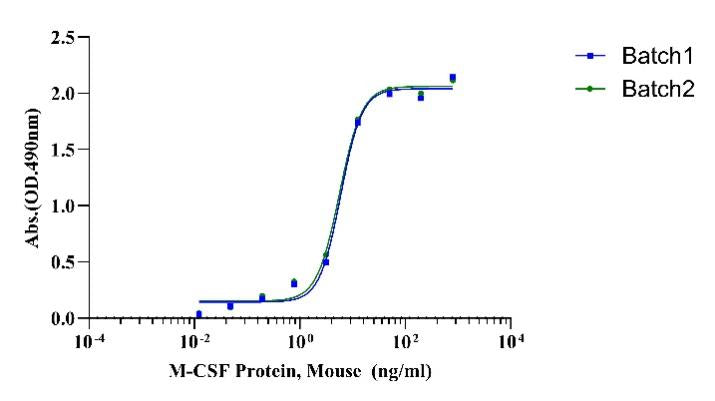
Measured in a cell proliferation assay using M‑NFS‑60 mouse myelogenous leukemia lymphoblast cells. The EC50 for this effect is 5.1-6.9 ng/ml.
M-CSF Protein, Mouse
M-CSF Protein, Mouse
Price:
Regular price
$120 USD
Regular price
Sale price
$120 USD
Unit price
per
For shipping services or bulk orders, you may request a quotation.
Secure checkout with

View full details
Product Details
Product Details
Product Specification
| Species | Mouse |
| Synonyms | M-CSF, CSF-1, Macrophage Colony Stimulating Factor |
| Accession | P07141 |
| Amino Acid Sequence | Lys33-Pro187 |
| Expression System | HEK293 |
| Molecular Weight | 16-25 kDa (Reducing) |
| Purity | >95% by SDS-PAGE & HPLC. |
| Endotoxin | <0.1EU/μg |
| Conjugation | Unconjugated |
| Tag | No Tag |
| Physical Appearance | Lyophilized Powder |
| Storage Buffer | PBS, pH7.4 |
| Reconstitution | Reconstitute at 0.1-1 mg/ml according to the size in ultrapure water after rapid centrifugation. |
| Stability & Storage | ·12 months from date of receipt, lyophilized powder stored at -20 to -80℃. |
| Reference | 1. Cosman D, Wignall J, Anderson D, et al. 1988. Behring Inst Mitt: 15-26. |
Background
Macrophage-Colony Stimulating Factor (M-CSF), also known as Colony Stimulating Factor-1 (CSF-1), is a hematopoietic growth factor. It can stimulate the survival, proliferation and differentiation of mononuclear phagocytes, in addition to the spreading and motility of macrophages. M-CSF is mainly produced by monocytes, macrophages, fibroblasts, and endothelial cells. M-CSF interaction with its receptor, c-fms, has been implicated in the growth, invasion, and metastasis of several diseases, including breast and endometrial cancers.
Picture
Picture
Bioactivity
SDS-PAGE
2μg (R: reducing condition, N: non-reducing condition).
SEC-HPLC
>95% as determined by SEC-HPLC.