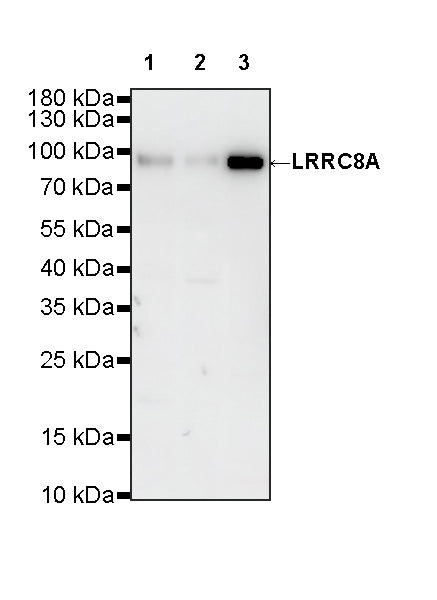
WB result of LRRC8A Recombinant Rabbit mAb
Primary antibody: LRRC8A Recombinant Rabbit mAb at 1/1000 dilution
Lane 1: A549 whole cell lysate 20 µg
Lane 2: HeLa whole cell lysate 20 µg
Lane 3: A431 whole cell lysate 20 µg
Secondary antibody: Goat Anti-Rabbit IgG (H+L), HRP conjugated at 1/10000 dilution
Predicted MW: 94 kDa
Observed MW: 95 kDa
This blot was developed with high sensitivity substrate
LRRC8A Recombinant Rabbit mAb (S-4149-44)
LRRC8A Recombinant Rabbit mAb (S-4149-44)
Price:
Regular price
$100 USD
Regular price
Sale price
$100 USD
Unit price
per
For shipping services or bulk orders, you may request a quotation.
Secure checkout with

View full details
Product Details
Product Details
Product Specification
| Host | Rabbit |
| Antigen | LRRC8A |
| Synonyms | Volume-regulated anion channel subunit LRRC8A; Leucine-rich repeat-containing protein 8A (HsLRRC8A); Swelling protein 1; KIAA1437; LRRC8; SWELL1 |
| Immunogen | Synthetic Peptide |
| Location | Lysosome, Cell membrane |
| Accession | Q8IWT6 |
| Clone Number | S-4149-44 |
| Antibody Type | Recombinant mAb |
| Isotype | IgG |
| Application | WB |
| Reactivity | Hu, Ms |
| Positive Sample | A549, HeLa, A431, NIH/3T3, C2C12, mouse brain |
| Purification | Protein A |
| Concentration | 2 mg/ml |
| Conjugation | Unconjugated |
| Physical Appearance | Liquid |
| Storage Buffer | PBS, 40% Glycerol, 0.05% BSA, 0.02% sodium azide |
| Stability & Storage | 12 months from date of receipt / reconstitution, -20 °C as supplied |
Dilution
| application | dilution | species |
| WB | 1:500-1:1000 | Hu, Ms |
Background
LRRC8A (Leucine-Rich Repeat-Containing Protein 8A, also known as SWELL1) is an indispensable core component of the volume-regulated anion channel (VRAC), whose functions have long surpassed the mere maintenance of cellular volume homeostasis to become a multifunctional regulatory factor playing critical roles in various major diseases. Structurally, LRRC8A serves as the essential subunit for forming functional VRAC channels and must assemble with other family members (LRRC8B–E) into heterohexameric complexes to exert its function. Its unique N-terminal domain folds back into the pore interior and, together with the extracellular selectivity filter, determines the channel's permeability to chloride ions as well as organic molecules such as taurine, glutamate, and ATP. The physiological and pathological functions of LRRC8A are remarkably extensive: in oncology, it promotes cancer cell proliferation, epithelial-mesenchymal transition, and metastasis in multiple cancer types through activating PI3K/AKT, JNK/MAPK, and other signaling pathways, though its role is dual-faced and can, in certain contexts, influence sensitivity to chemotherapeutic agents; in the nervous system, it is associated with seizures caused by astrocytic LRRC8A overexpression, while its C-terminal LRR domain can bind to NMDA receptors and limit their synaptic activity, thereby normally suppressing neuropathic pain; additionally, LRRC8A participates in insulin signaling to regulate glucose metabolism, and plays important roles in T-cell development and immune modulation through transporting cGAMP to activate the STING pathway.
Picture
Picture
Western Blot
WB result of LRRC8A Recombinant Rabbit mAb
Primary antibody: LRRC8A Recombinant Rabbit mAb at 1/1000 dilution
Lane 1: NIH/3T3 whole cell lysate 20 µg
Lane 2: C2C12 whole cell lysate 20 µg
Lane 3: mouse brain lysate 20 µg
Secondary antibody: Goat Anti-Rabbit IgG (H+L), HRP conjugated at 1/10000 dilution
Predicted MW: 94 kDa
Observed MW: 95 kDa
This blot was developed with high sensitivity substrate