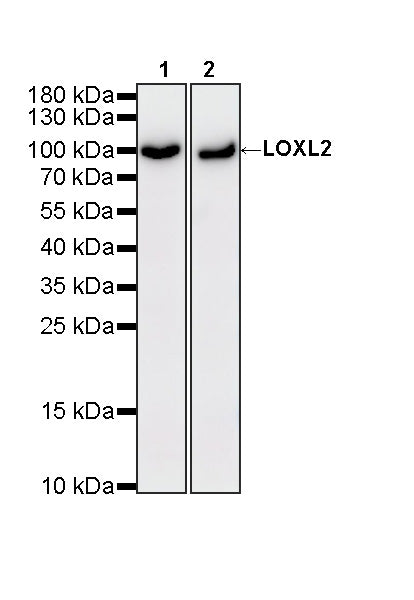
WB result of LOXL2 Recombinant Rabbit mAb
Primary antibody: LOXL2 Recombinant Rabbit mAb at 1/1000 dilution
Lane 1: SK-OV-3 whole cell lysate 20 µg
Lane 2: RD whole cell lysate 20 µg
Secondary antibody: Goat Anti-Rabbit IgG (H+L), HRP conjugated at 1/10000 dilution
Predicted MW: 86 kDa
Observed MW: 100 kDa
LOXL2 Recombinant Rabbit mAb (S-4565-21)
LOXL2 Recombinant Rabbit mAb (S-4565-21)
Price:
Regular price
$100 USD
Regular price
Sale price
$100 USD
Unit price
per
For shipping services or bulk orders, you may request a quotation.
Secure checkout with

View full details
Product Details
Product Details
Product Specification
| Host | Rabbit |
| Antigen | LOXL2 |
| Immunogen | Synthetic Peptide |
| Location | Nucleus, Secreted, Endoplasmic reticulum |
| Accession | Q9Y4K0 |
| Clone Number | S-4565-21 |
| Antibody Type | Recombinant mAb |
| Isotype | IgG |
| Application | WB |
| Reactivity | Hu |
| Positive Sample | SK-OV-3, RD |
| Predicted Reactivity | Bv, Or |
| Purification | Protein A |
| Concentration | 0.5 mg/ml |
| Conjugation | Unconjugated |
| Physical Appearance | Liquid |
| Storage Buffer | PBS, 40% Glycerol, 0.05% BSA, 0.02% sodium azide |
| Stability & Storage | 12 months from date of receipt / reconstitution, -20 °C as supplied |
Dilution
| application | dilution | species |
| WB | 1:1000 | Hu |
Background
LOXL2 (lysyl oxidase-like protein 2) is a multifunctional protein in the lysyl oxidase (LOX) family that possesses both enzymatic activity and signaling regulatory functions. Its structural features include a conserved C-terminal copper-dependent amine oxidase catalytic domain (containing the LTQ cofactor) and four N-terminal scavenger receptor cysteine-rich (SRCR) domains. As a classic matrix-remodeling enzyme, LOXL2 promotes extracellular matrix (ECM) crosslinking by oxidizing lysine residues in collagen and elastin, thereby increasing matrix stiffness and stability, and it plays a central role in tissue fibrosis and tumor microenvironment remodeling. Beyond its enzymatic activity, LOXL2 also has important intracellular functions, promoting tumor invasion and metastasis through non-enzymatic mechanisms such as stabilizing the Snail1 transcription factor, regulating epithelial-mesenchymal transition (EMT), and participating in the regulation of cell polarity. Numerous clinical studies have confirmed that LOXL2 is dysregulated in various malignant tumors and is closely associated with poor prognosis; it is also significantly elevated in liver, lung, and cardiac fibrosis.
Picture
Picture
Western Blot