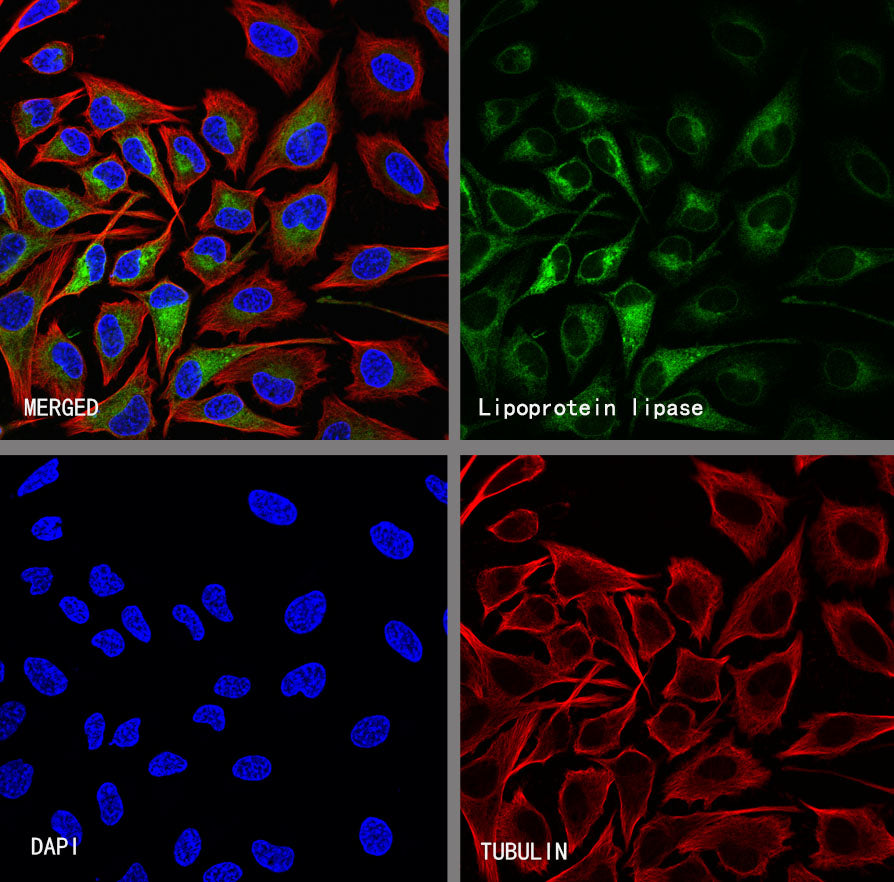
ICC shows positive staining in HeLa cells. Anti-Lipoprotein lipase antibody was used at 1/100 dilution (Green) and incubated overnight at 4°C. Goat polyclonal Antibody to Rabbit IgG - H&L (Alexa Fluor® 488) was used as secondary antibody at 1/1000 dilution. The cells were fixed with 100% ice-cold methanol and permeabilized with 0.1% PBS-Triton X-100. Nuclei were counterstained with DAPI (Blue). Counterstain with tubulin (Red).
Lipoprotein lipase Recombinant Mouse mAb (S-5402)
Lipoprotein lipase Recombinant Mouse mAb (S-5402)
Price:
Regular price
$100 USD
Regular price
Sale price
$100 USD
Unit price
per
For shipping services or bulk orders, you may request a quotation.
Secure checkout with

View full details
Product Details
Product Details
Product Specification
| Host | Mouse |
| Antigen | Lipoprotein lipase |
| Synonyms | LIPD; LPL |
| Location | Secreted |
| Accession | P06858 |
| Clone Number | S-5402 |
| Antibody Type | Mouse mAb |
| Isotype | IgG1,k |
| Application | ICC |
| Reactivity | Hu |
| Predicted Reactivity | Ms, Rt |
| Purification | Protein G |
| Concentration | 2 mg/ml |
| Conjugation | Unconjugated |
| Physical Appearance | Liquid |
| Storage Buffer | PBS, 40% Glycerol, 0.05% BSA, 0.02% sodium azide |
| Stability & Storage | 12 months from date of receipt / reconstitution, -20 °C as supplied |
Dilution
| application | dilution | species |
| ICC | 1:100 | Hu |
Background
Lipoprotein lipase (LPL) is a rate-limiting enzyme of paramount importance in lipid metabolism. It is primarily synthesized by parenchymal cells in adipose tissue, cardiac muscle, and skeletal muscle, and subsequently secreted to the luminal surface of capillaries. Its core function is to hydrolyze triglycerides within the core of circulating triglyceride-rich lipoproteins (such as chylomicrons and very low-density lipoproteins), releasing free fatty acids and monoacylglycerols for uptake by adjacent tissues—for storage in adipose tissue and for β-oxidation as an energy source in cardiac and skeletal muscle. The activity of LPL is subject to complex and precise regulation: under energy-replete conditions, insulin promotes LPL activity in adipose tissue to facilitate lipid storage; during fasting or exercise, hormones such as epinephrine preferentially activate LPL in muscle tissue to ensure energy supply. This tissue-specific regulation is mediated by members of the angiopoietin-like protein family, including ANGPTL3, ANGPTL4, and ANGPTL8. Given its central role in lipid partitioning, LPL dysfunction is closely associated with multiple metabolic diseases: mutations in the LPL gene lead to familial chylomicronemia syndrome, characterized by severe hypertriglyceridemia and an elevated risk of pancreatitis; reduced LPL activity is also linked to obesity, insulin resistance, and atherosclerotic cardiovascular disease, making it an important therapeutic target for the development of lipid-lowering drugs, such as ANGPTL3 inhibitors.
Picture
Picture
Immunocytochemistry