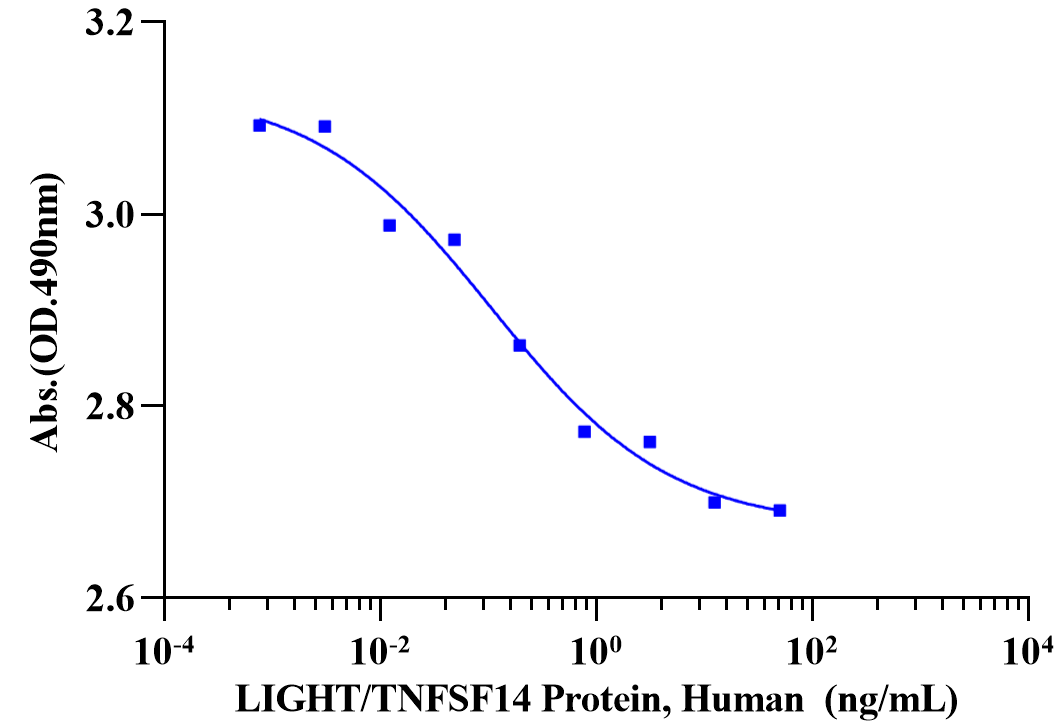
Determined by its cytotoxic effect on HT-29 (human colon adenocarcinoma cells), the EC50 for this effect is less than 0.39ng/mL.
LIGHT/TNFSF14 Protein, Human
LIGHT/TNFSF14 Protein, Human
Price:
Regular price
$100 USD
Regular price
Sale price
$100 USD
Unit price
per
For shipping services or bulk orders, you may request a quotation.
Secure checkout with

View full details
Product Details
Product Details
Product Specification
| Species | Human |
| Synonyms | Tumor necrosis factor ligand superfamily member 14, Herpes virus entry mediator ligand (HVEM-L; Herpesvirus entry mediator ligand) |
| Accession | O43557 |
| Amino Acid Sequence | Asp74-Val240 with His Tag at the N-Terminus |
| Expression System | HEK293 |
| Molecular Weight | 20-25, 40-42 kDa (Reducing) |
| Purity | >95% by SDS-PAGE. |
| Endotoxin | <0.1EU/μg |
| Conjugation | Unconjugated |
| Tag | His Tag |
| Physical Appearance | Lyophilized Powder |
| Storage Buffer | PBS, pH7.4 |
| Reconstitution | Reconstitute at 0.1-1 mg/ml according to the size in ultrapure water after rapid centrifugation. |
| Stability & Storage | ·12 months from date of receipt, lyophilized powder stored at -20 to -80℃. |
| Reference | J Clin Invest. 2001 Dec;108(12):1771-80. |
Background
TNFSF14, also known as tumor necrosis factor ligand superfamily member 14 or LIGHT (homologous to lymphotoxins, exhibits inducible expression, and competes with HSV glycoprotein D for HVEM, a receptor expressed by T lymphocytes), is a cytokine belonging to the tumor necrosis factor (TNF) superfamily. TNFSF14 is a type II transmembrane protein that can be cleaved to produce a soluble form. It functions as a ligand for two receptors, herpes virus entry mediator (HVEM) and lymphotoxin beta receptor (LTβR), and is involved in regulating immune responses, inflammation, and lymphoid organ development. TNFSF14 has been implicated in various physiological and pathological processes, including the modulation of T cell activation, the regulation of immune cell migration, and the promotion of antitumor immunity.
Picture
Picture
Bioactivity
SDS-PAGE
2μg (R: reducing condition, N: non-reducing condition).