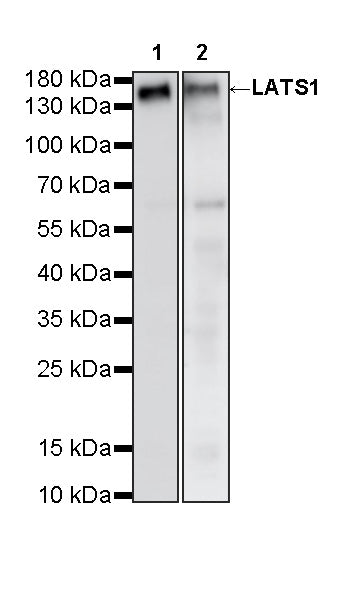
WB result of LATS1 Mouse mAb
Primary antibody: LATS1 Mouse mAb at 1/2000 dilution
Lane 1: K-562 whole cell lysate 20 µg
Lane 2: Jurkat whole cell lysate 20 µg
Secondary antibody: Goat Anti-Mouse IgG (H+L), HRP conjugated at 1/10000 dilution
Predicted MW: 127 kDa
Observed MW: 150 kDa
This blot was developed with high sensitivity substrate
LATS1 Mouse mAb
LATS1 Mouse mAb
Price:
Regular price
$100 USD
Regular price
Sale price
$100 USD
Unit price
per
For shipping services or bulk orders, you may request a quotation.
Secure checkout with

View full details
Product Details
Product Details
Product Specification
| Host | Mouse |
| Antigen | LATS1 |
| Synonyms | Serine/threonine-protein kinase LATS1; Large tumor suppressor homolog 1; WARTS protein kinase (h-warts); WARTS |
| Location | Cytoplasm, Cytoskeleton |
| Accession | O95835 |
| Antibody Type | Mouse mAb |
| Isotype | IgG1 |
| Application | WB |
| Reactivity | Hu |
| Positive Sample | K-562, Jurkat |
| Purification | Protein G |
| Concentration | 0.7 mg/ml |
| Conjugation | Unconjugated |
| Physical Appearance | Liquid |
| Storage Buffer | PBS, 40% Glycerol, 0.05% BSA, 0.02% sodium azide |
| Stability & Storage | 12 months from date of receipt / reconstitution, -20 °C as supplied |
Dilution
| application | dilution | species |
| WB | 1:1000-1:2000 | Hu |
Background
LATS1 (Large Tumor Suppressor Kinase 1) is a serine/threonine kinase that serves as a central component of the evolutionarily conserved Hippo signaling pathway, which plays a pivotal role in regulating organ size, tissue homeostasis, and tumorigenesis by controlling cell proliferation and apoptosis. Upon activation by upstream kinases such as MST1/2, LATS1 phosphorylates the transcriptional co-activators YAP and TAZ, leading to their cytoplasmic retention and proteasomal degradation, thereby preventing them from entering the nucleus and activating TEAD-mediated gene expression programs that drive cell growth and survival. Beyond its canonical function in the Hippo pathway, LATS1 also participates in cell cycle regulation, mitotic checkpoint control, and genomic stability maintenance through interactions with various binding partners, and its loss or downregulation has been frequently observed in multiple human cancers, including breast, liver, and lung carcinomas, where it correlates with poor prognosis and enhanced metastatic potential, underscoring its critical role as a tumor suppressor whose functional integrity is essential for preventing uncontrolled cellular expansion and malignant transformation.
Picture
Picture
Western Blot