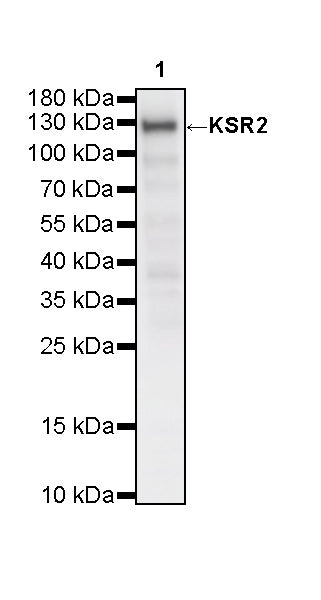
WB result of KSR2 Recombinant Rabbit mAb
Primary antibody: KSR2 Recombinant Rabbit mAb at 1/1000 dilution
Lane 1: PLC transfected with KSR2 protein whole cell lysate 20 µg
Secondary antibody: Goat Anti-Rabbit IgG (H+L), HRP conjugated at 1/10000 dilution
Predicted MW: 108 kDa
Observed MW: 125 kDa
This blot was developed with high sensitivity substrate
KSR2 Recombinant Rabbit mAb (S-2839-69)
KSR2 Recombinant Rabbit mAb (S-2839-69)
Price:
Regular price
$100 USD
Regular price
Sale price
$100 USD
Unit price
per
For shipping services or bulk orders, you may request a quotation.
Secure checkout with

View full details
Product Details
Product Details
Product Specification
| Host | Rabbit |
| Antigen | KSR2 |
| Synonyms | Kinase suppressor of Ras 2 |
| Immunogen | Synthetic Peptide |
| Location | Cytoplasm |
| Accession | Q6VAB6 |
| Clone Number | S-2839-69 |
| Antibody Type | Recombinant mAb |
| Isotype | IgG |
| Application | WB |
| Reactivity | Hu |
| Positive Sample | PLC transfected with KSR2 protein, mouse brain |
| Purification | Protein A |
| Concentration | 0.5 mg/ml |
| Conjugation | Unconjugated |
| Physical Appearance | Liquid |
| Storage Buffer | PBS, 40% Glycerol, 0.05% BSA, 0.02% sodium azide |
| Stability & Storage | 12 months from date of receipt / reconstitution, -20 °C as supplied |
Dilution
| application | dilution | species |
| WB | 1:1000 | Hu, Ms |
Background
KSR2 (kinase suppressor of Ras 2) is an intracellular scaffold protein belonging to the KSR family, whose defining feature is a pseudokinase domain that lacks the key catalytic residues and, although highly similar to protein kinases, does not possess conventional catalytic activity. The classical function of KSR2 is to serve as a molecular scaffold of the Ras–Raf–MEK–ERK signaling pathway, promoting MEK phosphorylation and cascade activation by directly binding RAF and MEK; it is also regulated by calcineurin to participate in calcium-mediated ERK signaling, and through interaction with AMPK it regulates energy metabolic processes such as glucose uptake and fatty acid oxidation. At the human genetics level, a 2013 study published in Cell sequenced 2,101 patients with severe early-onset obesity and 1,536 controls, identifying multiple rare KSR2 variants that disrupt Raf-MEK-ERK signaling and impair cellular fatty acid and glucose oxidation; mutation carriers exhibited childhood hyperphagia, reduced basal metabolic rate, bradycardia, and severe insulin resistance, establishing KSR2 as an important regulator of human energy intake, energy expenditure, and substrate utilization. In the field of oncology, a 2025 study further revealed that KSR2 is preferentially expressed in ASCL1-subtype small cell lung cancer and, through interaction with ERK, drives the self-renewal and clonogenic capacity of tumor-initiating cells, suggesting its value as a potential therapeutic target for this subtype.
Picture
Picture
Western Blot
WB result of KSR2 Recombinant Rabbit mAb
Primary antibody: KSR2 Recombinant Rabbit mAb at 1/1000 dilution
Lane 1: mouse brain lysate 20 µg
Secondary antibody: Goat Anti-Rabbit IgG (H+L), HRP conjugated at 1/10000 dilution
Predicted MW: 108 kDa
Observed MW: 125 kDa
This blot was developed with high sensitivity substrate