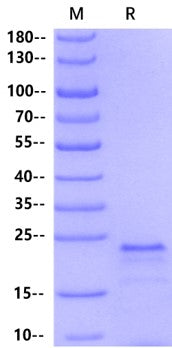
1μg (R: reducing condition, N:non-reducing condition).
KRAS(G13D) His Tag Protein, Human
KRAS(G13D) His Tag Protein, Human
Price:
Regular price
$250 USD
Regular price
Sale price
$250 USD
Unit price
per
For shipping services or bulk orders, you may request a quotation.
Secure checkout with

View full details
Product Details
Product Details
Product Specification
| Species | Human |
| Synonyms | K-Ras 2, Ki-Ras, c-K-ras, c-Ki-ras, GTPase KRas, KRAS2, RASK2 |
| Accession | P01116-2 |
| Amino Acid Sequence | Thr2- Cys185(G13D) with His Tag at the C-Terminus |
| Expression System | E.coli |
| Molecular Weight | 15-25kDa (Reducing) |
| Purity | >90% by SDS-PAGE |
| Conjugation | Unconjugated |
| Tag | His Tag |
| Physical Appearance | Liquid |
| Storage Buffer | 50mM Tris, 200mM NaCl, 20% Glycerol, 1mM DTT, PH7.5 |
| Stability & Storage | Stable for 12 months upon stored at -80℃ from the date of receipt. And avoid repeated freeze-thaws cycles. |
| Reference | 1. Gremer L, Merbitz-Zahradnik T, Dvorsky R, Cirstea IC, Kratz CP, Zenker M, Wittinghofer A, Ahmadian MR. Germline KRAS mutations cause aberrant biochemical and physical properties leading to developmental disorders. Hum Mutat. 2011 Jan;32(1):33-43. |
Background
KRAS G13D is an oncogenic mutant of the RAS family GTPase protein, characterized by a glycine-to-aspartic acid substitution at codon 13. this mutation disrupts the GTPase active center but retains partial intrinsic hydrolytic capacity, exhibiting conformational differences from G12 mutants. G13D locks KRAS in a constitutively GTP-bound active state, leading to aberrant activation of downstream MAPK and PI3K/AKT signaling pathways that promote cell proliferation and survival. Clinically significant, unlike G12 mutations, colorectal cancer patients harboring G13D mutations demonstrate favorable responses to anti-EGFR monoclonal antibodies such as cetuximab, with relatively improved prognosis. This distinctive feature establishes G13D as a "special subtype" among KRAS mutations, and it has been incorporated into certain clinical guidelines as a potential beneficiary population for anti-EGFR therapy, underscoring the importance of genotype-guided therapeutic decision-making in precision medicine.
Protocol
Assay protocol
Principle: The GTPase Glo™ Assay assesses the activities of KRAS by detecting the amount of GTP remaining after GTP hydrolysis in a KRAS reaction.
Materials
1.KRAS(G13D) His Tag Protein, Human
2.GTPase Glo™ Assay (Promega, Catalog # V7681T)
3.Solid white multi-well plate (384-well plate) (Corning, Catalog #3572)
4.Plate Reader (PerkinElmer)
Produce
1.Prepare a 2X GTP solution containing 10 µM GTP and 2mM DTT in GTPase/GAP Buffer.
2.Dilute the KRAS to 100 µg/mL, 80 µg/mL and 60 µg/mL in GTPase/GAP Buffer and dispense 5 µL into each well of a 384 well plate.
3.Initiate the reaction by adding 5 µL of the 2X GTP solution prepared in Step 1 to each well. Include a 2X GTP solution with 5 µL GTPase/GAP Buffer as Blank. The reaction volume is 10 µL.
4.Incubate the reaction at room temperature (22-25℃) for 30 minutes.
5.Gently mix the thawed GTPase Glo™ Reagent, 500X, by inversion; do not vortex. Prepare the required volume of reconstituted GTPase Glo™ Reagent by increasing or decreasing the component volumes provided below.
Sample Name |
Amount |
GTPase Glo ™ Reagent, 500X |
2 μL |
ADP, 10 mM |
0.5 μL |
GTPase Glo ™ Buffer |
998 μL |
Total volume |
1mL |
6.Add 10 µL of reconstituted GTPase-Glo™ Reagent to the completed reaction, mix briefly and incubate with shaking for 30 minutes at room temperature (22–25℃).
7.Add 20 µL of Detection Reagent and incubate the plate for 5-10 minutes at room temperature (22–25℃).
8.Read at emission wavelengths of 555 nm (luminescence), respectively in endpoint mode.
9.Calculate specific activity.
Specific Activity (pmol/min/μg) = |
(1-Sample OD/BLANK OD)*50pmol |
Incubation time(min) ×amount of enzyme (μg) |
Sample OD: Remains of ATP OD
BLANK OD: Added of GTP OD
50pmol: Added of GTP
Incubation time: 30 min
amount of enzyme: 0.5μg, 0.4 μg and 0.3 μg
Picture
Picture
SDS-PAGE