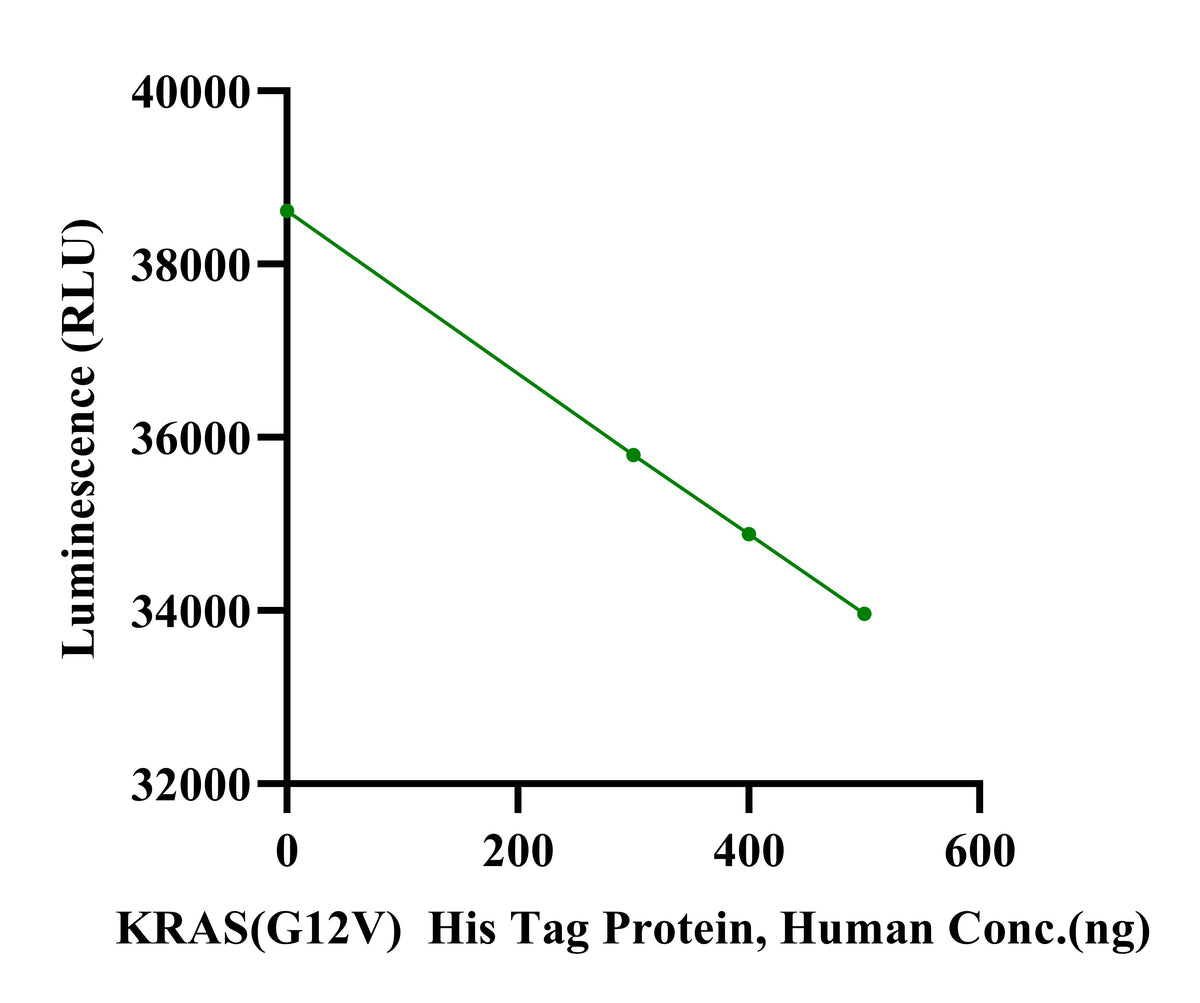
The specific activity of KRAS (G12V)His Tag Protein, Human was determined to be > 400 pmol/min/mg in a GTPase-Glo assay using GTP solution substrate.
KRAS(G12V) His Tag Protein, Human
KRAS(G12V) His Tag Protein, Human
Price:
Regular price
$250 USD
Regular price
Sale price
$250 USD
Unit price
per
For shipping services or bulk orders, you may request a quotation.
Secure checkout with

View full details
Product Details
Product Details
Product Specification
| Species | Human |
| Synonyms | K-Ras 2, Ki-Ras, c-K-ras, c-Ki-ras, GTPase KRas, KRAS2, RASK2 |
| Accession | P01116-2 |
| Amino Acid Sequence | Thr2-Cys185(G12V) with His Tag at the C-Terminus |
| Expression System | E.coli |
| Molecular Weight | 20-25kDa (Reducing) |
| Purity | >95% by SDS-PAGE |
| Conjugation | Unconjugated |
| Tag | His Tag |
| Physical Appearance | Liquid |
| Storage Buffer | 50mM Tris, 200mM NaCl, 20% Glycerol, 1mM DTT, pH7.5 |
| Stability & Storage | Stable for 12 months upon stored at -80℃ from the date of receipt. And avoid repeated freeze-thaws cycles. |
| Reference | 1.Wang X, Wang W, Zou S, Xu Z, Cao D, Zhang S, Wei M, Zhan Q, Wen C, Li F, Chen H, Fu D, Jiang L, Zhao M, Shen B. Combination therapy of KRAS G12V mRNA vaccine and pembrolizumab: clinical benefit in patients with advanced solid tumors. Cell Res. 2024 Sep;34(9):661-664. |
Background
KRAS (Kirsten rat sarcoma viral oncogene homolog) is a small GTPase that functions as a molecular switch regulating cell proliferation, differentiation, and survival signaling. Its protein structure consists of an N-terminal catalytic G domain (containing the P-loop, switch I/II regions, and the G12V mutation site) and a C-terminal hypervariable region (CAAX box). The G12V mutation locks the switch II region in a constitutively active GTP-bound state, abolishing GTPase activity and leading to persistent activation of downstream pathways such as RAF-MEK-ERK, PI3K-AKT, and RAL-GEF, thereby driving tumorigenesis. Clinically, KRAS G12V is one of the most common KRAS mutation subtypes in pancreatic cancer (approximately 30%), colorectal cancer, and lung cancer. Due to the lack of a cysteine residue for covalent targeting, it cannot be treated with G12C inhibitors, and therapeutic options have long been limited. In recent years, emerging strategies—including Pan-KRAS inhibitors, PROTAC degraders, mRNA vaccines targeting G12V neoantigens, and TCR-T cell therapies—have achieved breakthroughs, offering new precision treatment directions to overcome this "undruggable" target.
Protocol
Experimental Methods
Experimental Principles: The GTPase Glo™ assay evaluates KRAS activity by measuring the amount of GTP remaining after hydrolysis in the KRAS reaction.
Experimental Materials
1.KRAS(G12V) His Tag Protein, Human
2.GTPase Glo™ Assay (Promega, Catalog # V7681T)
3.Solid white multi-well plate (384-well plate) (Corning, Catalog #3572)
4.Plate Reader (PerkinElmer)
Experimental Steps
1.Prepare a 2X GTP solution containing 10 µM GTP and 2 mM DTT using GTPase/GAP Buffer.
2.Dilute KRAS with GTPase/GAP Buffer to concentrations of 100 µg/mL, 80 µg/mL, and 60 µg/mL, then add 5 µL to each well of a 384-well plate, respectively.
3.Add 5 µL of the 2X GTP solution prepared in Step 1 to each well to initiate the reaction. Use 5 µL of GTPase/GAP Buffer mixed with the 2X GTP solution as a blank control. The total reaction volume is 10 µL.
4.Incubate the reaction at room temperature (22–25°C) for 30 minutes.
5.Gently invert and mix the thawed GTPase Glo™ Reagent, 500X; do not vortex. Depending on your needs, adjust the volumes of the following components proportionally to prepare the desired volume of reconstituted GTPase Glo™.
Sample Name |
Amount |
GTPase Glo ™ Reagent, 500X |
2 μL |
ADP, 10 mM |
0.5 μL |
GTPase Glo™ Buffer |
998 μL |
Total volume |
1 mL |
6.Add 10 µL of resuspended GTPase-Glo™ Reagent to the reaction system that has completed the reaction, mix briefly, and then incubate with shaking at room temperature (22–25°C) for 30 minutes.
7.Add 20 µL of the detection reagent, and incubate the microplate at room temperature (22–25°C) for 5–10 minutes.
8.Read the results in endpoint mode at an emission wavelength of 555 nm (luminescence).
9.Calculate the specific activity.
Specific Activity (pmol/min/μg) = |
(1 - Sample OD / BLANK OD) * 50 pmol |
Incubation time (min) × amount of enzyme (μg) |
Sample OD value: OD value of remaining ATP
Blank OD value: OD value after adding GTP
50 pmol: Amount of GTP added
Incubation time: 30 minutes
Enzyme amounts: 0.5 μg, 0.4 μg, and 0.3 μg
Picture
Picture
Bioactivity
SDS-PAGE
1μg (R: reducing condition, N:non-reducing condition).