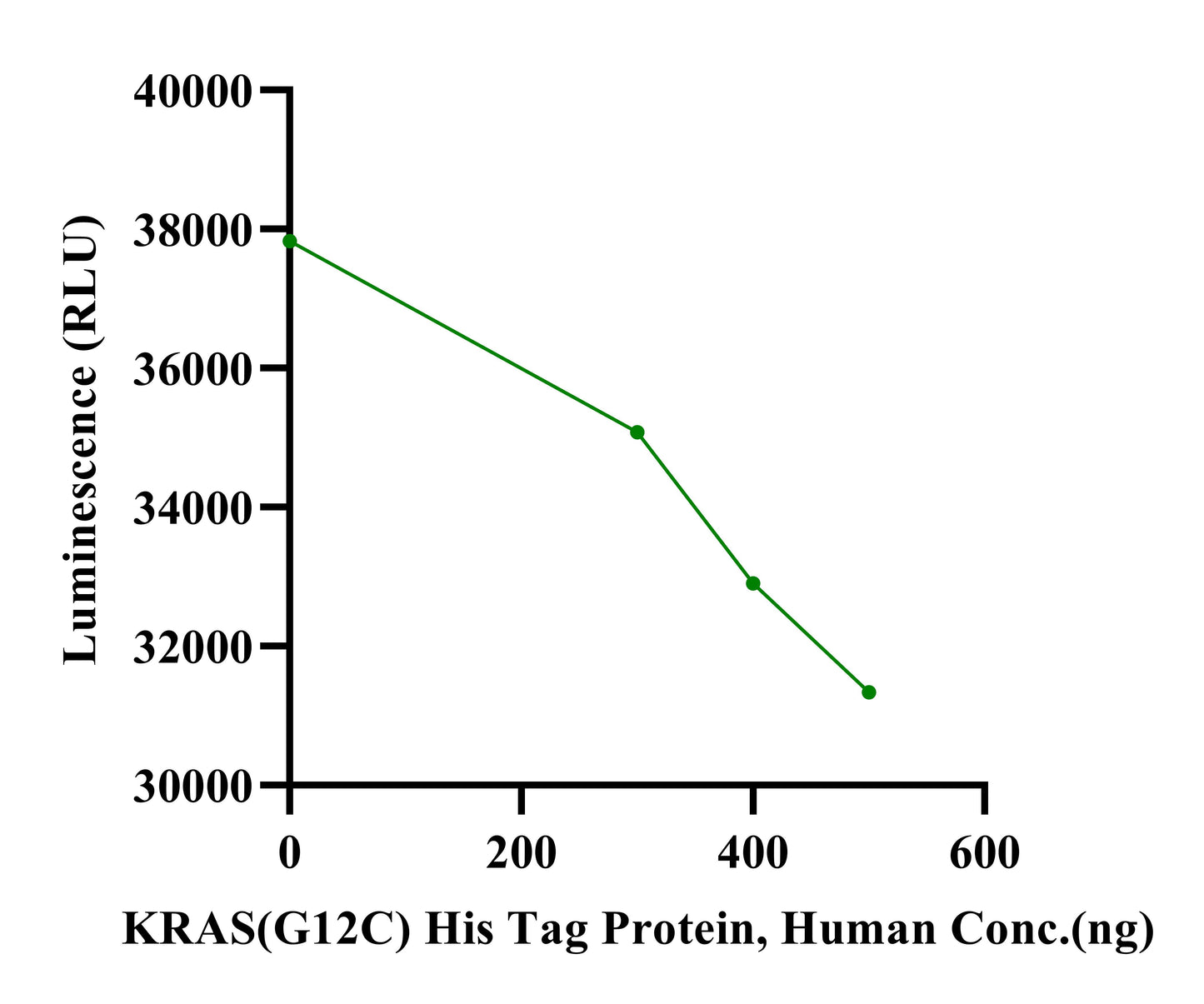
The specific activity of KRAS(G12C) was determined to be> 400 pmol/min/mg in a GTPase-Glo assay using GTP solution substrate.
KRAS(G12C) His Tag Protein, Human
KRAS(G12C) His Tag Protein, Human
Price:
Regular price
$250 USD
Regular price
Sale price
$250 USD
Unit price
per
For shipping services or bulk orders, you may request a quotation.
Secure checkout with

View full details
Product Details
Product Details
Product Specification
| Species | Human |
| Synonyms | K-Ras 2, Ki-Ras, c-K-ras, c-Ki-ras, GTPase KRas, KRAS2, RASK2 |
| Accession | P01116-2 |
| Amino Acid Sequence | Thr2-Cys185(G12C) with His Tag at the C-Terminus |
| Expression System | E.coli |
| Molecular Weight | 20-25kDa (Reducing) |
| Purity | >95% by SDS-PAGE |
| Conjugation | Unconjugated |
| Tag | His Tag |
| Physical Appearance | Liquid |
| Storage Buffer | 50mM Tris, 200mM NaCl, 20% Glycerol, 1mM DTT, pH7.5 |
| Stability & Storage | Stable for 12 months upon stored at -80℃ from the date of receipt. And avoid repeated freeze-thaws cycles. |
| Reference | 1.Kim D, Xue JY, Lito P. Targeting KRAS(G12C): From Inhibitory Mechanism to Modulation of Antitumor Effects in Patients. Cell. 2020 Nov 12;183(4):850-859. |
Background
KRAS(G12C) is an oncogenic mutant of the RAS family member KRAS, in which a glycine at position 12 is mutated to cysteine. This mutation disrupts GTP hydrolysis, causing the protein to remain persistently in the GTP-bound "activated state". The G12C mutation introduces a nucleophilic cysteine into the Switch II pocket, providing a binding site for covalent inhibitors (e.g., Sotorasib, Adagrasib), which lock KRAS in the inactive GDP-bound conformation. This mutation constitutively activates downstream pathways such as RAF-MEK-ERK and PI3K-AKT, driving cell proliferation and survival, making it a key driver in non-small cell lung cancer (NSCLC; ~14%), pancreatic cancer (~2%), and colorectal cancer (~3%). Clinically, KRAS(G12C) was once considered an "undruggable" target until the first covalent inhibitor, AMG 510, emerged in 2019, marking a major breakthrough in precision oncology. To date, the FDA has approved Sotorasib and Adagrasib for second-line treatment of KRAS G12C-mutant NSCLC. Combination therapy with EGFR inhibitors has also shown significant efficacy in colorectal cancer; however, acquired resistance remains a clinical challenge.
Protocol
Assay protocol
Principle: The GTPase Glo™ Assay assesses the activities of KRAS by detecting the amount of GTP remaining after GTP hydrolysis in a KRAS reaction.
Materials
1.KRAS(G12C) His Tag Protein, Human
2.GTPase Glo™ Assay (Promega, Catalog # V7681T)
3.Solid white multi-well plate (384-well plate) (Corning, Catalog #3572)
4.Plate Reader (PerkinElmer)
Produce
1.Prepare a 2X GTP solution containing 10 µM GTP and 2mM DTT in GTPase/GAP Buffer.
2.Dilute the KRAS to 100 µg/mL、80 µg/mL and 60 µg/mL in GTPase/GAP Buffer and dispense 5 µL into each well of a 384 well plate.
3.Initiate the reaction by adding 5 µL of the 2X GTP solution prepared in Step 1 to each well. Include a 2X GTP solution with 5 µL GTPase/GAP Buffer as Blank. The reaction volume is 10 µL.
4.Incubate the reaction at room temperature (22-25℃) for 30 minutes.
5.Gently mix the thawed GTPase Glo™ Reagent, 500X, by inversion; do not vortex. Prepare the required volume of reconstituted GTPase Glo™ Reagent by increasing or decreasing the component volumes provided below.
Sample Name |
Amount |
GTPase Glo ™ Reagent, 500X |
2 μL |
ADP, 10 mM |
0.5 μL |
GTPase Glo ™ Buffer |
998 μL |
Total volume |
1mL |
6.Add 10 µL of reconstituted GTPase-Glo™ Reagent to the completed reaction, mix briefly and incubate with shaking for 30 minutes at room temperature (22–25℃).
7.Add 20 µL of Detection Reagent and incubate the plate for 5-10 minutes at room temperature (22–25℃).
8.Read at emission wavelengths of 555 nm (luminescence), respectively in endpoint mode.
9.Calculate specific activity.
Specific Activity (pmol/min/μg) = |
(1-Sample OD/BLANK OD)*50pmol |
Incubation time(min) ×amount of enzyme (μg) |
Sample OD: Remains of ATP OD
BLANK OD: Added of GTP OD
50pmol: Added of GTP
Incubation time: 30 min
amount of enzyme: 0.5μg, 0.4 μg and 0.3 μg
Picture
Picture
Bioactivity
SDS-PAGE
1μg (R: reducing condition, N:non-reducing condition).